Fun Facts About The Amber Spyglass by Philip Pullman

70949The final book in the His Dark Materials trilogy was published in 2000; five years after Northern Lights first came out. At 548 pages it is the longest in the series and Pullman admits it took three years to write. This is an amazing book, not only for the ideas and the masterful execution, but because it brings together everything that Pullman had been working towards and building up to in the previous two books. There are moments towards the end of The Subtle Knife that break your heart, but that is nothing compared to what The Amber Spyglass will do to you.

The title refers to a telescope/spyglass created from two lenses with a lacquer from plants, as well as bamboo to separate the lenses. It was constructed by Dr Mary Malone and allows humans to see Dust. Like the previous two books, The Amber Spyglass has won numerous awards. In 2001 it became the first children’s book ever to win the Whitebread Book of the Year, and was named Children’s Book of the Year. It was also included on the longlist for the Man Book Prize, another first for a children’s book. Other awards it has received include winning the British Book Award, the American Library Association Best Book for Young Adults, Parents’ Choice Book Award, Horn Book Fanfare Honor Book, New York Public Library Book for the Teen Age, and ABC’s Children’s Booksellers’ Choice. It was also featured on the New York Times Bestseller list.

While the previous books has hand drawn images at the start of each chapter, The Amber Spyglass opens its chapters with a quote from one of Pullman’s favourite authors, and like the images, it has symbolic meaning to the coming chapter. Among the authors quoted are John Milton, William Blake, and Emily Dickinson, as well as many others, and Pullman included them as a way to acknowledge their influence. Later editions have the hand drawn images with each chapter, of which Pullman say are some of his best.

Similar to Northern Lights, there has been controversy with certain aspects of the story though less about religion more about apparent sexual references. This series has been marketed primarily towards young adults but Pullman also intended the book to speak to adults. This is clear with the content, themes, and some of the more adult inferences seen in The Amber Spyglass. In North America some parts of book have been censored where Lyra’s incipient sexuality is described, which is a shame because it does actually play an important role, as does everything Pullman includes. In response to this, and his story in general, Pullman has commented “Nowhere in the book do I talk about anything more than a kiss. And as a child, a kiss is enough. A kiss can change the world.” The sexual realisation of the characters is as natural and innocent as the kiss that’s described and as Pullman says, “This is exactly what happens in the Garden of Eden…Why the Christian Church has spent 2,000 years condemning this glorious moment, well, that’s a mystery. I want to confront that, I suppose, by telling a story that this so-called original sin is anything but. It’s the thing that makes us fully human.” You can see the changes here.

With this year being the 15th anniversary of The Amber Spyglass being published and the 20th since Northern Lights, it’s wonderful to see how over the course of five years of writing, three books, and an idea slightly controversial but incredibly brilliant, how much has changed, not only seeing how these characters have grown, but the effect it’s had on people reading about them. Pullman’s trilogy is apparently not as well known or popular worldwide as Harry Potter became (though still managing to sell almost 20 million copies) which is a shame, though interestingly sales matched those of Harry Potter in the USA, and despite the controversy has received a lot less criticism for books with a lot more obvious content than Harry Potter ever had. But all that aside, those who know it love it, and even with that movie it has remained loved and treasured.

Pullman has stated that when he began Northern Lights he did not know where the story was going, at least not in any detail. With a rough idea of where it was all headed it is astounding to see where it ended up. To read only one of these books is doing it a disservice, to understand fully the masterpiece all three need to be consumed, only then can you see the bigger picture, the grand idea and intricate and detailed creation that has been described as being the most ambitious work since Lord of the Rings.
Understanding Pullman’s Dæmons

Dæmons (pronounced demons) play an essential role in all three novels of His Dark Materials. They are iconic and a brilliantly original idea, and so ingenious that from my first time reading this series I have wanted one of my own.

Pullman got the idea of dæmons from paintings by Leonardo da Vinci (“The Lady with the Ermine“), Holbein (“The Lady and the Squirrel“), and Tiepolo (“Young Woman with a Macaw“) where it seems to show that a connection exists between the animal and the person, and to this day dæmons remain the single greatest idea ever that I have seen in a book. His Dark Materials is the first real reference to dæmons, but there is actually almost a small inclination of the idea of dæmons in one of Pullman’s books that was written years earlier called Spring-Heeled Jack, a children’s book that has a moth who flutters around as the villain’s conscience.

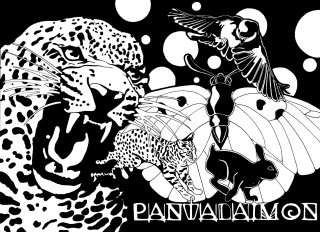
pantalaimon_by_ryerd

Various forms of Pantalaimon

Pullman explains that dæmons symbolise an aspect of a person’s personality. Everyone has a dæmon in Lyra’s world, and to see someone without a dæmon is like seeing a person walking around without their head. It is a part of them and a great horror to see someone without one. More than once dæmons are referred to as being like someone’s soul, and there is an invisible but evident connection between dæmon and human. The connection is strong and many times a person’s health, emotions, or subconscious can be reflected in their dæmon’s actions. This link also restricts how far they can move from one another and lets them feel what the other is feeling.

They are also used as a visual shift from innocence to experience. Pullman mentioned in an interview that he had been thinking about the transition which happens in adolescence for a long time and being a teacher he had seen this change in kids around Lyra’s age. Dæmons are a representation of this change.

As children, dæmons are able to change and shift form, often reflecting moods or used to intimidate other children. As they grow older their dæmon settle on a single, non-changing form. Having a dæmon settle is a part of growing up and while disappointing at first, it allows you to know the sort of person you are. Like the Able-Seaman tells Lyra in Northern Lights, “There’s plenty of folk as’d like to have a lion as a dæmon and they end up with a poodle”.

hester_h_595

Hester (Lee Scoresby)

Dæmons may also not settle on a form that someone may like either. The Able-Seaman tells Lyra about a sailorman whose dæmon settled as a dolphin, which meant he could never leave the water. Despite the fact he was a wonderful sailor and the best navigator who made his fortune fishing, he was never happy.

Typically dæmons are the opposite sex to their humans, though there are a few rare exceptions. They can talk and while they take the form of animals, they are not animals themselves. Being part of a person means that are different than an animal, this includes what happens to them when someone dies. When a person is killed their dæmon disappears instantly, it also reflects their growing weakness if it takes time. But a person can be killed through their dæmon as well. In Northern Lights Iorek Byrnison kills a Tartar’s wolf-dæmon and as he does “bright fire spilled out of her as she fell to the snow, where she hissed and howled before vanishing. Her human died at once”.

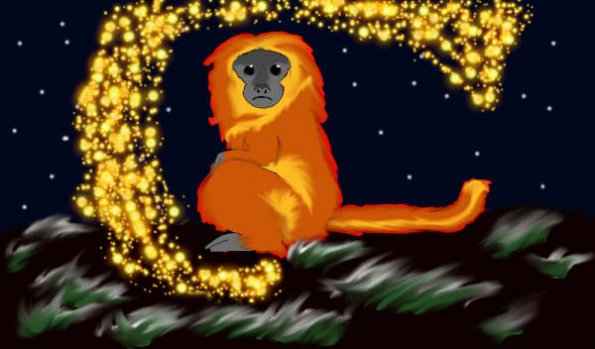
the_golden_monkey_595

The Golden Monkey (Mrs Coulter)

There are many great taboos relating to dæmons, unspoken rules but ingrained in the entire world. Dæmons can interact and touch other dæmons, often being used to settle disputes or show affection, but it is the greatest of taboos for a person to touch someone else’s dæmon. Dæmons will talk to another human, but it is also more common for dæmons to talk to other dæmons while their humans talk with each other.

What makes dæmons iconic and masterful is not only the idea, but how impeccably Pullman has used them in this series. They are not simply just an addition to a character or a quirky entity, they have a purpose and a role, they are involved in the story on a detailed and complicated level, they are just as important as any character or plot point, and are certainly not there to simply be a plot device either.

daemon001_595

Stelmaria (Lord Asriel)

When asked, Pullman has said his dæmon would probably be a raven, a rook, or a magpie – one of the birds from that family, mainly because she steals things, like ideas for stories, or images and phrases. But he also reminds us that you do not get to choose, you have to live with what you get.

Dæmons are a fascinating and brilliant concept that adds so much to an already intricate and rich series. In honour of the 20th anniversary, Buzzfeed have created a quiz that allows you to discover what your own dæmon would be. Now of course, Buzzfeed isn’t the greatest authority on these things, nor can they come close to doing a proper analysis of a person character and therefore proper dæmon, but it is a nice thing to see what you could possibly get.

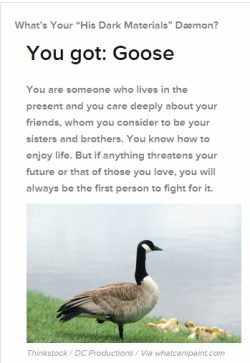
Daemon quizWhen I did the quiz I was given a goose. Reading through the comments on the page and you can see what other possibilities there could have been, and again, there are so many more varied options in Lyra’s world than what’s provided so who knows what it would have been!

You can do the Buzzfeed quiz yourself here.


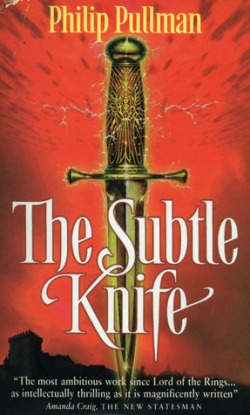
The Subtle Knife (#2) by Philip Pullman

Published:  16th October 1998Goodreads badge
Publisher: 
Scholastic Point
Pages: 341
Format: Paperback
Genre: Fantasy
★   ★   ★   ★   ★  – 5 Stars

70948Will is twelve years old and he’s just killed a man. Now he’s on his own, on the run, determined to discover the truth about his father disappearance.
Then Will steps through a window in the air into another world, and finds himself with a companion – a strange, savage little girl called Lyra. Like Will, she has a mission which she intends to carry out at all costs.

But the world of Cittàgazze is a strange and unsettling place. Deadly, soul-eating Spectres stalk in its streets, while high above, the wingbeats of distant angels sound against the sky. And in the mysterious Torre degli Angeli lurks Cittàgazze’s most important secret – an object which people from many worlds would kill to posses.

This is the second book in the His Dark Materials trilogy and Pullman begins it by changing not only points of view, but also changing worlds. The Subtle Knife begins in what is presumed to be our own world, with Will Parry the new focus. From early on Will grabs your attention and sympathy, he is a young boy trying to look after his mental ill mother, and doing everything he can to keep from drawing attention to himself for fear of being taken away and his mother institutionalised.

Will is a fierce and strong kid, he is tough as he needs to be and insistent, and has years of wisdom and cunning for his young age. Will has his own troubles and like Lyra, Pullman introduces us to him in the middle of a moment and lets us catch up. Unlike Lyra though, we are given a bit more explanation about Will’s life soon after, which builds a lot of character for Will in a short space of time. When Will meets Lyra the pair joins forces and evidently brings out the best in each other, using both their skills and cunning to help one another with what they need to do.

The Subtle Knife moves between three universes, Lyra’s, our own, and a third different again. The different worlds Pullman creates are always curious and remarkable, and this time is no different. With multiple worlds to describe Pullman gives each one depth and detail, and provides description within the narrative, keeping the flow of the story strong while making it vivid and complex at the same time. With three worlds there are a range of stories to follow, but Pullman links them all together seamlessly, and each one progresses the novel on, even when the events are not technically connected.

One thing I always notice upon reading The Subtle Knife is how much it makes me miss the world in Northern Lights. Don’t get me wrong, reading about Will, the knife, the entire adventure of finding new worlds is enjoyable and exciting, but there are moments, especially in the beginning, where I long to be back on the snow-covered landscape of the North. This feeling does pass as you become invested in Will’s story, and watch as Lyra almost takes a backseat to Will’s journey. I think having Lyra out of her element and in a world she doesn’t understand makes her seem smaller and less assured. She initially goes back to being a bit lost and a follower, instead of the brave girl who marched North to rescue her friends. But she gains confidence again and the old Lyra is clearly still there.

Pullman intricately and skillfully combines the characters of Northern Lights with new characters introduced from various worlds. Favourites from Northern Lights journey into new worlds on missions of their own and in doing so show off more about these new worlds, but also add crucial aspects to the story. Even when he appears to be telling one story, Pullman is pulling together pieces for the bigger picture, subtly and quietly in the background.

Once again Pullman is also a master at limiting obvious explanations yet still offering full understanding. Through character thoughts, conversations, and various descriptions Pullman manages to explain a lot about what is happening, whether it is the detail and appearance of a window to another world, strange beings such as angels, or the strange and mysterious Spectres. This is especially important since there are moments of great technicality, especially understanding scientific matters regarding Dust, also known as dark matter. Pullman makes these explanations appear natural and real, making readers understand things alongside characters, while also using casual remarks that have a lot of meaning behind them to answer questions and fill in gaps. Pullman puts a lot of faith in the reader to put the pieces together and understand various aspects of the story, no matter how big or important, without needing to spell it out for them.

There is a different tone in this book than the first, certainly due to the content, but there are still moments of the same excitement, suspense, mysteries and surprises that were in the first book. Pullman lays hints and clues as he goes along which make for thrilling discoveries, and seeing the mixture of characters interact with one another is enchanting. The language is intellectual but simple, and the story is thrilling to read and is marvellously written. This book is both a follow-up to the first novel and a stepping stone into the last; another step towards the grand finale we’ve been told about from the start. With intelligent writing Pullman keeps this momentum going and builds on it gradually, blending it seamlessly with the  main story and managing to fill you with anticipation, captivation, and an eagerness to jump right into book number three, as is the Pullman style.

You can purchase The Subtle Knife via the following

Amazon | Barnes & Noble

Book Depository | Booktopia

Bookworld | QBD

Dymocks | Kobo


Weekly Wrap Up

Weekly wrap up header

This week on the blog


Why I Love his Dark Materials


Northern Lights (#1) by Philip Pullman

 ★   ★   ★   ★   ★  – 5 Stars


Adaptations of Northern Lights


Fun Facts About The Subtle Knife


Characters in The Subtle Knife

Characters in The Subtle Knife

Many of the characters from Northern Lights make an appearance in The Subtle Knife, but there are many new characters introduced as well. The story focuses a lot on the new characters and the new worlds, but there is a great mixture of existing characters and introduced ones, woven into the story superbly to show off the new world, introduce new faces, as well as continue the story on. Returning characters include Lyra and Pan, Mrs Coulter, Lee Scoresby, and Serafina Pekkala, while the minor character, Lord Boreal, from Northern Lights reappears. Most returning characters have small but important roles, but all work together to move the story on with important details and plot points.

 Will Parry

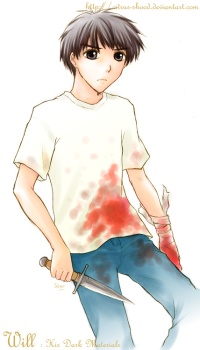
his_dark_materials___will_by_citrus_shoodWill is a character that comes from a place that is presumed to be our own world. He lives in England and is the only child to Elaine Parry. Will is a tough kid, he is strong willed and protective. Having had to grow up fast after realising his mother had mental problems, he does everything he can to protect her and himself from any unwanted attention. Wil’s life seems simple but after learning there were men who were after something that belonged to his father, he defends his home and his mother. After being attacked by and accidentally killing home invaders, Will flees his home and finds a window into another world. There he finds Lyra and Pan and becomes the bearer of the Subtle Knife. He is around the same age as Lyra, if not slightly older, but still prepubescent.

Pullman is brief on physical descriptions, but Will is described as having dark hair with straight black eyebrows, with eyes that are noticeably fierce and wide with a jutting jaw and broad cheekbones. Will travels with Lyra through multiple worlds, new ones as well as his own. Will has real world smarts that Lyra lacks, especially as his world is so much different than her own, but they both balance out in intelligence in a range of areas and Lyra knows things he doesn’t, especially regarding Dust. Being from the real world, Will has no daemon, but like people from others worlds, his daemon is on the inside.


John Parrytumblr_n8pniyNxSm1sk2kvno1_400

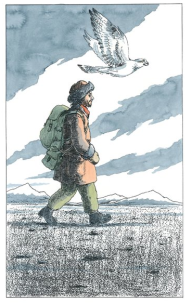
John Parry is the father of Will Parry, who in Will’s world went missing when he was an infant. In his world John was a famous explorer and during a trip to the Alaska he wandered through a window to another world and couldn’t return. In this new world John changed his name and become an explorer there as well, upon entering Lyra’s world his daemon appeared, an osprey named Sayan Kötör.


Lord Boreal

green_ink7_595Lord Carlo Boreal makes an appearance briefly in Northern Lights, but has a bigger role this time around as a main antagonist. Going by a different name and in a new world, he has interests in the Subtle Knife, as well as the alethiometer. He has connections with many characters, Lyra and Will initially, but also Mrs Coulter and Dr Mary Malone. Coming from Lyra’s world he has a daemon which takes the form of a serpent.

Dr. Mary Malone

tumblr_mk9639hlDI1r0388go1_500Dr Mary Malone is a physicist from Will’s world. She is investigating dark matter, the name of Dust in her world. Lyra meets her first, trying to find information about Dust, and with Lyra’s help finds a way to interact with dark matter, much like Lyra and the alethiometer. Mary discovers she has an important role to play in both Will and Lyra’s lives and she embarks on a journey of her own, discovering a new world with strange creatures. She will be the one to construct and utilise the Amber Spyglass.

Balthamos

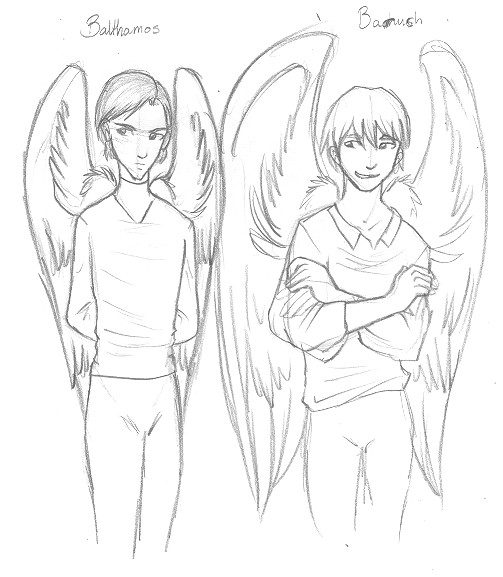
balthamos_by_ryerdBalthamos is an angel and part of the rebellion from the Kingdom of Heaven looking to join Lord Asriel’s army. Balthamos plays a larger role in The Amber Spyglass where his mission is to guide the knife bearer (Will) to help Lord Asriel. Angels are described as being luminous and humanlike, barely visible to the human eye. They can transform and are capable of flight though their wings have no corporeal form. Balthamos is cautious and sarcastic, and his relationship with Will has an air of ironic contempt. He also has a same-sex partner, Baruch, another angel who is also part of the rebellion.

Baruch

balthamos_and_baruch_by_blackmage339Baruch is an angel who is part of the rebellion from the Kingdom of Heaven alongside his same-sex partner, Balthamos. Baruch is courageous and often is the one to fix any of Balthamos’ failings. The connection and affection between the pair is evident, they are deeply loyal and in love. Both Baruch and Balthamos are low ranking angels, but they are determined to carry out their mission at all costs. Like Balthamos, Baruch plays a larger role in The Amber Spyglass, but is introduced first towards the end of The Subtle Knife.

Previous Older Entries Next Newer Entries