Newcastle Writers Festival 2014: Saturday

nwflogoReading Ryan O’Neill’s post last night about his Newcastle Writers experience reminded me I haven’t done my own, then I realised it was no longer a couple of days ago it was an entire week! Where does the time go? So I have finally found some time to tell you all about my awesome time at the Newcastle Writers Festival.

After the enjoyable and amazing time at the opening night on Friday, I was up early and off to Newcastle City Hall for day one of the festival. My first session, ‘From Little Things: Writing for Children‘, was excellent. On the panel was Kaz Delaney (aka Kerri Lane), Wendy Harmer, and Jesse Blackadder with Linsay Knight moderating. The mood in the room was wonderful, there was laughter and joking, each of the panellists played off each other and watching them joke and interact was as enjoyable for them as it was the entire audience.

Stories on writing were discussed and Kaz Delaney told us that she felt she was born to write and told us about her vast collection of books for children. With 69 books under her belt Kaz was first published at 9 with what she called a blatant rip off of the poem “Daffodils” by William Wordsworth. She also mentioned that some people have passions –  animals, the planet etc and her passion is children. I thought that was wonderful. Being passionate about writing is one thing but when you couple that with being passionate about children as well I really think it would help your work.

Wendy discussed her creation and development of her Pearly series. Pearly is a fairy that lives on a fountain in a park and as a big fairy fan,  Wendy said the idea for Pearly came very easily. She also said she wanted to create a fairy that didn’t look like other fairies, those that seem to look like Paris Hilton with wings; she wanted a fairy with daring do.

What I loved about Wendy was the reason she chose to set her Pearly series in a park. She said that most children don’t have gardens, instead they go to the park, Wendy herself took her daughter to the park. Because of this they cannot enjoy the magic of having a fairy at the bottom of their garden so by having Pearly live in the park it showed children that even if they didn’t have a garden they could still enjoy the magic of fairies.

Jesse Blackadder, an author who I had not previously heard of, is someone who bases her stories of real things that happen, she takes them and brings the story to life. Listening to Jesse talk was enjoyable, she was funny and played on the vast success of her fellow panellists and joked about her far fewer books, and amongst the strong presence and humour of the others Jesse held her own quite well.

She told us about her new book Stay, a story about a fibreglass Guide dog statue that had been kidnapped from Hobart and taken to Antarctica. She discussed the true story it was based upon as well as the issues she had trying to make an inanimate object tell its own story. Jesse also told us when telling stories about real events in real places it was important to her to go to the places themselves, and so having been to Antarctica, Dubai and numerous other places she was able to bring the story to life.

The entire session was excellent and one filled with learning, insight and a lot of laughter. All the panellists gave us a reading from their book, and as much as I loved them all I must say Wendy’s was the most animated. Naturally by the end of the session I was eager to read all of their books which resulted in the buying and signing of books from each author.

Linsey Knight, Kaz Delaney, Wendy Harmer, Jesse Blackadder

Linsey Knight, Kaz Delaney, Wendy Harmer, & Jesse Blackadder

The next session I attended was ‘Kate Forsyth in Conversation‘, a wonderful hour where Magdalena Ball discussed with Kate her creative journey as well as retelling fairy tales, and writing best selling works based on fables and fairy tales. So many wonderful lessons were learnt in this session, so many excellent quotes about writing, about fairytales and about creating I could hardly write fast enough to capture and remember it all.

Kate read to us from her novel Wild Girl, gave us insights in her research and her ideas, and even gave us a sneak peek into her new story that she was starting once the festival was over. For Kate immersing herself in the research was important, knowing about every detail about her characters was important, whether it was what they ate, believed, or how they peed. She also explained her four stages of writing, how she developed and planned her ideas, and the influences writing one novel can have on another.

Kate told us that if you have the compulsion to form life experiences into words than nothing should stop you, but she also said you cannot give someone the gift of writing, you may be able to teach it, but it is not the same. This was something I heard later in the weekend as well, and certainly something I hadn’t considered before.

Listening to Kate tell stories about how she started as a writer, how she writes and the work she puts into her books was inspiring, I have seen her a few times now over the years and every time she manages to amaze me more. Once again, more books were bought and signed.
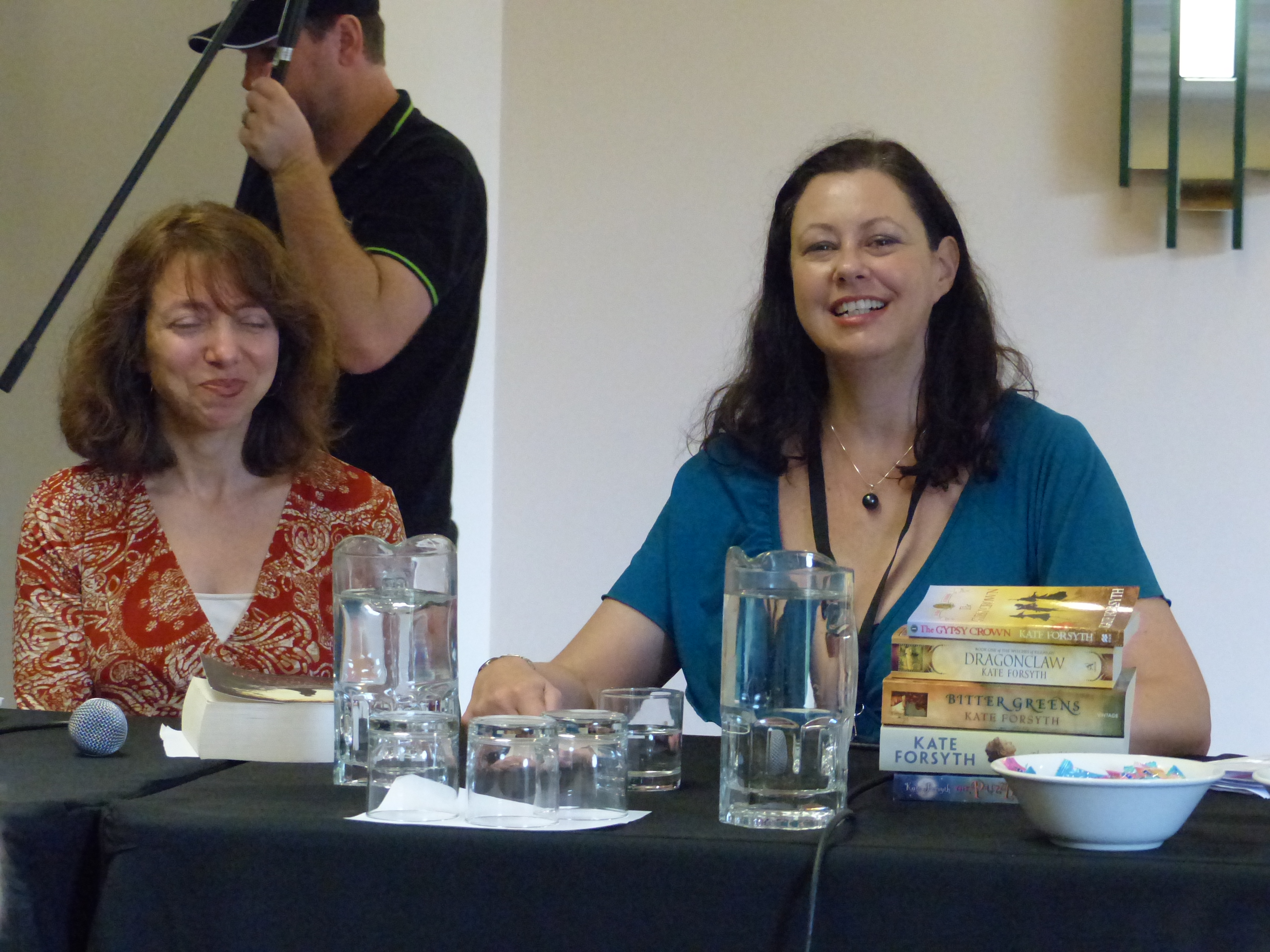
Magdalena Ball & Kate Forsyth

Magdalena Ball & Kate Forsyth

My last session was ‘Once Upon a Time: Exploring myths, fables, and fairy tales‘, again with Kate Forsyth but with John Hughes as well and Jenny Blackford moderating. Discussing the idea of reinventing fables and fairy tales into new inventive stories is something I adore doing and love reading about. John and Kate immediately addressed the incorrect notion that fables and fairytales are just for children, not to mention how and why these stories have lasted for millennia.

Kate said she believes that a story is retold if it is a story of longing and need and some kind of dilemma, and the stories that are retold and retold and shape shift really touch a core in the listeners. As she beautifully put it, she feels like a relay runner carrying on this beacon of stories, behind her is centuries of storytelling. I thought that was a wonderful way to describe it.

This was another session of excellent quotes about us as people, about our need for stories and love of them. From the cleaning up of darker tales in the Victorian era, and the Grimm’s changing the stories as well it was clear that these stories have been evolving for awhile. Naturally Disney poked its nose into this discussion about it taming down of fairytales further, but Kate wisely pointed out that Disney probably is the true source of the fairy tale revival, and that they did a wonderful service by keeping stories alive that may have been forgotten. John also pointed out that you cannot say these stories can only be used for high literature purposes and no other. It is really up to the person telling the stories how they want to do it. As Kate said, with each retelling of a tale the teller brings their own concerns to it. By the end of the session I has learned so much and gotten so many new ideas and motivation to write my own stories. After the session was over, yes, many books were bought and signed once more.
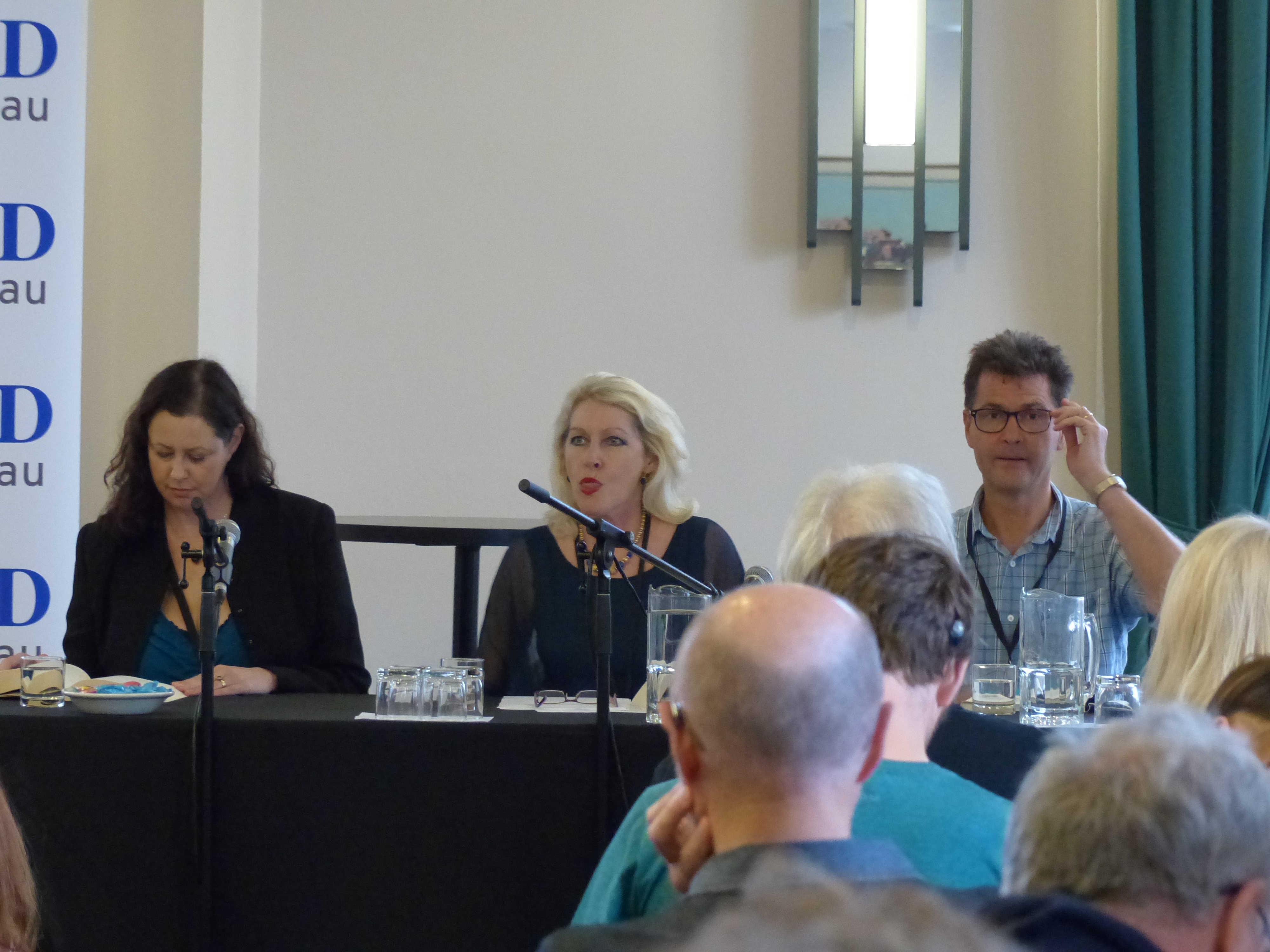
Kate Forsyth, Jenny Blackford, & John Hughes

Kate Forsyth, Jenny Blackford, & John Hughes

At the end of a very long first day I was on a buzz of knowledge and awe and just general happiness to be there. This is what I love, learning about how people write, where their inspiration comes from, but also the chance to broaden your own mind and gain new perspective and welcome new ideas and challenges. I truly adore this (and other) writing festivals. Not only do you learn so much but you also get exposed to great authors you may never have noticed or even considered before.

The Bloody Chamber & other Stories by Angela Carter

Birthday

Today is the birthday of author Angela Carter and in honour of that I am looking at her collection of short stories in The Bloody Chamber. It is an excellent collection, if you are a fan of fairytales, or love seeing fairytales reinvented in amazing ways, then I suggest you read these stories.

Born in England in 1940, Angela Carter wrote many books in her lifetime, sadly she only lived until she was 51 years old. However in that time she managed to write a large collection of stories, poems, radio plays, as well as children’s books and much more. What I found interesting was that before she died, Carter was planning on writing a sequel to Jane Eyre. I think this would have been fantastic, it was supposedly going to be told from the perspective of Jane’s step-daughter Adele, that would have been interesting to see.

Carter was listed on The Times “50 greatest British writers since 1945” in 2008, at tenth place it is a position I agree with immensely, what I didn’t agree was that Terry Pratchett didn’t make that list at all, but we can only just forgive that because of the others that were included.

Published: July 13th 2006
Goodreads badgePublisher: Vintage
Pages: 176
Format: Book
Genre: Fairy Tales/Fantasy
★   ★   ★   ★   ★  – 5 Stars

The Bloody Chamber & Other Stories is an anthology of short fiction by Angela Carter. All of the stories share a common theme of being closely based upon fairy tales or folk tales. However, she’s stated: “My intention was not to do ‘versions’ or, as the American edition of the book said, horribly, ‘adult’ fairy tales, but to extract the latent content from the traditional stories.”

The Bloody Chamber was published in 1979 and is a collection of short stories that are dark, sinister, and marvellous all at once. What Carter manages to do is turn the fairytales we know on their head, and she makes us look at them in a new light completely. The book comprises of ten stories, The Bloody Chamber; The Courtship of Mr Lyon; The Tiger’s Bride; Puss-in-Boots; The Erl-King; The Snow Child; The Lady of the House of Love; The Werewolf; The Company of Wolves; and Wolf-Alice.

Carter looks at stories such as Beauty and the Beast, Little Red Riding Hood, Puss in Boots, Bluebeard, as well as folklore tales, and what she has come up with are so unique, and so amazing that it is very hard to think of them as their original stories sometimes. There is definitely so much that that can be read into these stories, I know there are hundreds of references alluded to and mentioned in short story The Bloody Chamber that have scholars running about trying to interpret, but what references that are there does not distract from the story, nor does typically knowing the originals, they are easily enjoyed without understanding the origins, but for well known stories such as Little Red Riding Hood, Beauty and the Beast, or Puss in Boots, then it creates an eye opener for readers.

What is wonderful about these stories is that it isn’t just another version of the traditional telling, Carter brings so much more into these stories, she alternates points of view, and she brings in strong powerful women with highly emotional and intellectual insights that create meaning and force in these tales.

Her story The Werewolf, based on Little Red Riding Hood, had a huge impact on me. Very much like the novels of John Marsden’s when I realised stories did not have to be simple and straight forward; what Carter showed me in this story was that fairytales can be complex and may not be as they appear. From this simple story I suddenly looked at other fairytales like Hansel and Gretel in a whole new light, I realised and embraced that even the simplest stories of the Gingerbread man or Snow White could be recreated in an entirely new light, changing everything it was meant to be.

I already had a huge love for fairytales, and when I read Carter’s reinventions it opened my eyes to a world of interpretation, mixing and transforming these classics into something that is powerful and magical, while still showing signs of the history of the fairytales I knew. Personal favourites would have to be Company of Wolves, Wolf-Alice, and The Werewolf, definitely interesting since they are all variations on Little Red Riding Hood, a story that I didn’t like as a child, and yet has become one that I have enjoyed most in adapted form.

 Company of Wolves was turned into a very good film in 1984. It is classified as a British Gothic fantasy-horror film and director Neil Jordon co-wrote the screenplay with Carter. It is another variation on the Little Red Riding Hood story and is set in the modern day. It is a little gruesome at times, but it is an excellent film all the same.

There is something for everyone with Carter’s works and her writing makes you reconsider writing and storytelling, especially for fairytales. They hark back to the originals where it was more truthful and realistic, certainly told as cautionary tales, but also as a representation of powerful women. To steal from Wikipedia a wonderful synopsis: “By contrasting the barren and horrific atmosphere found typically within the Gothic to the strong heroines of her story, Carter is able to create sexually liberated female characters that are set against the more traditional backdrop of the fairy tale.”

A truly wonderful set of stories that stay with you long after you finish them, I wish Angela Carter a happy birthday and I want to thank her for the influence she has had on my own writing, as well as my ideas about fairytales and the power and possibilities they possess, no matter what the form.

Fairy Tales by Hans Christian Andersen

Birthday
Published
: October 22nd 1998
Goodreads badgePublisher: Oxford University Press
Pages: 376
Format: Book
Genre: Fairy Tales
★   ★   ★   ★   ★  – 5 Stars

Happy Birthday Hans Christian Andersen!

I have to admit, most of my favourite fairy tales come from Hans Christian Andersen. I’m not against the Grimm Brothers by any means, but I know what I like with Andersen, with the Grimms I generally think they are all pretty good but I wouldn’t know an absolute favourite.

This favourite for Andersen is of course The Little Match Girl. I think it is one of the most beautiful and heartbreaking stories, and yet by the end Andersen brings in his own version of happily ever after which was nothing like I had ever seen before.

Knowing the Grimm’s work, I thought Andersen was greater, there was more than princesses, more than forests and enchantments; instead there were conceited kings, and there were ducklings, soldiers in love, silent mermaids, admirable princes: each with their own stories about love and sorrow and justice. There was no attempt to make life fall into place, there was no real justice for those who did wrong, and not simplistic and easy happily ever after to sooth the senses after the tragedy that had been experienced. This is why I admire Andersen so much, possible without meaning to he provides a happily ever after of simple happiness than orchestrating love and marriage and vengeance disguised as justice.

I knew more Andersen fairy tales growing up than I did Grimm, sure I watched the Disney versions of Cinderella, Snow White and knew the story of Hansel and Gretel, but at the end of the day Red Riding Hood scared me, and the idea of a prince saving me from my family, or defeating a witch had no real interest to me; the messages in The Ugly Duckling, or the Steadfast Tin-Soldier did more for my than warning me to stay on the path or defeating a witch in an edible house.

Andersen was on track to do a lot of things before he started writing fairy tales; he began working as a weaver’s apprentice before moving into the world of acting. There he discovered he had an excellent soprano voice he was accepted into the Royal Danish Theatre. This however did not come to anything as his voice changed, but this seemingly unfortunate turn of events in fact started Andersen on his writing journey. After being told he would make a good poet by a fellow company member, Andersen took this to heart and began writing, his first novel The Ghost at Palnatoke’s Grave being published in 1822.

The first fairy tale he wrote was called The Tallow Candle, in the 1820s and told the story of a candle who did not feel appreciated. He worked on many short stories as well as theatre pieces and poetry, but it is his collection of fairy tales that have made him well known in the long run; though as soon as I can track down these other works I have every intention of reading them.

The immortal fairy tales we know today were first published in 1835 consisting of nine tales, including The Tinderbox, The Princess and the Pea, Thumbelina and The Little Mermaid. New stories were added in later installments in both 1836 and 1837, however like it is with most works of genius, these did not sell well and Andersen went back to novels to get by.

His personal life is fascinating, he was a friend of Charles Dickens, and his life was filled with misfortune and great opportunities at the same time. If you really want to know more about what a troubled yet brilliant person Andersen was you can read his autobiography The Fairy Tale of My Life: An Autobiography. There have been a few film versions of his life as well, though some more fanciful than others.

Andersen paved the way for Kenneth Grahame and A. A. Milne and their stories, and Lewis Carroll and Beatrix Potter would also take their inspiration from him as well. From slow beginnings it is astonishing how loved and well known his works are, even more so than those he was known for most in his early years.

April 2nd is celebrated as International Children’s Day which I did not know until now. Reading his fairy tales are such a joy and are so moving and emotional at the same time, just as all good stories should be. Where would the world be today without the selfless little mermaid, or the child who spoke against a king, or even the simple prince who judged royalty based on a legume?

You can read a range of fairy tales from a range of authors and backgrounds at SurLaLune. It is a great website where you can find out about variations, histories and general amazing things about fairy tales we know and love, as well as those we’ve never heard of before.

The Book of Lost Things by John Connolly

Published: 01 Aug 2008
Goodreads badgePublisher: Hodder and Stoughton
Pages: 512
Format: Book
Genre: Fantasy/Fairy Tales
★   ★   ★   ★   ★ – 5 stars

High in his attic bedroom, twelve-year-old David mourns the death of his mother, with only the books on his shelf for company. But those books have begun to whisper to him in the darkness. Angry and alone, he takes refuge in his imagination and soon finds that reality and fantasy have begun to meld. While his family falls apart around him, David is violently propelled into a world that is a strange reflection of his own — populated by heroes and monsters and ruled by a faded king who keeps his secrets in a mysterious book, The Book of Lost Things.
You know how sometimes you read a book, and from the first few chapters you already know it is going to be spectacular. That is what The Book of Lost Things is. I knew this was getting five stars and it held up its promise until the final word.

It tells the story of 12 year old David who struggles with the death of his mum and the new changes in his life as he struggles to hold on to the old. Trust me, this is not going where you think it is. As a character David loves books, loves to read and is always reading about fairytales and stories about knights and history. Anything he can get his hands on, but he always returns to the fairytales. For a kid his age David has pretty good insights. A lot are childhood irrationalities, but others are profound and well developed.

When David is propelled into a strange new world and must face what sits before him. Through his books he finds recognition as there are references to multiple fairytales and other books in Connolly’s story, but it is nothing like you expect and even more than you can imagine. It is like a book of fairytales gone mad, but in a sinister but amusing fashion. They clash and cross over and intertwine with myth and legend. There are deeper meanings, lessons and insights in everything Connolly writes and it makes even the stories being told seem like memories rather than works of fiction.

Connolly’s imagination and creativity is amazing, yes there are things he’s borrowed but where he takes them is beyond what they were intended for. The creativity he shows surrounding these characters is fantastic and allows you to see more than what the story requires but opens up this cavern of detail and insight about the rest of the world, what goes on when the story is not being told.

Not many books can make me emotional, like proper emotional. I am not sure what it was, but I’d like to think it was a combination of sadness and happiness, but also perhaps a little bit of admiration about this entire journey and story. They were not bad tears, there is something wonderful about books that make you cry, much like a movie. I’m also not saying you will start crying reading this story but when you finish, if you do not feel differently about the world, about friends, about family, about reading and growing up, then you must turn back to page one and try again because you’ve read it wrong.

Connolly writes this story with such honesty and truth that he hold nothing back about the realities of life, the impact of stories and the importance of family. It keeps you going and you know these things to be true and you admire the strength and heart that this book has. How you could not reread this a hundred times over is beyond me. This book is going to stay with me for the rest of my life and for every good reason

Next Newer Entries