Harry Potter and the Chamber of Secrets (#2) by JK Rowling

Published: 2nd July 1998Goodreads badge

Publisher:
Bloomsbury Publishing
Pages: 251
Format: Paperback
Genre: Fantasy
★   ★   ★   ★   ★  – 5 Stars
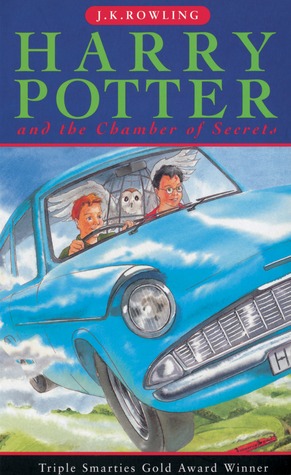
The Dursleys were so mean and hideous that summer that all Harry Potter wanted was to get back to the Hogwarts School for Witchcraft and Wizardry. But just as he’s packing his bags, Harry receives a warning from a strange, impish creature named Dobby who says that if Harry Potter returns to Hogwarts, disaster will strike.

And strike it does. For in Harry’s second year at Hogwarts, fresh torments and horrors arise, including an outrageously stuck-up new professor, Gilderoy Lockhart, a spirit named Moaning Myrtle who haunts the girls’ bathroom, and the unwanted attentions of Ron Weasley’s younger sister, Ginny. But each of these seem minor annoyances when the real trouble begins, and someone, or something, starts turning Hogwarts students to stone. Could it be Draco Malfoy, a more poisonous rival than ever? Could it possibly be Hagrid, whose mysterious past is finally told? Or could it be the one everyone at Hogwarts most suspects: Harry Potter himself?

What I think is good about Harry Potter, is that Rowling manages to add new details and information that lead you in to the next book without you realising. It isn’t until a second or third reading you notice how new bits of information help the story in the following book. The writing is very easy to manage, the books do get longer but the language and writing style is simple but detailed and filled with meaning and substance which just adds to the greatness. This was not one of my favourites initially, there are others that trump it, but it has an immense amount of charm on its own merit. I think certain things like characters swayed my dislike initially, but I think given it’s been so many years since my first reading that they have all grown on me with odd appeal, but it’s still my least favourite overall.

One great thing about it is we get to see more of Hogwarts in this second book, we learn more about character histories, where they began and how they ended up as they are. Everything is being released slowly in trickles which keeps you engaged and give rise to a multitude of additional questions where only a few have been answered. Having knowledge of future books is interesting as you go, but I do remember being very curious as I struggled to try and piece everything together and guess where book three would lead me.

You certainly cannot read these out of order I don’t think, though there is enough basic recap in the first few chapters to warrant a basic understanding if you don’t. By book three I imagine it would be almost impossible to follow, but also I think going in order just adds to the complete world and story Rowling is trying to convey.

Reviewing these after becoming so familiar with them over the years is an odd experience. I know I probably am not doing it as I normally would, but these are only mini reviews and I feel like I am preaching to the choir, though I know people out there haven’t read the series. I think if you enjoyed the movies, the books are a must, there is such a depth and fascination of story and character that Rowling conveys, even in these shorter books, that are just a marvel to experience.

Fun Facts

It is the second shortest book at 85,141 words, but it’s the longest of the films.

First published 2nd July 1998.

Cover art is by Cliff Wright.

The Ford Anglia is actually the same color and model car that Rowling and her best friend from school used to ride around in when they were younger. She used the car for the book out of her fond memories driving in it.

Upon publication it immediately took first place in UK best-seller lists, displacing popular authors such as John Grisham, Tom Clancy, and Terry Pratchett, making Rowling the first author to win the British Book Awards Children’s Book of the Year for two years in succession

Listed among the 2000 Notable Children’s Books by the American Library Association

In 1999, Booklist named Harry Potter and the Chamber of Secrets as one of its Editors’ Choices and put it in its Top Ten Fantasy Novels for Youth.

Shortlisted for the 1998 Guardian Children’s Award and the 1998 Carnegie Award.

Was the inaugural winner of the Children’s Book Award by the Scottish Arts Council in 1999.

An illustrated version was released in October 2016, with illustrations by Jim Kay.

This book has a strong connection with book six, with many crucial items first appearing in it. In fact, Half Blood Prince was the working title of Chamber of Secrets.

The novel implies that the story takes place in 1992/1993

Riddle’s name changes in translations so that an appropriate anagram could be formed, which results in Voldemort being called wonderful names like Martin and Trevor:
In French, his name is Tom Elvis Jedusor, which becomes Je suis Voldemort
In Spanish, his name became Tom Sorvolo Ryddle, which transforms into Soy Lord Voldemort
In Dutch, his name is Marten Asmodom Vilijn, which is an anagram for Mijn naam is Voldemort
In Turkish the name is Tom Marvoldo Riddle, which makes up Adim Lord Voldemort
In Brazilian Portuguese the name is Tom Servolo Riddle, which makes up Eis Lord Voldemort
In Danish, his name is Romeo G. Detlev Jr., which makes up Jeg er Voldemort
In Italian his name is Tom Orvoloson Riddle, which makes up Son io Lord Voldemort
In German his name is Tom Vorlost Riddle, which makes up Ist Lord Voldemort
In Icelandic his name is Trevor Délgome, which makes up Ég er Voldemort
In Swedish his name is Tom Gus Mervolo Dolder, which makes up Ego sum Lord Voldemort (which is actually in Latin)

Harry Potter and the Philosopher’s Stone (#1) by JK Rowling

Published: June 26th 1997Goodreads badge
Publisher:
Bloomsbury Publishing
Pages: 223
Format: Paperback
Genre: Fantasy
★   ★   ★   ★   ★  – 5 Stars

Harry Potter’s life is miserable. His parents are dead and he’s stuck with his heartless relatives, who force him to live in a tiny closet under the stairs. But his fortune changes when he receives a letter that tells him the truth about himself: he’s a wizard. A mysterious visitor rescues him from his relatives and takes him to his new home, Hogwarts School of Witchcraft and Wizardry.
What Rowling has managed to do from her very first book, is create an entire world, history and character base, but she has also sneakily then refused to divulge any of it. Instead, we get snippets and trickles of information and acts, we learn as Harry learns, but we also get blocked when he does. What Rowling does not want us knowing, what Rowling does not need to tell us, we do not find out. This leads you very eagerly into the sequels I assure you.

What makes Harry as a character so charming is his age I think, but also his innocent naivety and contrasting instinct that he has to help. It’s a weird thing, this 11 year old, who never knew abut magic, the wizarding world, or about the feared He-Who-Must-Not-Be-Named, yet he still leaps almost instantly into saving it. It is the wonderful courage he has and the deep down sense that he should be doing it and it is his role. We certainly see enough of this reasoning later on.

There are clues hidden throughout, laughs and emotion, always a good combination. But we also get so much more than a basic introduction into a new world, we get enough but not everything, but we also get so much more than you probably ever expected.

The characters are quirky, charming, hilarious, and even the ones you dislike you enjoy reading about. There’s mystery but there’s also exploration of this new wizarding world as Rowling opens the reader up to all the possibilities while not overloading us. It’s the ideal balance of story and information, with more than enough left over to entice us to keep reading, mixed together with seamless precision. As an introduction to a series and a whole complicated world, Rowling has done an impeccable job.

Fun Facts

Written in numerous cafés around Edinburgh, including one called The Elephant House which has a plaque commemorating this.

Is 76 944 words, making it the shortest of the series.

Written between approximately June 1990 and some time in 1995.

First published 26 June 1997 by Bloomsbury Children’s Books.

Cover art was by Thomas Taylor. You can read a fascinating post about him and the cover here.

Called Harry Potter and the Sorcerer’s Stone in the United States because US publisher Scholastic thought that a child wouldn’t buy a book with the word “philosopher” in the title. I mean, really.

The novel won most of the British book awards that were judged by children.

Reached the top of the New York Times list of best-selling fiction in August 1999 and stayed near the top of that list for much of 1999 and 2000.

It has been translated into at least sixty-seven other languages, all of which have gorgeous covers you can see here. (I particularly love the Italian one. Is there a scene where there is a moment with Harry wearing a giant rat hat? I also love the Spanish version because it makes Harry look like a child, unlike the English one where I’ve always thought he looks about 30.)

An illustrated version was released in October 2015, with illustrations by Jim Kay.

Prices for first edition first printings go up to around $6,500 with a selection between $4,000 and $5,000.

A first edition copy containing a rare typo is expected to fetch up to $34,000 at auction.

17 Fun Facts About JK Rowling

I was all prepared to do a bunch of research to find out fun facts about JK Rolling, but upon investigation I realised her own website has a detailed list already. So a lot of these I’ve borrowed from there but not all.
1. Joanne Rowling was born on 31st July 1965 and grew up in Gloucestershire in England and in Chepstow, Gwent, in south-east Wales. She shares her birthday with Harry Potter.

2. Full name is Joanne Rowling (pronounced rolling), she has no middle name. Using the initials ‘JK’ was a publishing suggestion to make her identity anonymous, for fear that a wizarding story penned by a woman might be unpopular. As a result, a girl called Francesca Gray wrote Rowling her first fan letter addressing her as: ‘Dear Sir…’

3. Father was a Rolls-Royce aircraft engineer and her mother was a science technician.

4. Was Head Girl at Wyedean School and College, and graduated from the University of Exeter with a BA in French and Classics.

5. Wanted to be a writer from an early age. She wrote her first book at the age of six – a story about a rabbit, called ‘Rabbit’. At just eleven, she wrote her first novel – about seven cursed diamonds and the people who owned them. (I really want to read this book.)

6. Worked as a researcher and bilingual secretary for Amnesty International.

“There in my little office I read hastily scribbled letters smuggled out of totalitarian regimes by men and women who were risking imprisonment to inform the outside world of what was happening to them. My small participation in that process was one of the most humbling and inspiring experiences of my life.”

7. On a delayed train from Manchester to London in 1990, Rowling wrote her initial Potter ideas on a napkin. She typed Harry Potter and the Philosopher’s Stone on a typewriter, often choosing to write in Edinburgh cafés. One in particular was The Elephant’s House in Edinburgh which I absolutely visited when I was in Edinburgh. It was awesome.

8. Went from being unemployed and living on state benefits to becoming a multi-millionaire in five years.

9. In 2000, Rowling established the Volant Charitable Trust, which uses its annual budget of £5.1 million to combat poverty and social inequality. The fund also gives to organisations that aid children, one parent families, and multiple sclerosis research.

10. Her mother was diagnosed with Multiple Sclerosis when Rowling was a teenager. Rowling regrets not being able to tell her about Harry Potter before she died.

11. Was awarded the Order of the British Empire in the Queen’s Birthday Honours List in 2000. Since then she’s received an incredible amount of awards. The full list can be found here. She has also received honorary degrees from St Andrews University, the University of Edinburgh, Edinburgh Napier University, the University of Exeter, the University of Aberdeen and Harvard University.

12. In 2004, Forbes named Rowling as the first person to become a U.S.-dollar billionaire by writing books.

13. In 2008 she spoke at the Harvard commencement ceremony. This speech was made into an illustrated book in 2015 called Very Good Lives: The Fringe Benefits of Failure and the Importance of Imagination (Sphere), and sold in aid of Lumos and university-wide financial aid at Harvard.

14. Rowling was diagnosed with clinical depression which she claims gave her inspiration to create the Dementors in the Potter series. She also suffers from insomnia which she puts down to working too late and reading things on which she has a strong opinion.

15. Her first marriage was to television journalist Jorge Arantes to which she had one daughter, Jessica. Her second marriage was to anaesthetist Neil Murray, to which she has another son and daughter. Rowling admits to buying her wedding dress for her second marriage in disguise, to avoid being recognised.

16. Her first novel for adults was The Casual Vacancy  which has now been translated into 44 languages and was adapted for TV by the BBC in 2015. She also writes crime novels under the pseudonym Robert Galbraith about private detective Cormoran Strike. The first being The Cuckoo’s Calling, then The Silkworm, then Career of Evil. The series is being adapted for a television series for BBC One, produced by Brontë Film and Television.

17. Made her screenwriting debut on the film Fantastic Beasts and Where to Find Them. She is also a producer, and is writing the sequel.


So there’s some of my fun facts about JK Rowling. I kept it relatively short otherwise it would go on forever. If you want to know more about Rowling and the Potterverse, I can highly suggest searching out all of her interviews. All of them highly fascinating, especially the ones from the early years when the phenomena started, but also the later, intimate ones because you discover a whole bunch of exciting things about the Potterverse and more about Rowling herself. You can also explore her own website and her Wikipedia page for further fun facts and information.


The Origins of Harry

The history of Rowling getting Harry Potter published is fairly familiar to fans. She went to 12 different, well known publishers trying to get her manuscript out into the world before Bloomsbury picked it up. Interestingly, Rowling told Oprah in an interview that she knew that getting it published would be hard, but once it was out in the world she had a feeling it would be well received. Of course, well received and the phenomena it has become are two very different things.

One of the reasons it was rejected, it seems, was its length. Which is interesting because not only is it quite thin compared to the others, but according to the CEO of Bloomsbury, Nigel Newton the length was never an issue. What did concern them was that they thought boys wouldn’t read it because it was written by a woman (*eye roll*). Can you imagine a world where Joanne Rowling is a household name instead of JK? The world wouldn’t have collapsed in on itself and boys would have been fine. But we’re drifting off.

The whole Bloomsbury side is a story I hadn’t actually heard before. In an article, Newton describes how he gave his then eight year old daughter a copy of a chapter to read and one hour later she told him he had to publish it. She told him that it was ‘so much better than anything else.”

Rowling famously also got the idea for Harry whilst on a train. She’s spoken in interviews how a vivid image of a boy with glasses and as the story began to form around Harry she realised it was more a wizard story than a normal one. I would love to have read the story of Harry that didn’t involve magic because it would be so different it would be hard to imagine but it would also be wonderful because, you know, it’s Rowling.

This first idea was written down on a napkin and would then be typed up on a typewriter. This is a common occurrence as Rowling has mentioned multiple times that she writes anywhere and on anything, one example being she came up with the ideas for the house names whilst flying and ended up writing them on a sick bag.

Philosopher’s Stone began with Harry and a train in 1990 and by 1995 there was a completed manuscript. It took another year for it to be picked up by a publisher, and by 1997 it was out in the world. Since then it has only grown and grown; from expanded universes and incredibly detailed characters and backstories. Rowling has said that she liked to make biographies for her characters so she knows who they are, and that certainly shows in the story. Even the smallest characters can have so much depth. It is also a bonus because we have been getting additional character information for years since both the books and the movies have finished.

There is so much to discover in the Harry Potter universe itself that it’s always fun to recall its humble beginnings and Rowling’s early life. I guess given what that one little idea sparked we can be eternally grateful that she listened to that idea that popped into her head or we might be in a world without Harry Potter!

Magical Month Begins

Today marks the start of my month-long Harry Potter celebrations! 20 years ago an unknown author published a book called Harry Potter and the Philosopher’s Stone and took the world by storm. I was only 9 or 10 years old when the first book was published in Australia, I remember reading it with such fascination. The one copy we had was passed around the family, a tradition which continued for the remaining six books. Now of course I have copies and special editions coming out my ears, but my original set sit faithfully on their shelf, preserving them, lest anything should happen to them.
Since its release, Harry Potter fever has taken over the world. From 8 movies, numerous re-releases and cover changes for the books, a theme park, a website, even a brilliant experience where you get to walk among the movie props and sets.

In an interview from 1999 ,Rowling is asked if she ever expected this kind of reaction from her books to which she replied ‘No. Of course not. I would have been crazy to expect this. No one – no one could have expected this.”  I know she’s had this question a lot over the years, and one that is wonderfully ironic given the line in Philosopher’s Stone where McGonagall says that “There will be books written about Harry, every child in our world will know his name.” A fact that has most certainly come to fruition If 1999 Rowling could see her today. For the last 20 years Harry Potter has moved beyond being a mere children’s book (though was it ever only a children’s book?). Not only is it loved by readers of all ages, it’s the series of a generation; it’s a lifestyle, as close as a religion as it can be. It’s a series that is filled with lessons about friendship, courage, life, and of course, magic.

One of the things I’m looking forward to exploring this month, well, revisiting really, is all the things that make this series beloved by millions. Billions? I’m sure it’s billions by now. I love reading fan theories (even when they are a tad ridiculous and too far fetched), I love seeing people point out seemingly unimportant but fun and curious bits of story that have been forgotten. I especially love seeing all the fan created content that are just magical in their own right, I’m thinking Harry and the Potters, any Hank Green Potter song, A Very Potter Musical, and of course, The Mysterious Ticking Noise.

All of this and more I am eager to get exploring, so much so I have to retrain myself from publishing it all in random bursts of Harry Potter excitement and actually write a cohesive post about. But never fear! There will no doubt be ramblings at some point along the way. It is me after all.

So sit back, relax, put your feet up with a Butter Beer and prepare yourself for the magical journey that is 20 years of Harry Potter.

Previous Older Entries Next Newer Entries