Dæmons (pronounced demons) play an essential role in all three novels of His Dark Materials. They are iconic and a brilliantly original idea, and so ingenious that from my first time reading this series I have wanted one of my own.
Pullman got the idea of dæmons from paintings by Leonardo da Vinci (“The Lady with the Ermine“), Holbein (“The Lady and the Squirrel“), and Tiepolo (“Young Woman with a Macaw“) where it seems to show that a connection exists between the animal and the person, and to this day dæmons remain the single greatest idea ever that I have seen in a book. His Dark Materials is the first real reference to dæmons, but there is actually almost a small inclination of the idea of dæmons in one of Pullman’s books that was written years earlier called Spring-Heeled Jack, a children’s book that has a moth who flutters around as the villain’s conscience.
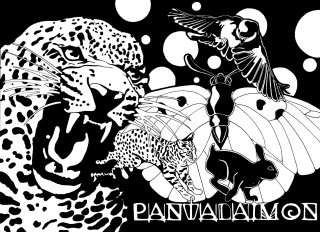
Various forms of Pantalaimon
Pullman explains that dæmons symbolise an aspect of a person’s personality. Everyone has a dæmon in Lyra’s world, and to see someone without a dæmon is like seeing a person walking around without their head. It is a part of them and a great horror to see someone without one. More than once dæmons are referred to as being like someone’s soul, and there is an invisible but evident connection between dæmon and human. The connection is strong and many times a person’s health, emotions, or subconscious can be reflected in their dæmon’s actions. This link also restricts how far they can move from one another and lets them feel what the other is feeling.
They are also used as a visual shift from innocence to experience. Pullman mentioned in an interview that he had been thinking about the transition which happens in adolescence for a long time and being a teacher he had seen this change in kids around Lyra’s age. Dæmons are a representation of this change.
As children, dæmons are able to change and shift form, often reflecting moods or used to intimidate other children. As they grow older their dæmon settle on a single, non-changing form. Having a dæmon settle is a part of growing up and while disappointing at first, it allows you to know the sort of person you are. Like the Able-Seaman tells Lyra in Northern Lights, “There’s plenty of folk as’d like to have a lion as a dæmon and they end up with a poodle”.
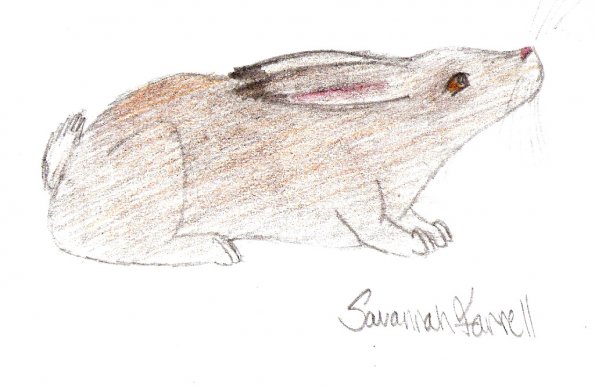
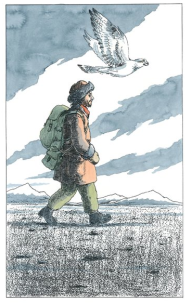
Hester (Lee Scoresby)
Dæmons may also not settle on a form that someone may like either. The Able-Seaman tells Lyra about a sailorman whose dæmon settled as a dolphin, which meant he could never leave the water. Despite the fact he was a wonderful sailor and the best navigator who made his fortune fishing, he was never happy.
Typically dæmons are the opposite sex to their humans, though there are a few rare exceptions. They can talk and while they take the form of animals, they are not animals themselves. Being part of a person means that are different than an animal, this includes what happens to them when someone dies. When a person is killed their dæmon disappears instantly, it also reflects their growing weakness if it takes time. But a person can be killed through their dæmon as well. In Northern Lights Iorek Byrnison kills a Tartar’s wolf-dæmon and as he does “bright fire spilled out of her as she fell to the snow, where she hissed and howled before vanishing. Her human died at once”.
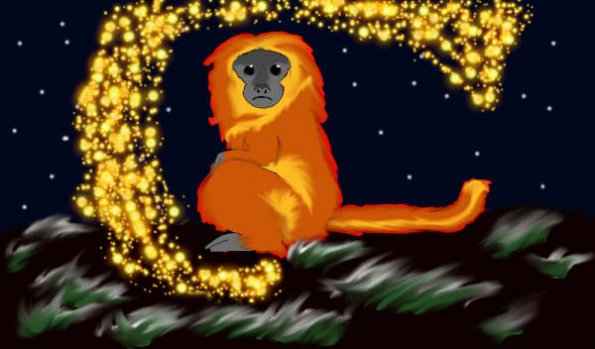
The Golden Monkey (Mrs Coulter)
There are many great taboos relating to dæmons, unspoken rules but ingrained in the entire world. Dæmons can interact and touch other dæmons, often being used to settle disputes or show affection, but it is the greatest of taboos for a person to touch someone else’s dæmon. Dæmons will talk to another human, but it is also more common for dæmons to talk to other dæmons while their humans talk with each other.
What makes dæmons iconic and masterful is not only the idea, but how impeccably Pullman has used them in this series. They are not simply just an addition to a character or a quirky entity, they have a purpose and a role, they are involved in the story on a detailed and complicated level, they are just as important as any character or plot point, and are certainly not there to simply be a plot device either.

Stelmaria (Lord Asriel)
When asked, Pullman has said his dæmon would probably be a raven, a rook, or a magpie – one of the birds from that family, mainly because she steals things, like ideas for stories, or images and phrases. But he also reminds us that you do not get to choose, you have to live with what you get.
Dæmons are a fascinating and brilliant concept that adds so much to an already intricate and rich series. In honour of the 20th anniversary, Buzzfeed have created a quiz that allows you to discover what your own dæmon would be. Now of course, Buzzfeed isn’t the greatest authority on these things, nor can they come close to doing a proper analysis of a person character and therefore proper dæmon, but it is a nice thing to see what you could possibly get.
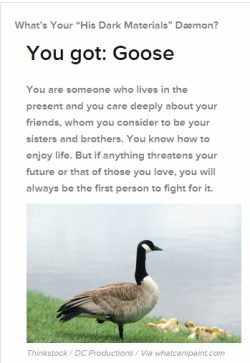 When I did the quiz I was given a goose. Reading through the comments on the page and you can see what other possibilities there could have been, and again, there are so many more varied options in Lyra’s world than what’s provided so who knows what it would have been!
You can do the Buzzfeed quiz yourself here.

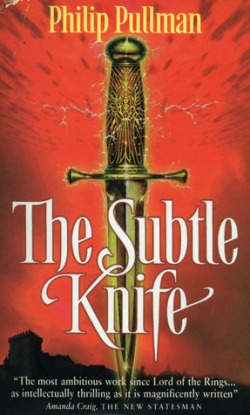 Will is twelve years old and he’s just killed a man. Now he’s on his own, on the run, determined to discover the truth about his father disappearance.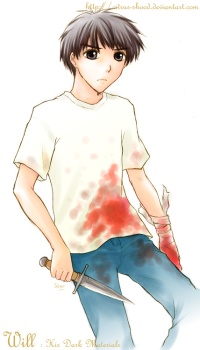



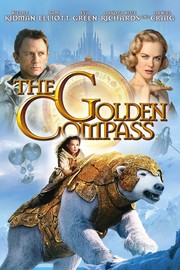 The first discussion about turning Northern Lights into a film came in 2002 following the success of other fantasy epics, but due to significant delays it wasn’t until 2007 that a film was finally made. There are many interesting things about this movie’s production, including Director Chris Weitz being unhappiness about being controlled by the studio and having many scenes cut from the film. Overall the film was popular in some countries, a failure in others, and on average it gets 5/10 stars by reviewers and rating websites.
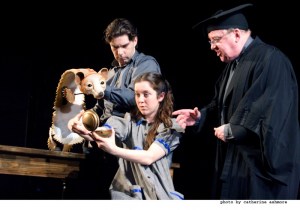 In 2003-2004 a play entitled His Dark Materials premiered at the Olivier Theatre in London. The play was written by playwright Nicholas Wright and was adapted from the entire trilogy. Because of complications in staging something based on the narrative of three books, the play was performed in two parts in alternative performances. The plot is the same as the books – a coming of age story of the two key characters Lyra and Will, but there are clear differences, the absence of Dr Mary Malone (from The Amber Spyglass) being a major one, her role being reallocated to the witch Serafina Pekkala. The amber spyglass that is typically associated with her is largely absent as well. The play was extremely popular and it sold out its entire four-month run before reviews were even published.
 There have been two audiobooks made based on Pullman’s trilogy. The first in 1996, was an audiobook of Northern Lights narrated by Natasha Richardson. The second was in 2003 and was an abridged dramatisation of the trilogy by BBC Worldwide. An unabridged version was released by BBC Audiobooks and was narrated by Philip Pullman himself. Cast voices included Joanna Wyatt as Lyra, Alison Dowling as Mrs Coulter, Sean Barret as Lord Asriel and Iorek Byrnison, and Stephen Thorne as the Master and Farder Coram.
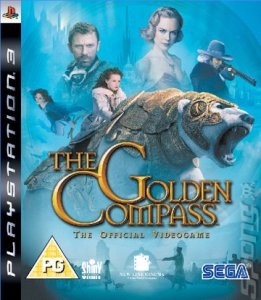 Based from The Golden Compass film, this game of the same name was released in 2007. The game is an action-adventure/puzzle game, told from a third person point of view and you take the role of Lyra and must travel through the North trying to find her kidnapped friend from the Gobblers.