The Authorship Debate

If you expect me to believe a lawyer wrote A Midsummer Night’s Dream, I must be dafter than I look.”
– Thursday Next, The Eyre Affair
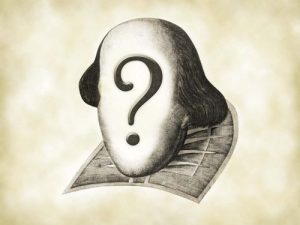
__claimant_splashThe theory of another author of Shakespeare’s plays has been debated for over two centuries, inflamed by movies like Anonymous that portrayed Shakespeare in a poor light. There are two main contenders, Edward de Vere and Francis Bacon but there are many others as well.

I never really liked the authorship debate; it was so silly, not only on poor evidence but one of the reasons for it. The argument being how could a guy from Stratford upon Avon know about such high class things like court and royalty. It just seems like an argument against education and staying in one’s class. I dunno, it just seems unfair to claim he wasn’t capable of something so wonderful just because of where he came from. People believe that he was educated in a range of things after all.

Looking at the evidence it’s obvious a few of these people aren’t candidates, but it’s interesting to see the arguments. Edward de Vere was only nine when A Midsummer Night’s dream was written so that alone should bump him out of the list, and Christopher Marlowe died before a few were written as well. Other even less likely contenders include Ben Jonson, the Earls of Derby, Rutland, Southampton, and Essex, and Sir Walter Raleigh.

A wonderful argument for Shakespeare’s authorship is that many playwrights came from humble beginnings, Ben Jonson included. The son a bricklayer no one has ever suggested he wasn’t the author of his plays, and not one of Shakespeare’s contemporaries accused him of being false either.

Bacon and de Vere are the best bets if you were to even consider it. It’s believed that Bacon wrote under the nom de plume of “Shakespeare” to hide his royal background and to abide Rosicrucian order, were anonymity had to be maintained for a hundred years. There is even a manuscript which is known as the “Northumberland Manuscript” that has both Shakespeare and Bacon’s name on it including the phrase ‘by Francis William Shakespeare’, and the words, ‘essays by the same author’.

De Vere has more comprehensive argument with many Oxfordians believing the aristocrat wrote under a pseudonym to avoid breaking voluntary convention against aristocrats publishing poetry and plays and to escape any consequences as a result of the subject matter being written about. De Vere’s knowledge of the upper classes through to his education are arguments, as well as the supposed structural similarities between his poetry and Shakespeare’s. It has even been argued in a 1589 book by George Puttenham called The Arte of English Poesie.

Absolute Shakespeare is a treasure of information and has compiled a list where the best evidence can be found with arguments for every candidate. No Sweat Shakespeare also has a list of candidates with arguments for each of them. It’s interesting because even offering up the evidence for it just seems to work against them, death and birth being big barriers.

Whether you believe Shakespeare is the true author it’s hard to deny that the plays and sonnets themselves are pretty spectacular. And really, the same argument could be made now, out of print books, books attributed to people 50 years ago, 100 years ago, is there any real evidence to say they wrote anything? Are we all supposed to leave a clear cut paper trail to stop our work being criticised and doubted. I say leave Shakespeare alone and realise that genius can come from anywhere. But that’s just me.

702ABC with Richard Glover discussed this in 2011 and it’s a really interesting listen if you wanted something else. It’s about 12 minutes long and they discuss the authorship debate and where this idea came from and whether the era people lived in contributed to this. If you want something that looks at the Anonymous film argument, Quora has a brief article on this as well with connecting links. There is also an interesting Frontline TV special that looks at who the real author could be for all those plays, it’s curious and worth a watch if you’re interested.

Links and Bits
Is Anonymous Plausible?

Authorship Arguments

Shakespeare Authorship

Shakespeare Conspiracy Theory

Who Wrote Shakespeare?

The Telegraph

In the Spotlight: A Midsummer Night’s Dream

In the Spotlight

“This is magnificent…and it’s true! It never happened, yet it is still true! What magic art is this?”
Robin Goodfellow, Sandman #19

A Midsummer Night’s Dream is one of Shakespeare’s most popular plays and one of my favourites. It is classed as a comedy and is part of the First Folio collection printed after Shakespeare’s death.

Date Written: 1595 or 1596

First performed: 1595 or early 1596

Setting: Athens, Greece

Summary

The play consists of four interconnecting plots, all connected to the marriage of Theseus, the Duke of Athens, to Hippolyta, Queen of the Amazons and takes place in both the forest and in Fairyland. From the start it’s a complex plot, two sets of couples (Hermia & Lysander and Helena & Demetrius), whose romantic affections are complicated enough already, enter the forest and find themselves in the realm of King Oberon and his Fairy Queen Titania. Also entering the forest are a band of amateur actors (known as the Mechanicals) who wish to rehearse their play. Throughout all of this a mischievous fairy known as Puck wreaks havoc and the other fairies play tricks on those who’ve entered as well.

Characters

The Athenians

Theseus: Duke of Athens
Hippolyta: Queen of the Amazons, betrothed to Theseus
Philostrate: Master of the Revels
Egeus: father of Hermia, wants her to marry Demetrius
Hermia: daughter of Egeus, in love with Lysander
Helena: in love with Demetrius, Hermia’s friend
Lysander: in love with Hermia at first but later loves Helena and then returns to loving Hermia
Demetrius: initially loves Hermia but later loves Helena
Spirits 1 & 2 (speak only to Puck and Oberon)

The fairies

Oberon: Titania’s husband and King of the Fairies
Titania: Oberon’s wife and Queen of the Fairies
Robin Goodfellow/Puck: servant to Oberon
Peaseblossom: fairy servant to Titania
Cobweb: fairy servant to Titania
Moth: fairy servant to Titania
Mustardseed: fairy servant to Titania

The Mechanicals

Peter Quince: carpenter, leads the troupe and plays Prologue
Nick Bottom: weaver, plays Pyramus
Francis Flute: bellows-mender, plays Thisbe
Robin Starveling: tailor, plays Moonshine
Tom Snout: tinker, plays Wall
Snug: joiner, plays Lion

 Famous quotes

The course of true love never did run smooth.” (Act I, Scene I)

Love looks not with the eyes, but with the mind, and therefore is winged Cupid painted blind.” (Act I, Scene I)

Lord, what fools these mortals be!” (Act III, Scene II)

Though she be but little, she is fierce!” (Act III, Scene II)

If we shadows have offended, 
Think but this, and all is mended,
That you have but slumbered here
While these visions did appear.
And this weak and idle theme,
No more yielding but a dream,
Gentles, do not reprehend:
If you pardon, we will mend:
And, as I am an honest Puck,
If we have unearned luck
Now to ‘scape the serpent’s tongue,
We will make amends ere long;
Else the Puck a liar call;
So, good night unto you all.
Give me your hands, if we be friends,
And Robin shall restore amends.” (Act V, Scene I)

Fun Facts

1. The mechanicals’ play-within-a-play was performed by the Beatles as part of Around the Beatles, a TV special, broadcast by ITV on 28 April 1964. Paul McCartney played Pyramus, John Lennon was Thisbe, while George Harrison and Ringo Starr played Moonshine and Lion respectfully.

2. Judi Dench enjoys the rare privilege of having played Titania in early youth and relatively old age. She played the role at school in York in the 1940s, on stage and screen for Peter Hall in the 1960s and then again for Hall in 2010 at the Rose Theatre, Kingston.

3. Samuel Pepys, the diarist, saw it on 29 September 1662 and is recorded as hating it, saying “Then to the King’s Theatre, where we saw “Midsummer’s Night’s Dream,” which I had never seen before, nor shall ever again, for it is the most insipid ridiculous play that ever I saw in my life. I saw, I confess, some good dancing and some handsome women, which was all my pleasure.”

4. After the Restoration era, the play was not performed in its entirety until the 1840s.

5. The scholar Harold F Brooks pointed out that the title could be read as “The Dream of a Midsummer Night”, noting that Theseus’s palace is to be sprinkled with the fairies’ field-dew benediction – “It was to dew gathered on May-day morning that magic properties were attributed.” It could therefore be set in May and people are dreaming of midsummer.

6. According to the Rough Guide to Shakespeare, one staging that took place around 1631 at Buckdale, Huntingdonshire broke the Sabbath, causing the actor playing Bottom to be placed in the stocks for 12 hours, still wearing his ass’ head.

7. The 19th century saw a rash of extravagantly designed productions. The most over the top in the UK was probably Charles Kean’s 1856 production at the Princess’s Theatre, which employed the services of 90 tutu-wearing sprites for the finale. The show was also notable for casting an eight-year-old Ellen Terry as Puck.

8. A Midsummer Night’s Dream inspired the musician Felix Mendelssohn. He wrote Wedding March in 1842 and is from his Midsummer Night’s Dream incidental music. This wedding march is very popular to hear in weddings and is often played by using a church pipe organ. Interestingly Mendelssohn was just 17 when he wrote it.

9. The wedding march was very popular after the Princess Royal Victoria chose the music on her wedding on 25 January 1858 with Prince Frederick William of Prussia.

10. If you look at the traditional folklore, there is no name for a fairy queen. Shakespeare took the name Titania from Ovid’s Metamorphoses.

11. The two largest moons of Uranus are named after Titania and Oberon. In 1787, British astronomer William Herschel discovered the moons and named them after the King and Queen.

12. A Midsummer Night’s Dream has been the inspiration for classical ballets such as George Balanchine’s two-act ballet of the same name in 1962 and Frederick Ashton’s one-act ballet entitled The Dream in 1964.

13. Aside from in the title, the word ‘midsummer’ does not appear at all in the play.

Links and Bits

Fun Facts sources

Wikipedia

Fun Facts About Shakespeare

Children are made to learn bits of Shakespeare by heart, with the result that ever after they associate him with pedantic boredom. If they could meet him in the flesh, full of jollity and ale, they would be astonished…Shakespeare did not write with a view to boring school-children; he wrote with a view to delighting his audiences. If he does not give you delight, you had better ignore him.
– Bertrand Russell

Shakespeare is such a fascinating and complicated character there is always something to discover and discuss. Especially since records are so few and a lot of what is known is based on what others have said about him. Having over 400 years of exposure and being famed in his lifetime as well as after his death, there are a multitude of facts about his life, his work, and the world around him. I’ve selected a few that I’ve found to share, some I’ve mentioned in previous posts and others I have also just learnt. If you’re a trivia nut like I am then these may be very useful to you.

These facts are sourced and adapted from No Sweat Shakespeare.

1. There is documentary proof that Shakespeare was baptised on 26th April 1564, and scholars believe that, in keeping with the traditions of the time, he would have been baptised when he was three days old, meaning Shakespeare was probably born on April 23rd. However, as Shakespeare was born under the old Julian calendar, what was April 23rd during Shakespeare’s life would actually be May 3rd according to today’s Gregorian calendar.

2. Shakespeare had seven siblings: Joan (b 1558, only lived 2 months); Margaret (b 1562); Gilbert (b 1566); another Joan (b 1569); Anne (b 1571); Richard (b 1574) and Edmund (b 1580).

3. One of Shakespeare’s relatives on his mother’s side, William Arden, was arrested for plotting against Queen Elizabeth I, imprisoned in the Tower of London and executed.

4. Shakespeare and Anne Hathaway had three children together – a daughter, Susanna, and twins, Judith and Hamnet (who died in 1596 aged 11). His only granddaughter Elizabeth – daughter of Susanna – died childless in 1670. Shakespeare therefore has no descendants.

5. Shakespeare lived a double life. By the seventeenth century he had become a famous playwright in London but in his hometown of Stratford, where his wife and children were, and which he visited frequently, he was a well-known and highly respected businessman and property owner.

6. It’s likely that Shakespeare wore a gold hoop earring in his left ear – a creative, bohemian look in the Elizabethan and Jacobean eras. This style is evidenced in the Chandos portrait, one of the most famous depictions of Shakespeare.

7. During his lifetime Shakespeare became a very wealthy man with a large property portfolio. He was a brilliant businessman – forming a joint-stock company with his actors meaning he took a share in the company’s profits, as well as earning a fee for each play he wrote.

8. Shakespeare’s family home in Stratford was called New Place. The house stood on the corner of Chapel Street and Chapel Lane, and was apparently the second largest house in the town.

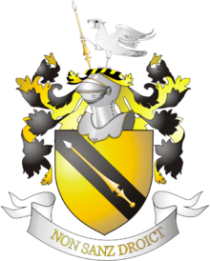
coat-of-arms-Shakespeare

Shakespeare coat of arms

9. Sometime after his unsuccessful application to become a gentleman, Shakespeare took his father to the College of Arms to secure their own Shakespeare family crest. The crest was a yellow spear on a yellow shield, with the Latin inscription “Non Sans Droict”, or “Not without Right”.


10. On his death Shakespeare made several gifts to various people but left his property to his daughter, Susanna. The only mention of his wife in Shakespeare’s own will is: “I gyve unto my wief my second best bed with the furniture”.The “furniture” was the bedclothes for the bed.

Note: People are often confused by the second best bed thing, thinking it meant Shakespeare didn’t love his wife. I actually learnt last week that the second best bed was actually the marital bed, the best bed in the house was reserved for guests.

11. Shakespeare’s original grave marker showed him holding a bag of grain. Citizens of Stratford replaced the bag with a quill in 1747.

12. Although Catholicism was effectively illegal in Shakespeare’s lifetime, the Anglican Archdeacon, Richard Davies of Lichfield, who had known him wrote some time after Shakespeare’s death that he had been a Catholic.

13. Shakespeare’s shortest play, The Comedy of Errors is only a third of the length of his longest, Hamlet, which takes four hours to perform.

14. Two of Shakespeare’s plays, Hamlet and Much Ado About Nothing, have been translated into Klingon. The Klingon Language Institute plans to translate more!

15. In the King James Bible the 46th word of Psalm 46 is ‘shake’ and the 46th word from the end of the same Psalm is ‘spear’. Some think this was a hidden birthday message to the Bard, as the King James Bible was published in 1611 – the year of Shakespeare’s 46th birthday.

16. The moons of Uranus were originally named in 1852 after magical spirits from English literature. The International Astronomy Union subsequently developed the convention to name all further moons of Uranus (of which there are 27) after characters in Shakespeare’s plays or Alexander Pope’s The Rape of the Lock.

17. Shakespeare never actually published any of his plays. They are known today only because two of his fellow actors – John Hemminges and Henry Condell – recorded and published 36 of them posthumously under the name ‘The First Folio’, which is the source of all Shakespeare books published.

18. The United States has Shakespeare to thank for its estimated 200 million starlings. In 1890 an American bardolator, Eugene Schiffelin, embarked on a project to import each species of bird mentioned in Shakespeare’s works that was absent from the US. Part of this project involved releasing two flocks of 60 starlings in New York’s Central Park. These have since gone on to become a significant pest and threat the native wildlife, even once causing a fatal plane crash. Interestingly the starling is only mentioned once in all the plays, in Henry IV Part One.

19. Rumour has it that poet John Keats was so influenced by Shakespeare that he kept a bust of the Bard beside him while he wrote, hoping that Shakespeare would spark his creativity. So

So there’s 19 fun facts you may not have known about William Shakespeare. I’ve got plenty more so look for another batch in the coming weeks.

Shakespeare 400th Owl

Shakespeare’s Sonnets

“What majesty flows from his pen
His poetry soars like a sweet violin”
                    – Nigel Bottom, Something Rotten

Shakespeare’s sonnets are not really my area of expertise, though having said that Shakespeare isn’t my area of expertise either, but I love it therefore I am flooding my blog with it for the month of April. However! I do love looking up all this stuff about the Bard and his work and discovering new things I didn’t know, especially regarding the sonnets. My only real knowledge of the sonnets before now was Sonnet 18, Shall I compare thee to a summer’s day, and the fact he mentions a ‘dark lady’ a lot in them which I learnt from Doctor Who.

Writing, Quill, Books, Transparent Background, Vector

Some say Shakespeare’s sonnets are his most popular work, I thought his plays were but considering I knew about Sonnet 18 as a kid without knowing the title or that it was by Shakespeare maybe that’s the evidence there, I don’t know. But with 154 sonnets a fair few were going to enter the general population and become incredibly well known.

Along with his 37 plays, Shakespeare also wrote 2 long poem narratives, as well as the 154 sonnets. His first piece was the narrative poem Venus and Adonis which was written and published in 1593 when Shakespeare was 29 years old. The sonnets themselves were likely composed over an extended period from 1592 to 1598. Shakespeare’s sonnets are much more numerous than his plays so I will not be including a full list here. I’ve included a few links below that let you read them; many include commentary and annotations as well.

Edit: I discovered that the reason Shakespeare started his sonnets was because an outbreak of the plague in Europe resulted in all theatres being closed between 1592 and 1594. During this time no one wanted to see plays so Shakespeare started working on his sonnets instead.

Shakespeare Online has a wonderful break down of the content and reoccurring subjects of each sonnet; many seem to be grouped together with running stories or subjects, similar themes and tones such as the passage of time, love, beauty, and mortality. Many of them are considered the most romantic poems ever written and judging how popular and well known they are to this day it is hard to dispute.

The sonnets are written predominately in iambic pentameter, a rhyming scheme in which each line consists of ten syllables. These syllables are divided into five pairs called iambs or iambic feet. An iamb is made up of one unstressed syllable followed by one stressed syllable. Shakespeare Online provides an excellent example:

A line of iambic pentameter flows like this:
baBOOM / baBOOM / baBOOM / baBOOM / baBOOM.

Shall I / com PARE/ thee TO / a SUM / mer’s DAY?
Thou ART / more LOVE / ly AND / more TEM / per ATE (Sonnet 18)

Each sonnet is made up of 14 lines and only three of the 154 don’t follow this rule: Sonnet 99 (with 15 lines), Sonnet 126 (12 lines), and Sonnet 145 (written in iambic tetrameter). Many of Shakespeare’s plays are also written in iambic pentameter but the lines do not rhyme nor are they grouped into stanzas. Iambic pentameter that doesn’t rhyme is known as blank verse.

Sonnets1609titlepageIn 1609 there was a possible breach of copyright as Shakespeare’s sonnets were published by Thomas Thorpe without his permission under the title: SHAKE-SPEARES SONNETS. Never before Imprinted. (despite sonnets 138 and 144 being previously published in 1599). There is debate about whether Thorpe actually published without Shakespeare’s permission; he may have used an authorised manuscript from Shakespeare or an unauthorised copy.

It’s argued that Shakespeare’s Sonnets is a prototype of new ‘modern’ love poetry. While not that popular in 18th century England, Shakespeare’s sonnets grew in popularity in the 19th century alongside the renewed interest in his original works as part of the Romantic era.

Sonnet 1

From fairest creatures we desire increase,
That thereby beauty’s rose might never die,
But as the riper should by time decease,
His tender heir might bear his memory:
But thou, contracted to thine own bright eyes,
Feed’st thy light’s flame with self-substantial fuel,
Making a famine where abundance lies,
Thyself thy foe, to thy sweet self too cruel.
Thou that art now the world’s fresh ornament
And only herald to the gaudy spring,
Within thine own bud buriest thy content
And, tender churl, makest waste in niggarding.
Pity the world, or else this glutton be,
To eat the world’s due, by the grave and thee.

Sonnet 18

Shall I compare thee to a summer’s day?
Thou art more lovely and more temperate:
Rough winds do shake the darling buds of May,
And summer’s lease hath all too short a date:
Sometime too hot the eye of heaven shines,
And often is his gold complexion dimmed,
And every fair from fair sometime declines,
By chance, or nature’s changing course untrimmed:
But thy eternal summer shall not fade,
Nor lose possession of that fair thou ow’st,
Nor shall death brag thou wander’st in his shade,
When in eternal lines to time thou grow’st,
So long as men can breathe, or eyes can see,
So long lives this, and this gives life to thee.

Sonnet 33

Full many a glorious morning have I seen
Flatter the mountain tops with sovereign eye,
Kissing with golden face the meadows green,
Gilding pale streams with heavenly alchemy;
Anon permit the basest clouds to ride
With ugly rack on his celestial face,
And from the forlorn world his visage hide,
Stealing unseen to west with this disgrace:
Even so my sun one early morn did shine,
With all triumphant splendour on my brow;
But out, alack, he was but one hour mine,
The region cloud hath mask’d him from me now.
Yet him for this my love no whit disdaineth;
Suns of the world may stain when heaven’s sun staineth.

Edit: Musician Paul Kelly had turned some of Shakespeare’s Sonnets in songs. You can watch the video of him discussing it here or find out more on his website.

Links and Bits

Shakespeare’s sonnets

Shakespeare’s Sonnets

Famous sonnets

Theories about the sonnets

Outline of sonnet content

Sonnet structure and style

Listen to famous sonnets being read

Shakespeare’s Plays

Shakespeare led a life of Allegory; his works are the comments on it.
– John Keats

During his career Shakespeare is believed to have written 37 plays. No one knows for sure because of poor documentation and records, that and plays were meant to be performed so no one was too fussed on making sure they survived in print. If the collaborated plays, as well as those believed lost like Cardenio and Love’s Labour’s Won are included, then the number rises. Some argue he wrote 28 plays himself and collaborated on 10 and the Wikipedia article on collaborations is even more confusing again.

Sticking with the 37 figure for now, the majority of plays were comedies with a total of 17, while tragedies and historical plays come next at 10 each. The first play scholars believe Shakespeare penned was Henry VI, Part One, written sometime during 1589-1590 when Shakespeare was 25 years old. Part Two and Part Three followed in 1590-91. He composed plays on average every 1.5 years until his final play Cardenio which is thought to have been written in 1612-13. The Tempest in 1611 is his last surviving solo creation, though he is recorded as a contributor on The Two Noble Kinsmen with John Fletcher in 1613 when he was 49, his last official recorded play.

 There is a wonderful timeline that maps out when each work was written which you can see a more detailed version here including key performances. I’ve chosen a few dates to show the timeline of when each play was written.

1589-1590. Shakespeare is believed to have written his very first play, Henry VI, Part One

1590-91. Shakespeare is believed to have written Henry VI, Part Two and Henry VI, Part III.

1592-93. Shakespeare is thought to have written the plays Richard III and The Two Gentlemen of Verona.

1592-94. The Comedy of Errors written in this time.

1593-94. Titus Andronicus and The Taming of the Shrew are thought to have been written.

1594-1595. Shakespeare pen’s Love Labour’s Lost.

1594-1596. King John is assumed to have been written.

1595. Shakespeare is thought to have composed Richard II (performed that very same year), A Midsummer Night’s Dream (thought to be composed for a wedding), and Romeo and Juliet.

1596. The Merry Wives of Windsoris thought to have been written.

1596-1597. The Merchant of Venice and Henry IV, Part One are thought to have been written.

1598. Thought to have written the play Henry IV, Part Two.

1598-99. Writes Much Ado About Nothing.

1599. Julius Caesaris performed at the newly opened Globe Theatre for the first known time. Henry V believed to be written.

1600-1601. Shakespeare is thought to have composed Hamlet at this time.

1601-1602. Twelfth Night or What You WillAll Well That Ends Well, and Troilus and Cressida are probably composed.

1604. Measure for Measure is believed to have been written in this year. Othello is also written.

1605. King Lear is believed to have been composed in this year and as is Macbeth.

1606. Antony And Cleopatra is believed to have been composed.

1607-1608. Timon of Athens, Pericles and Coriolanus are composed.

1609-1610. Cymbeline is thought to have been composed.

1610-1611. The Winter’s Tale is written.

1611. The Tempest was written.

1612-1613. Shakespeare is thought to have written Cardenio, his only lost play during this period and with John Fletcher as a likely contributor, composes Henry VIII.

1613. The Two Noble Kinsmen is penned. A 1634 entry within the Stationer’s Registry confirms that both William Shakespeare and John Fletcher composed this play.

Shakespeare was also an actor, performing in his own and other people’s plays. His first recorded role in Ben Jonson’s Every Man in his Humour in 1598. But it’s believed during 1585-1592 that Shakespeare first went to London to join a company of actors as a playwright and performer. He appeared in many plays over his career, many by Ben Johnson who was a friend. His final known acting performance was in Johnson’s production of Sejanus in 1603.

What I found interesting was not only did Shakespeare help build the Globe to have his theatre company’s plays performed, it’s believed The Tempest was written specifically with performances at the Blackfriars Theatre in mind, which The King’s Men (as they’d became known) leased in 1608.

I’ll be discussing in a later post about why these plays have survived and been loved while other playwright’s didn’t. I also like that while the comedies outnumber the tragedies, they aren’t as well known and the “masterpieces” like Hamlet or Macbeth. I’ve included some links below to learn more about the plays as well as included a full list of his surviving plays.

Shakespeare’s Plays

Comedies
All’s Well That Ends Well | As You Like It
Cymbeline | The Comedy of Errors
Love’s Labour’s Lost | Measure for Measure
The Merchant of Venice | The Merry Wives of Windsor
A Midsummer Night’s Dream | Much Ado About Nothing
Pericles | The Taming of the Shrew
Troilus and Cressida | The Two Gentlemen of Verona
Twelfth Night | The Winter’s Tale
The Tempest

Tragedies
Antony and Cleopatra | Coriolanus
Hamlet | Julius Caesar
King Lear | Macbeth
Othello | Romeo and Juliet
Timon of Athens | Titus Andronicus

Histories
Henry IV 1 and 2 | Henry V
Henry VI 1, 2, and 3 | Henry VIII
King John | Richard II
Richard III 

Links and Bits

Shakespeare Online

Absolute Shakespeare

Shakespeare Collaborations

Shakespeare’s Plays

Shakespeare Infographic Timeline

38 Facts about Shakespeare’s 38 Plays

Previous Older Entries Next Newer Entries