Quoting Shakespeare

If Shakespeare required a word and had not met it in civilised discourse, he unhesitatingly made it up.”
– Anthony Burgess
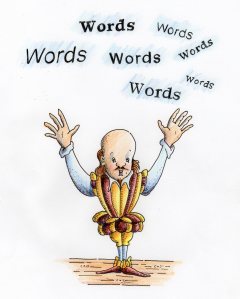
Shakespeare.words_The fact that Shakespeare added over 1700 words to the English language is a well-known fact that has been used to show off his creativity and ingenuity but how true is it? Shakespeare created new words by changing nouns into verbs, changing verbs into adjectives, connecting words together, adding prefixes and suffixes, and creating entirely original words. Arguments have been made over whether adding prefixes to existing words counts as a new word or not. Does adding ‘arch’ to villain to create arch-villain mean a new word is created? ‘Assassination’ existed in a form in both English and Arabic before Macbeth, does this mean Shakespeare created that intention of the word? If we leave the deep discussion to the linguists and take the number as is, there are so many we use today. I will restrain myself from posting a massive list but there is a collection on a few sites which I’ve linked below. A small selection of created words include:

accused | addiction | advertising | amazement | arouse | bandit | bedroom | besmirch | blanket | blushing | bet | bump | buzzer | champion | compromise | courtship | critic | dauntless | dawn | deafening | drugged| dwindle | elbow | excitement | eyeball | fashionable | flawed | gloomy | gnarled | grovel | hint | hobnob | impartial | lonely | luggage | lustrous | majestic | marketable | metamorphise | mimic | negotiate | obsequiously | ode | olympian | outbreak | puking | rant | scuffle | skim milk | submerge | summit | swagger | torture | tranquil | worthless | zany

Of course, since Shakespeare added completely new words to the language he deserves credit for that, and many words he used existed already he merely popularised them. One thing he can be credited with, away from individual words, he was also the creator of phrases and terms we still use today. These are a few phrases that have survived the centuries and cemented themselves so deep in English language that it’s hard to believe we were once without them.

Come what may (Macbeth) | Heart of gold (Hamlet)
Good riddance (Troilus and Cressida) | Knock-knock (Macbeth)
All of a sudden (The Taming of the Shrew) | Faint-hearted (Henry IV part I)
Heart of gold (Henry V) | Wild-goose chase (Romeo and Juliet)
Brave new world (The Tempest) | Break the ice (The Taming of the Shrew)
For goodness’ sake (Henry VIII) | Foregone conclusion (Othello)
Love is blind (The Merchant of Venice) | The beast with two backs (Othello)
Assassination (Macbeth) | Bated breath (A Midsummer Night’s Dream)
Be-all and end-all (The Merchant of Venice) | One fell swoop (Macbeth)
Kill with kindness Macbeth | Twinkling of an eye (The Merchant of Venice)
Fair play (The Tempest) | Wild-goose chase (Romeo and Juliet)
As good luck would have it (The Merry Wives of Windsor)
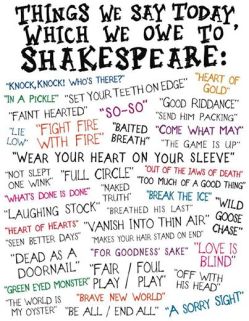
shakespeare_words_used_todayThere are also a range of words Shakespeare invented and used that have faded into history. On the Shakespeare-themed QI episode Stephen Fry discusses them and their meanings. Some of these include kickie-wickie, tanling, slugabed, boggler, wappened, and carlot. More can be found here. Another incredibly fun way to remember the words and phrases Shakespeare gave us is through song. Horrible Histories created a wonderful and catchy song about Shakespeare’s words which you can find here, they also did a skit about Shakespeare on Mastermind with his phrases. But, if you get carried away thinking Shakespeare quoted everything, there is are a few blogs dedicated to proving that not everything is from Shakespeare which you can find here and here.

Virginia Woolf asked in To the Lighthouse, “If Shakespeare had never existed…would the world have differed much from what it is today? Does the progress of civilisation depend upon great men? Is the lot of the average human being better now that in the time of the Pharaohs?” Looking at the range of words and phrases that we use every day without even thinking about their origins it would certainly be a different world if Shakespeare had never existed. So much of our language would be different, the deeper you fall into his dictionary of terms it’s really quite hard to imagine.

Links and Bits

Words Shakespeare invented
Unsuccessful Shakespearean words
Quips Created by Shakespeare
Shakespeare’s Neologisms
Words Shakespeare used that had different meanings
In the Spotlight: The Tempest

In the Spotlight

Now, Ariel, I am that I am, your late and lonely master,
Who knows what magic is;—the power to enchant
– The Sea and the Mirror, W. H. Auden

The Tempest is one of Shakespeare’s classic comedies; it appears first in the 1623 First Folio selection and is considered by many scholars to be the final play Shakespeare wrote on his own. It also has one of my favourite quotes in it, ‘Thought is free”.

Date Written: 1610 or 1611

First performed: There are records indicating that The Tempest was performed before James I on November 1 1611 but it’s likely there were performances before this.

Setting: an unnamed, uninhabited island

Summary

The magician, Prospero, rightful Duke of Milan, and his daughter, Miranda, have been stranded for twelve years on an island after Prospero’s jealous brother Antonio deposed him. Prospero is reluctantly served by a spirit, Ariel, whom Prospero had rescued from a tree in which he had been trapped by the cruel witch, Sycorax. Her son, Caliban, a deformed monster and the only non-spiritual inhabitant before the arrival of Prospero, was initially adopted and raised by him. He taught Prospero how to survive on the island, while Prospero and Miranda taught Caliban religion and their own language.

Three plots alternate through the play. In one, Caliban falls in with Stephano and Trinculo, two drunkards. They attempt to raise a coup against Prospero, which ultimately fails. In another, Prospero works to encourage a romantic relationship between Ferdinand and Miranda. In the third subplot, Antonio and Sebastian conspire to kill Alonso and Gonzalo so that Sebastian can become King.

Themes: Theatre, the soul, and magic

Characters

Prospero: the main character. The overthrown Duke of Milan. He now lives on an island and is a great sorcerer.

Miranda: Prospero’s daughter

Ariel: a spirit who does Prospero’s bidding and is, at times, visible only to him.

Caliban: a villainous island native, who ruled the island before Prospero arrived. Sycorax (unseen), a deceased Algerian sorceress who was banished to the island before Prospero arrived and enslaved the spirits on the island.

Iris, Ceres, and Juno: spirits who perform the roles of goddesses in a masque presented to the young lovers.

Alonso: King of Naples

Sebastian: Alonso’s treacherous brother.

Antonio: Prospero’s brother, who usurped his position as Duke of Milan.

Ferdinand: Alonso’s son.

Gonzalo: a kindly Neapolitan courtier

Trinculo: the King’s jester

Stephano: the King’s drunken butler

Boatswain

Master of the ship

 Famous quotes

Hell is empty, and all the devils are here!” (Act I, Scene II)
Misery acquaints a man with strange bedfellows.” (Act II, Scene II)

Thought is free.” (Act III, Scene II)

He that dies pays all debts.” (Act III, Scene II)

We are such stuff as dreams are made on, and our little life, is rounded with a sleep.” (Act IV, Scene I)

O, brave new world that has such people in’t!” (Act V, Scene I)

Fun Facts

1. Adaptations of the play, different from Shakespeare’s original, dominated theatre performances from the English Restoration in 1660 until the mid-19th century.

2. The Tempest has more music than any other Shakespeare play, and has proved more popular with composers than most of his other plays with 46 operatic performances throughout history, the first in 1695 by Henry Purcell. Two arrangements that might have been used in Shakespeare’s time still exist – one for “Full Fathom Five” and another for “Where The Bee Sucks There Suck I”, both printed in the 1659 publication Cheerful Ayres or Ballads’.

3. There is no single origin for the plot in The Tempest and many scholars believe it is an amalgamation of many. A strong contender being a document from William Strachey, titled A True Reportory of the Wracke and Redemption of Sir Thomas Gates, Knight.

4. Many well known phrases came from The Tempest including “Brave new world”, “In a pickle”, “Melted into thin air”, “sea change” and “Such stuff as dreams are made on”.

5. The play also demonstrates Shakespeare’s knack for creating new words with word such as abstemious (from the Latin absetmius meaning to indulge slightly in an alcoholic drink), baseless, eyeball, leaky, and watchdog.

6. With only one female speaking role The Tempest has the fewest female characters compared with the other plays.

7. The 1948 western Yellow Sky is a subtle yet clear adaptation of the play, as is the 1956 film Forbidden Planet.

8. One of the shortest Shakespeare play with 17 233 words; outdone only by A Midsummer Night’s Dream (16 511) and A Comedy of Errors (14 701).

9. It is the most performed Shakespeare play on BBC Radio with 21 productions.

10. Thanks to a precedent set by John Herschel, son of astronomer William Herschel who discovered Uranus, two regular moons and seven of the outermost moons of Uranus are named after characters from The Tempest. These are Ariel, Miranda, Caliban, Sycorax, Prospero, Setebos, Stephano, Trinculo, Francisco, and Ferdinand.

11. Unlike most of his plays, The Tempest conforms to Aristotle’s unities – the neoclassical notion that drama should follow three rules: unity of action (a play should have one main plot line with few distractions), unity of place (it should take place in one physical space) and the unity of time (the action fit within 24 hours).

12. Characters from The Tempest have gone further into space than even Uranus with numerous satellites being launched with their namesakes. Ariel 1 was the first British satellite in space, launched in 1962, in addition to six other Ariel satellites developed between 1962 and 1979. In 1971, the Black Arrow R3 rocket launched “Prospero X-3.

Links and Bits

Fun Facts source

Wikipedia

The Whole World Is A Playhouse

All the world’s a stage
– As You Like It, William Shakespeare.

The Globe that stands in London today is actually the third reincarnation. The first Globe was built around 1599 by Shakespeare and his company but because it was too expensive in the original location, it was moved to the other side of the river. This rebuild was then burnt down during a performance of Henry VIII when a cannon went through the thatched roof. It was rebuilt the following year but was then removed permanently by the Puritans. The new and current version was built by Sam Wanamaker, American actor and director, after a 20 year campaign and stands only a few hundred metres from its original location. Based on the original design and layout and historically accurate as possible, the new Globe is really spectacular. There are tours and a museum/display section, but the best part is that it still puts on plays. And with everything looking historically accurate you can experience what it was like to see a play almost as if it were in the 1600s.

P1130681During my visit to London a few years ago I was fortunate enough to see a rehearsal for Henry VI and it was so wonderful, it was one of the highlights of my trip. There really is something magical about live theatre, and to see a Shakespeare play being performed, not in the original but practically in the same environment, was pretty spectacular.
I’ve got some fun facts about the original Globe as well as its rebuild to share and I’ve linked a great page from No Sweat Shakespeare below that looks more into the theatre’s history.

1. The Globe Theatre was built between 1597 and 1599 in Southwark on the south bank of London’s River Thames, funded by Richard Burbage and built by carpenter Peter Smith and his workers.

2. The timber for The Globe Theatre was actually reused wood from “The Theatre” – an earlier theatre built in 1576 and owned by Burbage’s father. Due to a dispute with the landlord, Giles Allen, it closed 20 years later. While Allen was celebrating Christmas in 1598, William Shakespeare and his company dismantled The Theatre and transported the materials to the new site in Southwark.

3. The architectural style of The Globe was similar to the Coliseum in Rome, but on a smaller scale – other Elizabethan theatres also followed this style of architecture which were called amphitheatres.

4. The Globe had three stories of seating and was able to hold up to 3,000 spectators in its 100 foot diameter.

5. At the base of the stage was an area called “the pit” which held “the groundlings” – people who paid just a penny to stand and watch a performance.

6. At the peak of summer time the groundlings were also referred to as ‘stinkards’

The original Globe Theatre, complete with stage “apron”

The original Globe Theatre, complete with stage “apron”

7. Part of the stage was called the “apron stage” – a rectangular platform that thrust out amongst the audience into the pit.

8. William Shakespeare was a shareholder who owned 12.5% of The Globe Theatre. As a young writer Shakespeare bought shares in the theatre and benefited financially as his popularity grew.

9. Colour coded flags were used outside the theatre to advertise the type of play to be performed – a red flag for a history play, white for a comedy play and black for a tragedy play.

10. A crest above the main entrance to The Globe Theatre was inscribed with motto “Totus mundus agit histrionem” – Latin for “The whole world is a playhouse”.

11. At the start of each play after collecting money from the audience the admission collectors took boxes full of money to a room backstage – the box office

12. A trumpet was sounded to announce to people that the play was about to begin at the Globe Theatre in order for people to take their final places.

13. There were no actresses performing at The Globe Theatre – or any other theatre at that time. Female roles were played by young boys as theatre stages were considered too risqué a place for ladies.

14. Outbreaks of the Bubonic Plague were so serious in London that the Globe Theatre was forced to close in 1603 and 1608 to restrict its’ spread.

15. The Globe Theatre burnt down in 1613 when a special effect on stage went wrong. A cannon used for a performance of Henry VIII set light to the thatched roof and the fire quickly spread, reportedly taking less than two hours to burn down completely. No one was hurt but an account does claim a man’s trousers caught fire but a quick-thinking friend doused him with a flagon of beer.

16. After burning down in 1613 The Globe Theatre was rebuilt on the same spot in 1614.

17. The Puritans brought an end to The Globe Theatre in 1642 with an order suppressing all stage plays. In 1644 The Globe Theatre was turned into tenement housing, ending 85 years of turbulent history.

18. In 1997 a third version and faithful reconstruction of The Globe Theatre was built as “Shakespeare’s Globe Theatre”, close to the original site in Southwark.

19. The Globe was generally considered to be a circular building, however when a small part of the theatre’s foundations were uncovered the late 1980’s it seems that the building was actually an icosagon (a 20 sided polygon).

20. This new Globe Theatre was built using 1,000 oak trees from English forests and 6,000 bundles of reeds from Norfolk for the thatched roof.

21. Each of the two big pillars on the stage is one oak tree. The builders had to measure lots of trees to find two just the right size.

22. The bricks in the foundations that hold the theatre up are copies of an actual Tudor brick.

23. Shakespeare’s Globe holds 1500 people, about half the number of the original Globe. People are bigger now and are less happy to squash up. Also people in Shakespeare’s time didn’t have to obey safety regulations.

24. Many Londoners were strict Protestants – Puritans in fact, who abhorred the theatres and many of the people they attracted and in 1596 London’s authorities banned the public presentation of plays and all theatres within the city limits of London. All theatres located in the City were forced to move to the South side of the River Thames

25. People who stand to watch a play at the Globe sometimes faint, especially in warm weather. The play with most fainting people is Titus Andronicus – there were 15 in one performance!

26. Music was an extra effect added in the 1600’s. The musicians would also reside in the Lords rooms

27. In just two weeks Elizabethan theatres could often present eleven performances of ten different plays.

28. Shakespeare’s first biographer, Nicholas Rowe, referred to a role performed by William Shakespeare at the Globe theatre as “the Ghost in his own Hamlet” in which he was at “the top of his performance”.

Sources

The Globe

The New Globe

Absolute Shakespeare Globe Trivia

Shakespeare’s Globe Website

No Sweat Shakespeare – The Globe

No Sweat Shakespeare – Globe Facts

Shakespeare’s Globe – Facts

Globe Theatre Facts

The Authorship Debate

If you expect me to believe a lawyer wrote A Midsummer Night’s Dream, I must be dafter than I look.”
– Thursday Next, The Eyre Affair

__claimant_splashThe theory of another author of Shakespeare’s plays has been debated for over two centuries, inflamed by movies like Anonymous that portrayed Shakespeare in a poor light. There are two main contenders, Edward de Vere and Francis Bacon but there are many others as well.

I never really liked the authorship debate; it was so silly, not only on poor evidence but one of the reasons for it. The argument being how could a guy from Stratford upon Avon know about such high class things like court and royalty. It just seems like an argument against education and staying in one’s class. I dunno, it just seems unfair to claim he wasn’t capable of something so wonderful just because of where he came from. People believe that he was educated in a range of things after all.

Looking at the evidence it’s obvious a few of these people aren’t candidates, but it’s interesting to see the arguments. Edward de Vere was only nine when A Midsummer Night’s dream was written so that alone should bump him out of the list, and Christopher Marlowe died before a few were written as well. Other even less likely contenders include Ben Jonson, the Earls of Derby, Rutland, Southampton, and Essex, and Sir Walter Raleigh.

A wonderful argument for Shakespeare’s authorship is that many playwrights came from humble beginnings, Ben Jonson included. The son a bricklayer no one has ever suggested he wasn’t the author of his plays, and not one of Shakespeare’s contemporaries accused him of being false either.

Bacon and de Vere are the best bets if you were to even consider it. It’s believed that Bacon wrote under the nom de plume of “Shakespeare” to hide his royal background and to abide Rosicrucian order, were anonymity had to be maintained for a hundred years. There is even a manuscript which is known as the “Northumberland Manuscript” that has both Shakespeare and Bacon’s name on it including the phrase ‘by Francis William Shakespeare’, and the words, ‘essays by the same author’.

De Vere has more comprehensive argument with many Oxfordians believing the aristocrat wrote under a pseudonym to avoid breaking voluntary convention against aristocrats publishing poetry and plays and to escape any consequences as a result of the subject matter being written about. De Vere’s knowledge of the upper classes through to his education are arguments, as well as the supposed structural similarities between his poetry and Shakespeare’s. It has even been argued in a 1589 book by George Puttenham called The Arte of English Poesie.

Absolute Shakespeare is a treasure of information and has compiled a list where the best evidence can be found with arguments for every candidate. No Sweat Shakespeare also has a list of candidates with arguments for each of them. It’s interesting because even offering up the evidence for it just seems to work against them, death and birth being big barriers.

Whether you believe Shakespeare is the true author it’s hard to deny that the plays and sonnets themselves are pretty spectacular. And really, the same argument could be made now, out of print books, books attributed to people 50 years ago, 100 years ago, is there any real evidence to say they wrote anything? Are we all supposed to leave a clear cut paper trail to stop our work being criticised and doubted. I say leave Shakespeare alone and realise that genius can come from anywhere. But that’s just me.

702ABC with Richard Glover discussed this in 2011 and it’s a really interesting listen if you wanted something else. It’s about 12 minutes long and they discuss the authorship debate and where this idea came from and whether the era people lived in contributed to this. If you want something that looks at the Anonymous film argument, Quora has a brief article on this as well with connecting links. There is also an interesting Frontline TV special that looks at who the real author could be for all those plays, it’s curious and worth a watch if you’re interested.

Links and Bits

Is Anonymous Plausible?

Authorship Arguments

Shakespeare Authorship

Shakespeare Conspiracy Theory

Who Wrote Shakespeare?

The Telegraph

In the Spotlight: A Midsummer Night’s Dream

In the Spotlight

“This is magnificent…and it’s true! It never happened, yet it is still true! What magic art is this?”
Robin Goodfellow, Sandman #19

A Midsummer Night’s Dream is one of Shakespeare’s most popular plays and one of my favourites. It is classed as a comedy and is part of the First Folio collection printed after Shakespeare’s death.

Date Written: 1595 or 1596

First performed: 1595 or early 1596

Setting: Athens, Greece

Summary

The play consists of four interconnecting plots, all connected to the marriage of Theseus, the Duke of Athens, to Hippolyta, Queen of the Amazons and takes place in both the forest and in Fairyland. From the start it’s a complex plot, two sets of couples (Hermia & Lysander and Helena & Demetrius), whose romantic affections are complicated enough already, enter the forest and find themselves in the realm of King Oberon and his Fairy Queen Titania. Also entering the forest are a band of amateur actors (known as the Mechanicals) who wish to rehearse their play. Throughout all of this a mischievous fairy known as Puck wreaks havoc and the other fairies play tricks on those who’ve entered as well.

Characters

The Athenians

Theseus: Duke of Athens
Hippolyta: Queen of the Amazons, betrothed to Theseus
Philostrate: Master of the Revels
Egeus: father of Hermia, wants her to marry Demetrius
Hermia: daughter of Egeus, in love with Lysander
Helena: in love with Demetrius, Hermia’s friend
Lysander: in love with Hermia at first but later loves Helena and then returns to loving Hermia
Demetrius: initially loves Hermia but later loves Helena
Spirits 1 & 2 (speak only to Puck and Oberon)

The fairies

Oberon: Titania’s husband and King of the Fairies
Titania: Oberon’s wife and Queen of the Fairies
Robin Goodfellow/Puck: servant to Oberon
Peaseblossom: fairy servant to Titania
Cobweb: fairy servant to Titania
Moth: fairy servant to Titania
Mustardseed: fairy servant to Titania

The Mechanicals

Peter Quince: carpenter, leads the troupe and plays Prologue
Nick Bottom: weaver, plays Pyramus
Francis Flute: bellows-mender, plays Thisbe
Robin Starveling: tailor, plays Moonshine
Tom Snout: tinker, plays Wall
Snug: joiner, plays Lion

 Famous quotes

The course of true love never did run smooth.” (Act I, Scene I)

Love looks not with the eyes, but with the mind, and therefore is winged Cupid painted blind.” (Act I, Scene I)

Lord, what fools these mortals be!” (Act III, Scene II)

Though she be but little, she is fierce!” (Act III, Scene II)

If we shadows have offended, 
Think but this, and all is mended,
That you have but slumbered here
While these visions did appear.
And this weak and idle theme,
No more yielding but a dream,
Gentles, do not reprehend:
If you pardon, we will mend:
And, as I am an honest Puck,
If we have unearned luck
Now to ‘scape the serpent’s tongue,
We will make amends ere long;
Else the Puck a liar call;
So, good night unto you all.
Give me your hands, if we be friends,
And Robin shall restore amends.” (Act V, Scene I)

Fun Facts

1. The mechanicals’ play-within-a-play was performed by the Beatles as part of Around the Beatles, a TV special, broadcast by ITV on 28 April 1964. Paul McCartney played Pyramus, John Lennon was Thisbe, while George Harrison and Ringo Starr played Moonshine and Lion respectfully.

2. Judi Dench enjoys the rare privilege of having played Titania in early youth and relatively old age. She played the role at school in York in the 1940s, on stage and screen for Peter Hall in the 1960s and then again for Hall in 2010 at the Rose Theatre, Kingston.

3. Samuel Pepys, the diarist, saw it on 29 September 1662 and is recorded as hating it, saying “Then to the King’s Theatre, where we saw “Midsummer’s Night’s Dream,” which I had never seen before, nor shall ever again, for it is the most insipid ridiculous play that ever I saw in my life. I saw, I confess, some good dancing and some handsome women, which was all my pleasure.”

4. After the Restoration era, the play was not performed in its entirety until the 1840s.

5. The scholar Harold F Brooks pointed out that the title could be read as “The Dream of a Midsummer Night”, noting that Theseus’s palace is to be sprinkled with the fairies’ field-dew benediction – “It was to dew gathered on May-day morning that magic properties were attributed.” It could therefore be set in May and people are dreaming of midsummer.

6. According to the Rough Guide to Shakespeare, one staging that took place around 1631 at Buckdale, Huntingdonshire broke the Sabbath, causing the actor playing Bottom to be placed in the stocks for 12 hours, still wearing his ass’ head.

7. The 19th century saw a rash of extravagantly designed productions. The most over the top in the UK was probably Charles Kean’s 1856 production at the Princess’s Theatre, which employed the services of 90 tutu-wearing sprites for the finale. The show was also notable for casting an eight-year-old Ellen Terry as Puck.

8. A Midsummer Night’s Dream inspired the musician Felix Mendelssohn. He wrote Wedding March in 1842 and is from his Midsummer Night’s Dream incidental music. This wedding march is very popular to hear in weddings and is often played by using a church pipe organ. Interestingly Mendelssohn was just 17 when he wrote it.

9. The wedding march was very popular after the Princess Royal Victoria chose the music on her wedding on 25 January 1858 with Prince Frederick William of Prussia.

10. If you look at the traditional folklore, there is no name for a fairy queen. Shakespeare took the name Titania from Ovid’s Metamorphoses.

11. The two largest moons of Uranus are named after Titania and Oberon. In 1787, British astronomer William Herschel discovered the moons and named them after the King and Queen.

12. A Midsummer Night’s Dream has been the inspiration for classical ballets such as George Balanchine’s two-act ballet of the same name in 1962 and Frederick Ashton’s one-act ballet entitled The Dream in 1964.

13. Aside from in the title, the word ‘midsummer’ does not appear at all in the play.

Links and Bits

Fun Facts sources

Wikipedia

Previous Older Entries Next Newer Entries