Even More Shakespeare Facts!

But my God, how beautiful Shakespeare is, who else is as mysterious as he is; his language and method are like a brush trembling with excitement and ecstasy.
– Vincent van Gogh

welcome-shakespeare-quiz-and-activitiesAs my  Shakespeare Month is drawing to a close it’s time for the final installment of Shakespeare Fun Facts. All my sources are included below and there are still so many more I didn’t include! If you look hard enough there is so much to discover.

1. According to Shakespeare professor Louis Marder, “Shakespeare was so facile in employing words that he was able to use over 7,000 of them – more than occur in the whole King James Version of the Bible – only once and never again.”

2. Some scholars have maintained that Shakespeare did not write the plays attributed to him, with at least fifty writers having been suggested as the “real” author. However, the evidence for Shakespeare’s having written the plays is very strong.

3. The American President Abraham Lincoln was a great lover of Shakespeare’s plays and frequently recited from them to his friends. His assassin, John Wilkes Booth was a famous Shakespearean actor.

4. ‘William Shakespeare’ is an anagram of ‘I am a weakish speller’.

5. The first ever amateur performance of a Shakespeare play took place in 1623. A handwritten manuscript survives of an adaptation of the two parts of Henry IV, which was performed by a household in Pluckley in Kent. Sir Edward Dering, the amateur theatre enthusiast who commissioned it was the first person we know of to buy a First Folio of Shakespeare’s plays when it hit the bookstalls in 1623.

6. In Huckleberry Finn, Mark Twain describes how two swindlers posing as English actors on their way down the Mississippi stage a night of Shakespeare in the court house of a one-horse town in Arkansas. When the audience drift away before the end, one of them declares: “Arkansas lunkheads couldn’t come up to Shakespeare! “

7. Shakespeare followed the Gold Rush west in the 1840s. There are stories of pioneer companies of actors playing among the ore-rich gulches, to mining camps full of desperados and sharpers of all nations.

8. Fellow playwright Ben Jonson called Shakespeare ‘Our Star of Poets’: “Take him and cut him out in little stars/And he will make the face of heaven so fine,/ That all the world will be in love with night”. And though there are satellites named after Shakespeare characters, there is no star named after Shakespeare himself.

9. The most popular name from a Shakespeare play used today is Olivia. He was also the first to use this spelling.

10. Shakespeare took phrases from other languages. For instance, ‘fat paunches make lean pates’ from Love’s Labour’s Lost was originally a Greek and Latin proverb by St Jerome.

11. The word ‘love’ appears 2,191 times in the complete works

12. Legend has it that at the tender age of eleven, William watched the pageantry associated with Queen Elizabeth’s visit to Kenilworth Castle near Stratford and later recreated this scene many times in his plays.

13. Unlike most famous artists of his time, the Bard did not die in poverty. When he died, his will contained several large holdings of land.

14. Shakespeare has been credited by the Oxford English Dictionary with introducing almost 3,000 words to the English language.

Sources
Absolute Shakespeare

No Sweat Shakespeare

The Telegraph

British Council

In the Spotlight: Romeo and Juliet

In the Spotlight

Romeo and Juliet
Were very much in love when they were wed
They honoured every vow
So where are they now?
They’re dead, dead, very, very dead
– Ms. Fieldmouse, Thumbelina

Date Written: Uncertain but typically placed between 1594-1595

First performed: between 1594 and 1595

Setting: Verona and Mantua in Italy

Summary

Romeo Montague and Juliet Capulet are teenagers in Verona who fall in love but can’t be together because their families are enemies. They decide to marry in secret despite Juliet being betrothed to Count Paris. Romeo is then forced to leave Verona for killing Juliet’s cousin in a duel and is unable to return.

In an attempt to escape marrying Paris, Juliet fakes her death and tries to let Romeo know of her plan. Unfortunately he never gets the message and he visits her crypt thinking she’s dead. In his grief he kills himself, but Juliet wakes up and seeing Romeo dead before her, kills herself.

Themes: love, revenge, fate

Characters

Prince Escalus: ruling Prince of Verona.

Ruling house of Verona

Count Paris: a kinsman of Escalus who wishes to marry Juliet.

Mercutio: a kinsman of Escalus, and a friend of Romeo.

House of Capulet

Capulet: patriarch of the house of Capulet.

Lady Capulet: the matriarch of the house of Capulet.

Juliet: the 13-year-old daughter of Capulet, and the play’s female protagonist.

Tybalt:  cousin of Juliet, and the nephew of Lady Capulet.

The Nurse: Juliet’s personal attendant and confidante.

Rosaline: Lord Capulet’s niece, and Romeo’s love in the beginning of the story.

House of Montague

Montague:  patriarch of the house of Montague.

Lady Montague: matriarch of the house of Montague.

Romeo: son of Montague, and the play’s male protagonist.

Benvolio: Romeo’s cousin and best friend.

Others

Friar Laurence: a Franciscan friar, and is Romeo’s confidant.

 Famous quotes

“Do you bite your thumb at us, sir?” (Act I, Scene I)

“My only love sprung from my only hate.” (Act I, Scene V)

“It is the east, and Juliet is the sun.” (Act II, Scene II)

“Good Night, Good night! Parting is such sweet sorrow, that I shall say good night till it be morrow.” (Act II, Scene II)

“What’s in a name? That which we call a rose by any other name would smell as sweet.” (Act II, Scene II)

“For never was a story of more woe than this of Juliet and her Romeo.” (Act V, Scene III)

Fun Facts

1. The first words of Romeo and Juliet are in the form of a sonnet. This prologue reveals the ending to the audience before the play has properly begun.

2. The number of words in Romeo and Juliet, according to the Complete Public Domain Text is 25,948

3. Romeo and Juliet has inspired other works, such as Berlioz’s dramatic symphony (1839), Tchaikovsky’s fantasy-overture (1869-80), and Prokofiev’s full-length ballet (1938).

4. The academy award winning musical West Side Story is based on the story of Romeo and Juliet.

5. 90% of the play is in verse, with only 10% in prose. It contains some of Shakespeare’s most beautiful poetry, including the sonnet Romeo and Juliet share when they first meet.

6. Although a story of passionate first love, the play is also full of puns. Even in death, Mercutio manages to joke: ‘ask for me tomorrow and you will find me a grave man’.

7. Juliet is only 13 at the time she meets and marries Romeo, but we never learn exactly how old he is.

8. Nahum Tate adapted the play to give it a happy ending.

9. The famous balcony didn’t appear in Shakespeare’s performances. In the 16th Century, the theatrical scenery was so poor that the location was described by actors, and a balcony would’ve been very difficult to represent. Nevertheless, subsequent stagings of the play made it so famous, that it had to be added to Juliet’s house in Verona at the beginning of the 20th Century.

10. In 1916, a silent film version of the play was made.

11. Shakespeare did not invent the story of Romeo and Juliet. He probably heard it via a poem: Romeus and Juliet (1562) written by a poet called Arthur Brooks.

12. Tudor theatre audiences were vulgar and rude, and they would have cheered Mercutio’s rude sexual innuendos.

13. In the famous line ‘Romeo, Romeo, wherefore art thou Romeo?’ ‘wherefore’ doesn’t mean ‘where’ – it means ‘why’.

14. Shakespeare original title for Romeo and Juliet is “The Most Excellent and Lamentable Tragedy of Romeo and Juliet.”

15. A summary going around the internet is that Romeo and Juliet is not a love story it is a 3 day romance between a 13 years old and a 17 year old that caused six deaths. It is a very weird love story to idealise.

Sources

Five Facts about Romeo and Juliet
Shakespeare Facts
Wikipedia
Romeo & Juliet Facts

ShakespeaRE-Told

“Shakespeare told every kind of story – comedy, tragedy, history, melodrama, adventure, love stories and fairy tales – and each of them so well that they have become immortal. In all the world of storytelling he has become the greatest name.”
Marchette Chute

I was going to include this in the other post about adaptations but I had more to say about this series and the other post was already quite long. I couldn’t have a Shakespeare adaptation talk without including the amazing ShakespearRE-Told series.

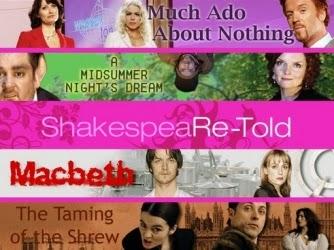
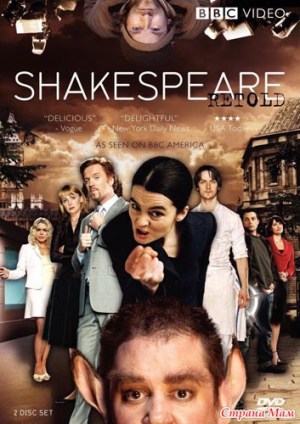
ShakespeaRE-Told is a series that aired on BBC One in November 2005. The title is an umbrella term that covers the four TV adaptations that are remakes of Shakespeare plays. Each play is adapted by a different writer and the setting is relocated to the present day. The plays adapted were Much Ado About Nothing, Macbeth, The Taming of the Shrew, and A Midsummer Night’s Dream. Most of the stories stay the same but some stories do combine characters, or change a few details but these are fairly inconsequential.

I was in my first year of uni when I heard about this series. We watched Macbeth in one of my classes and it was possible the greatest thing I had seen, certainly one of my all time favourite Shakespeare adaptations. Before that I had seen a few movies that mixed up the story and a few with location changed but this was something different, it seemed so close to the original story I knew but was a world away at the same time.

There is a star-studded line up of British actors who play iconic characters like Macbeth, Duncan, Hero, Claude, Oberon, and Titania. The retellings are so incredibly clever and you can still see the strong Shakespeare story even in this modern setting.

studio-universal-e-diva-universal-celebrano-i-L-o23kM4

Much Ado About Nothing

 Adapted by: David Nicholls
Directed: Brian Percival
Setting: In a local news studio
Cast: Sarah Parish, Damian Lewis, Billie Piper, Tom Ellis

Beatrice and Benedick are feuding anchors. Hero, weather girl and daughter of station manager Leonard, becomes engaged to Claude, the sports presenter. Jealous visual effects manager Don, plots to break up Hero and Claude, whilst the others attempt to get Beatrice and Benedick together.

IMDB

Macbeth

Adapted by: Peter Moffat
Directed: Mark Brozel
Setting: In a three Michelin star restaurant
Cast: Vincent Regan, James McAvoy, Keeley Hawes, Richard Armitage

Celebrity chef Duncan Docherty owns the restaurant with Joe Macbeth as the sous chef and his wife Ella as the Maître d’. Joe and his fellow chef Billy Banquo are annoyed that Duncan takes the credit for Joe’s work and that Duncan’s son Malcolm has, in their opinion, no real flair for the business. Then they encounter three supernatural bin men who predict that Macbeth will get ownership of the restaurant, as will Billy’s children. Joe and Ella are inspired to kill Duncan, but the bin men subsequently warn that Macbeth should be wary of headwaiter Peter Macduff.

IMDB

The Taming of The Shrew

Adapted by: Sally Wainwright
Directed: David Richards
Setting: In politics
Cast: Shirley Henderson, Rufus Sewell, Jaime Murray, David Mitchell

Katherine Minola is a politician who hopes to become the Leader of the Opposition. She’s told that her abrasive personality is bad PR and that it might be good for her image to get married. When penniless nobleman Petruchio shows up, interested at first in Katherine’s money, sparks fly as Katherine seems to have met her match. The relationship and battle of wills bring big surprises for both parties.

IMDB

 A Midsummer Night’s Dream

Adapted by: Peter Bowker
Directed: Ed Fraiman
Setting: At Dream Park inclusive leisure facility
Cast: Bill Paterson, Imelda Staunton, Zoe Tapper, Tom Ellis, Rupert Evans

Theo and Polly visit Dream Park inclusive leisure facility to celebrate the engagement of their daughter Hermia to James. The engagement party is, much to the irritable Theo’s horror, disrupted by Hermia’s true love Xander. Despite their own disagreements, the fairy rulers of the woods around Dream Park, Titania and Oberon, have a duty to ensure a happy ending, so Oberon gets Puck — portrayed as a sort of magical wide boy — to try to sort things out with “love juice” eyedrops, while Oberon and Theo discuss their marriages.

IMDB

16477058_96830-650x0

Links and Bits

ShakespeaRE-Told Website

Wikipedia 

Celebrating Shakespeare 400

Today marks the 400th anniversary of Shakespeare’s death and the world is coming together to honour and celebrate that man that brought us such wonderful plays like Hamlet, Romeo and Juliet and beautiful sonnets and phrases we still use today. While I’ve been posting all April about all things Shakespeare, this is the actual day that marks the momentous occasion, even the Google Doodle is getting involved. It’s been 400 years since Shakespeare died somewhat unexpectedly (no one is sure what he died from) and judging by the effort and the scale in which people are honouring the playwright it’s incredible that he is as important today as he was in his own day.

shakespeare400

The best place to see all the Shakespeare action is to follow the #Shakespeare400 tag on Twitter and Facebook. There is a myriad of posts from people offering up fun facts, trivia, quizzes and hosting other fun events. I know Bell Shakespeare here in Australia has a scavenger hunt going to find copies of Othello hidden around various cities and the bookstore Dymocks in Sydney have a whole afternoon of Shakespeare activities planned. Over in Britain the BBC have a range of live broadcasts planned as well when they tick over to the 23rd in a few hours. You don’t even need to do anything grand, go on Facebook and share your favourite quote, favourite movie, rewatch Romeo+Juliet, undoubtedly one of the greatest Shakespeare movies ever made. Even if you just want to share in the comments your favourite play/adaptation/quote, feel free!

I’ve included a selection of links below to get you into the Shakespearean mood and I will be posting on Facebook and Twitter (and Instagram if I can) a bunch of things to help keep the celebrations going strong. Or have a look at past Shakespeare posts from this month and see what fun things I’ve included and links I’ve suggested. It’s important to remember Shakespeare isn’t all stuffy boring plays; he’s so ingrained in history and our society there’s a myriad of ways to enjoy his work.

Shakespeare

Good Tickle Brains makes Shakespeare fun

A few wonderful things I will suggest to start off your Shakespeare experience are from Good Tickle Brain, an amazing website where the delightful Mya creates cartoons and funny Shakespeare-themed things. She has recently created a useful flowchart to help you decided which Shakespeare play you should go and see, as well as an awesome Shakespeare Game of Life.

Other things I suggest if you’re in the USA is high tail it over to New York and book a seat to see the hilarious Something Rotten play because while I’ve only heard the soundtrack (on repeat all day every day), I assure you it is amazing.

If reading is more your thing (and why wouldn’t it be) grab a copy of Jasper Fforde’s Thursday Next series for some great Shakespeare moments. The best one is Something Rotten which is filled with all sorts of great and hilarious things about Shakespeare and a very dramatic Hamlet. Or, if fun insults are more your thing, check out this chart of great Shakespearean insults.

As the day goes on and as other countries move into 23rd April there will no doubt be more exciting things revealed but for now take a look at what’s already around and who knows, you may discover something interesting!


Links and Bits

Shakespeare Quiz

Another Shakespeare Quiz

BBC Live broadcast celebrations

Good Tickle Brain

Shakespearean insults

Shakespeare inspired novels

Lessons from Shakespeare

That was Shakespeare?

The very stone one kicks with one’s boot will outlast Shakespeare
– Virginia Woolf

While in terms of human civilisation Woolf may be correct, but as the 400th anniversary of his death approaches it’s clear that Shakespeare is not going away anytime soon. The simplest search proves that Shakespeare is ingrained heavily in today’s culture, not only his original works, but in adaptations and reimaginings, and his influence is undeniably impressive.

There are grand, traditional movies by great directors that bring Shakespeare’s original words to the screen, and there are remakes that play with dialogue or characters but still tell the same story. These modern adaptations can be so clever that you don’t even realise they are Shakespeare adaptations, or they can bring together the new and the old into something fantastic and memorable.

Movies are not the only thing to get the Shakespeare treatment, literature is just as filled with people retelling the works of Shakespeare in new and creative ways. From graphic novels to feminist retellings there are some wonderfully creative retellings out there.

 There really are too many to go into depth about but I’ve linked them to the Wiki page, IMDB page, or other sources like an ultimate movie list from No Sweat Shakespeare. Since there are so many to pick from so I’ve only chosen a select few, some of the greats and some of the sneaky adaptations that may have slipped past you, and some that I myself only just discovered were Shakespeare in disguise.

Movies

Laurence Olivier in Henry V

Laurence Olivier in Henry V

Traditional

Henry V (1944) dir. Laurence Olivier IMDB

Hamlet (1948) dir. Laurence Olivier IMDB

Othello (1952) dir. Orson Welles IMDB

Julius Caesar (1953) dir. Joseph L. Mankiewicz IMDB

Taming of the Shrew (1967) dir. Franco Zeffirelli IMDB

Romeo and Juliet (1968) dir. Franco Zeffirelli IMDB

Macbeth (1971) dir. Roman Polanski IMDB

Henry V (1989) dir. Kenneth Branagh IMDB

Hamlet (1990) dir. Franco Zeffirelli IMDB

Much Ado About Nothing (1993) dir. Kenneth Branagh IMDB

Hamlet (1996) dir. Kenneth Branagh IMDB

Coriolanus (2011) dir. Ralph Fiennes IMDB

Much Ado About Nothing (2012) dir. Joss Whedon IMDB

Remixed

The Boys from Syrcacuse (1940) IMDB dir. A. Edward Sutherland (The Comedy of Errors)

Kiss Me Kate (1953) IMDB dir. George Sidney (Taming of the Shrew)

Forbidden Planet (1956) IMDB dir. Fred M. Wilcox (The Tempest)

Throne of Blood (1957) IMDB dir. Akira Kurosawa (Macbeth)

West Side Story (1961)  IMDB dir. Robert Wise and Jerome Robbins (Romeo and Juliet)

Chimes at Midnight (1965) IMDB dir. Orson Welles (Multiple plays)

My Own Private Idaho (1991) IMDB dir. Gus Van Sant (Henry IV and Henry V)

The Lion King (1994) IMDB dir. Roger Allers and Rob Minkoff (Hamlet)

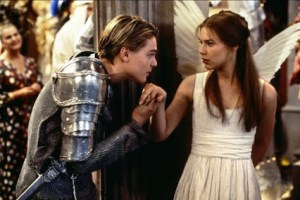
William Shakespeare’s Romeo + Juliet (1996) IMDB dir. Baz Luhrmann

10 Things I Hate About You (1999) IMDB dir. Gil Junger (Taming of the Shrew)

Hamlet (2000) IMDB dir. Michael Almereyda

Love’s Labour’s Lost (2000) IMDB dir. Kenneth Branagh

She’s the Man (2012) IMDB dir.  Andy Fickman (Twelfth Night)

Baz Luhrmann's Romeo+Juliet

Baz Luhrmann’s Romeo+Juliet

Books

The Gap of Time by Jeanette Winterson (The Winter’s Tale)

A Thousand Acres by Jane Smiley (King Lear)

Vinegar Girl by Anne Tyler (The Taming of the Shrew)

The Story of Edgar Sawtelle by David Wroblewski (Hamlet)

The Dead Father’s Club by Matt Haig (Hamlet)

A Wounded Name by Dot Hutchinson (Hamlet)

Exit Pursued by a Bear by E.K. Johnston  (The Winter’s Tale)

Fool by Christopher Moore (King Lear)

Dream of Perpetual Motion by Dexter Palmer (The Tempest)

Warm Bodies by Issac Marion (Romeo and Juliet)

Graphic Novels

Requiem of the Rose King by Aya Kanno (Richard III)

Kill Shakespeare by Conor McCreery, Anthony Del Col, and Andy Belanger (Multiple plays)

Prince of Cats by Ron Wimberly (Romeo and Juliet)


There are arguments for whether a traditional or remake is better to see first if you’re new to all things Shakespeare. I have found seeing an adaptation first can help you make sense of the story and get a handle on what’s happening, but on the other hand, if you see the traditional first you can pick up the clever references that have been included when you do see an adaptation. The other fun thing about adaptations is seeing one and not realising it was Shakespeare until later.

Hopefully this list has offered up some great suggestions to start or continue your Shakespeare experience and maybe even enlightened you about just how ingrained Shakespeare has become and how versatile he can be! If I’ve left off one that’s your absolute favourite, let me know in the comments.

Links and Bits

Book Riot | Shortlist

Flavorwire | Refinery29

The Ultimate Movie Adaptation List


Previous Older Entries Next Newer Entries