Who was Shakespeare?

“Shakespeare – The nearest thing in incarnation to the eye of God. “
– Laurence Olivier

The funny thing about Shakespeare is that as well known, famous, and everlasting he is, there is so much still unknown about him, scholars aren’t even 100% on his birth date. There are two primary sources about him where we draw our information from, his works and the legal documents that have survived.

What is known is that Shakespeare was born in 1564, most likely on 23 April. At the time, it was customary for babies to be baptised three days after they’re born, and church records show Shakespeare was baptised on 26 April. Born to John Shakespeare, a glover and leather merchant, and Mary Arden, daughter of an affluent farmer, William was one of eight children, with only five surviving to adulthood.

At school it is theorised he studied Greek mythology, Roman comedy, Latin, grammar, rhetoric, and ancient history which is no doubt where he got the inspiration and context for some of his plays. At age 18 he married Anne Hathaway, a woman eight years his senior in what was a shotgun wedding of sorts as Anne was three months pregnant at the time. Together they had three children, Susanna (1583), and twins Hamnet and Judith (1585). It is after their births that little is definitely known about Shakespeare, and what has been referred to by scholars as the “lost years”.

Shakespeare appears on records again in 1592 as a playwright and an actor. There is evidence of envy by fellow playwright Robert Greene who refers to Shakespeare as “…an upstart crow, beautified with our feathers, that with his Tiger’s heart wrapped in a player’s hide, supposes he is as well able to bombast out a blank verse as the best of you: and being an absolute Johannes fac totum [Jack of all trades], is in his own conceit the only Shake-scene in a country.”

1594 saw Shakespeare become a shareholder in the Lord Chamberlain’s Men, one of the most popular acting companies in London. A company which he remained a member of for the remainder of his career, and often playing before Queen Elizabeth I and her court. It was around 1595 that Shakespeare was wrote a lot of his plays, writing Richard IIRomeo and JulietA Midsummer Night’s Dream, and The Merchant of Venice. These plays were very successful and as a result in 1597 Shakespeare bought the second largest home in Stratford, despite continuing to live in London.

With the Lord Chamberlain’s Men he helped established the Globe theatre in 1599, and in 1608 when King James came to the throne Shakespeare and the group were issued a royal licence dubbing them the King’s Men. During James’ reign, Shakespeare wrote his most popular plays about court and power including King Lear, Macbeth, and Antony and Cleopatra. From 1609-11 his sonnets were published and his First Folio of plays was published in 1623 though he did not survive to see this.

Aged 52 when he died Shakespeare died on 23 April 1623, his alleged birthday. No source explains how or why he died, and he described himself as being in perfect health only a month beforehand. A vicar, some 50 years later, wrote that a fever contracted after a night of drinking may have been the cause, not impossible, but no further evidence exists.

Shakespeare was buried in the chancel of the Holy Trinity Church two days after his death. His epitaph includes a curse which warns against moving his bones, which even during the restoration in 2008, were carefully avoided. The epitaph reads:

Good friend, for Jesus’ sake forbeare
To dig the dust enclosed here.
Blessed be the man that spares these stones,
And cursed be he that moves my bones.
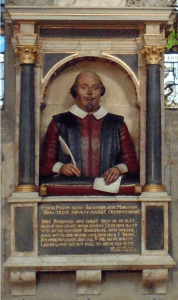
Shakespeare bust

Funeral monument at Holy Trinity Church, Stratford-upon-Avon

The memorial bust at the church in Stratford is considered one of the two authentic likenesses, approved by those who knew him. The second is an engraving by Martin Droeshout. This is probably the most famous likeness of the Bard, which was used on the title page of the First Folio publication in 1623.

Martin Droeshout’s Engraving


There is so much more about Shakespeare and his life, family, and work that I haven’t mentioned. I’ve added a bunch of links and sources of where my info comes from, as well as some additional details I didn’t have room to include. Now that you’ve been introduced to the Bard, for the remainder of the month I will bring you posts about his plays, his sonnets, and fill you with a myriad of fun facts plus so much more!

Links

Wikipedia

Shakespeare in a minute

Shakespeare’s Biography

The Life of William Shakespeare

Droeshout’s portrait

Shakespeare’s Funeral Monument

Shakespeare’s Life

Shakespeare Biography

William Shakespeare Biography

Shakespeare Infographic Timeline


April Brings A Month of Shakespeare

wpid-wp-1424525891884Like a lot of people who studied Shakespeare in high school I didn’t have the best appreciation for it. I remember being in primary school and being fascinated and saddened that he died on his birthday, but that was as far as my childhood Shakespeare experience went. My distaste in high school initially was because the texts we had to study weren’t that interesting and of course how it was taught to us wasn’t that engaging. In Year 9 we studied Romeo and Juliet as well as Richard III. I remember sitting in class while my teacher had a tape player on her desk of someone reading Richard III aloud and I promise you it was as boring as it sounds. We also watched a movie adaptation which wasn’t great either. Because of this I have not read Richard III since because of my first impression. I have though found it interesting discovering just how false a lot of it is and how inaccurate Shakespeare was and why, but still that isn’t enough to make me read it again.


Jump forward to Year 11 and 12 when we studied Macbeth, King Lear, and Othello. While not as engaging lesson wise, I found that I loved the play Othello; Iago was interesting and everyone seemed so overly dramatic about everything so it was entertaining. The BBC film we watched was emotional and intense and it was my favourite play for a while there.

I did quite a few Shakespeare classes at Uni, courses that looked at original plays, modern adaptations, and classic movies. I chose Shakespeare on Film as one and I loved seeing the different ways the texts had come to life on screen. Granted in that class I had to read Henry V, as boring if not worse than Richard III (and also avoided since), but I also fell in love with so many great stories like Hamlet and Macbeth and got to see so many played out in film. In another class I studied The Tempest and A Midsummer Night’s Dream which was firmly cemented as a new favourite with the beautiful story of Theseus and Hippolyta, not to mention Oberon, Titania, and Puck. A love reinforced by the stunning 1935 film we watched with Mickey Rooney, if you get a chance to see it I strongly recommend it.

In other courses I got to experience Macbeth in a new and fascinating manner and discovered there were so many ways to tell the story of the Bard. I’d grown up of course watching Romeo + Juliet, a classic modern retelling, as well as 10 Things I Hate About You, but the Macbeth adaptation was something entirely different. I plan to write a post later this month devoted entirely to adaptations so I won’t carry on about it too much yet.

Since leaving high school and uni I became more and more fascinated with Shakespeare, not just the movie adaptations, but also the man himself, his creativity, his lasting language and creation of new words. There is something grand about this playwright from the 16th century, and if you look at his work and understand its meaning, it really is not as pompous as people assume it is. A popular rumour which I’m still unsure whether it’s entirely true, though the evidence is convincing, is that the famous line from Twelfth Night, “Be not afraid of greatness. Some are born great, some achieve greatness, and others have greatness thrust upon them” is in fact a discussion about genitals. There are also so many instances of humour and jokes inside Shakespeare’s plays, they are not really quite as high brow as they first appear.

If that astounds you than I have a month long series of posts that look at just how versatile, creative, and hidden Shakespeare is. He is everywhere and influences so much. I have always tried to participate in Shakespeare Week each year and post a range of fun Shakespeare-related things in Twitter and Facebook, but being the 400th anniversary it’s time to go bigger. I want to share with you all the fun and quirky things about Shakespeare that make him much more exciting than the stuffy playwright people may perceive him to be. Over the coming weeks I will be posting about Shakespeare’s language, looking at and reviewing some of his famous and less popular plays, his beautiful sonnets, and taking a lighter look with songs, musicals, and infographs (the best kind of graphs), as well by sharing with you all the myriad of fascinating facts and figures about the Bard and his influence and affect over the centuries since his death. Bring on April, and bring on the start of celebrating the 400th anniversary of Shakespeare (even if it is, quite morbidly, his death).

Shakespeare Owl

Shakespeare Week 17th-23rd March


shakespeare week

17th to 23rd March 2014 will see the first Shakespeare Week taking place across the UK and a few places around the world in celebration of the 450th anniversary of the bard’s birth. Celebrations are held each year but being the 450th anniversary big things are happening. This is certainly a big deal in Britain, I haven’t so far seen anything for Australia but that isn’t to say there aren’t any celebrations, just perhaps not as grand. Toby’s gotten into the spirit here so that’s how we’re celebrating.

Shakespeare Owl

Despite the festivities, this is not the week Shakespeare was born though. William Shakespeare was born on 23rd April 1564 in Stratford-upon-Avon, and actually died in 1616 on this same date. This was one of my favourite facts as a child, that Shakespeare died on his birthday. I did think it was a bit spooky, but it was a nice circular way to go, out the same day you came in; though it would be slightly depressing to die on your birthday. There is actually no exact date recorded of his birthday, though based on christening records historians have worked out when he would have most likely been born, giving us the 23rd April. He is buried in Stratford-Upon-Avon and you are still able to see his grave at the Holy Trinity Church.

According to Stratford Vision’s website, the aim of Shakespeare Week is to “bring Shakespeare’s stories, language, historical backdrop and creative influence vividly to life for more than 3 million children in the UK and ensure that his cultural legacy is a central part of the primary school learning experience”. While there is a school and children focus for Shakespeare Week, there are other things for everyone, especially in Stratford-Upon-Avon. Being the centre of all things Shakespeare, Stratford-Upon-Avon have a multitude of festivities to enjoy including parades and other activities. This isn’t the first celebration either, there have been birthday celebrations for hundreds of years, dating all the way back to 1824 for the bard, though with the 450th anniversary it is possibly going to be bigger and better than ever.  I think it is wonderful that people are celebrating so much, even after 450 years there is still a place for Shakespeare in the world.

There are a lot of interesting facts about Shakespeare, he invented so many words and phrases we still use today in the English language, he was loved by Queen Elizabeth I (which influenced the script and events depicted in his play Richard III), and he spelt his name at least six different ways. That is another fun fact, in the Tudor era there was no formalised way of spelling so anything went really. This could have advantages, but you would know there would be a time when you spell something a bit too much on pronunciation alone there is going to be some long and strange looking words you have to decipher. Though really, I would have thought being his own name he may have found one way he liked and stuck with it. Makes you wonder whether we’d have “Shakespeare” looking differently if he did.

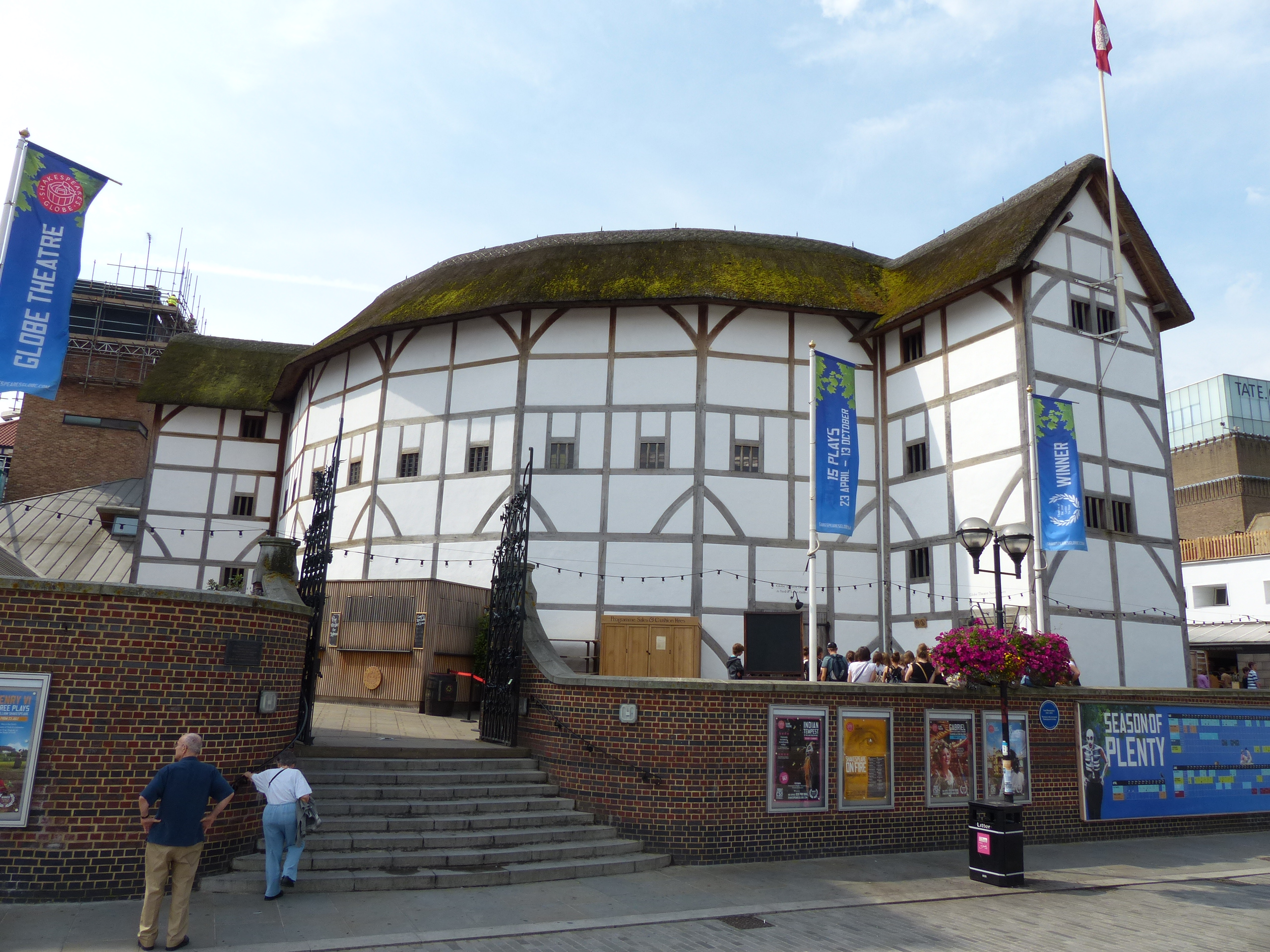
There are so many other wonderful things to learn about Shakespeare too, and you can’t ignore just how influential to language and to theatre he was. I really wish I could be in Stratford-Upon-Avon this week to see these events because I think it would be amazing. When I was in the UK last year I got to go there and it was pretty amazing. When I was in London I also went to the Globe Theatre and for those who haven’t been, let me tell you it was amazing! This was Globe No. 3 mind you. The first Globe was built but then because it was too expensive in that location, Shakespeare moved to the other side of the river. Then this rebuild actually got burned down during a performance. The new and current version was built by Sam Wanamaker, American actor and director, and it stands only a few hundred metres from its original location. Based on the original design and layout and historically accurate as possible, the new Globe is a wonder. There are tours given and a museum/display section, but the best part is that it still puts on plays. And with everything historically right you can experience what it was like to see a play as Shakespeare wanted. When I was there I sat in on a rehearsal for Henry VI and it was amazing, I only wish I had been able to see something performed there properly, but alas it wasn’t to be. 

P1130681

The Globe Theatre

I could talk about all things Shakespeare for days if given the chance but I shan’t. I will just insist that you check out some sites about his life, his works, and about the Globe itself. As for the celebrations, the few links I’ve given show you the grand fan fair in Stratford-Upon-Avon with some links to other places, I can’t say I know of anything happening in Australia, I haven’t seen anything from the Australian Shakespeare Company, but that isn’t stopping you from having your own celebrations. Also, there are bound to be events throughout the year to celebrate this 450th anniversary, so look out for them as well. I believe the Stratford Vision site mentioned that the Royal Shakespeare Company and the Shakespeare Birthplace Trust will run other events and exhibitions through 2014 to celebrate the legacy. Yet another reason I wish I was in Britain, they get all the fun.

For now I must enjoy from a distance. I’ve put some links below for all things Shakespeare Week, no doubt I have missed some but I found what I could to start you off. And if you want some fun Shakespeare things, I’ve added some QI clips as well as some skits and a song from the show Horrible Histories which are simply divine, plus I’ve added in Shakespeare’s Birthday Bonanza that I did last year for his birthday where I have a bit more information and  look  briefly at a few of my favourite plays. Who knows, with all this excitement and information at your disposal, you may learn something new and wonderful about the bard and have an ‘oohhh, didn’t know that’ moment, they’re always fun.

Have a wonderful Shakespeare Week wherever you are. If you’re in Britain I hope you enjoy it and get to go to some celebrations, if not, maybe grab a copy of a play or sonnet and appreciate some of the great works Shakespeare has contributed to the world in your own way.

Shakespeare Week

Shakespeare’s Birthday Celebrations

Stratford Division – Shakespeare’s 450th birthday

About Shakespeare

Shakespeare’s Globe

Happy Birthday Shakespeare

QI episode ‘The Immortal Bard’

QI clip – Words of Shakespeare that didn’t catch on

Horrible Histories – William Shakespeare song

Horrible Histories – Shakespeare insults

Horrible Histories – Shakespeare invented words

Horrible Histories – Shakespeare’s Globe

Next Newer Entries