Cover Reveal: Divinity by Michelle L. Johnson

Reveal
Today I get to reveal to you the gorgeous cover for Michelle L. Johnson’s new urban fantasy novel Divinity which was designed by Regina Wamba over at Mae I Design.

Divinity will out September 23rd thanks to Spence City.

Divinity_highJacket copy:

When Julia climbs into a flaming car to save a trapped child, she’s left wondering why either of them survived. Then she learns that her father is the Archangel Gabriel, and that she is half human, half Archangel.

With guidance from Michael, the most powerful Archangel, Julia sets out to discover her own history and explore her angelic powers. But her journey is cut short when an evil force, invisible to human and angel alike, tears her world apart.

Now Julia must fight through her despair, harness her newfound gifts, and risk her very soul to stop the A’nwel and protect the family she never knew she had.

What she doesn’t know is that Archangels have secrets too.


All Your Bits and Pieces
Twitter
Website


Cover Reveal: Harbour by Penelope Louleas

Reveal

I have got a wonderful cover reveal treat for you all. Penelope Louleas‘ debut contemporary romance novel Harbour, the first book in the Runaway Home series, is due out May 20th and I am here to give you a sneak peek with a few teasers and the wonderful cover.

Synopsis
Harbour Manning’s life wasn’t going to plan. 

After finding her boyfriend, Derek, between the thighs of another woman, she was forced to re evaluate her life. When an offer to uproot and move to New York is presented to her, she grabs it with both hands and runs with it. 

Lincoln Whitmore’s engagement to model Rachael started with fireworks, but soon the love they shared diminished. On his final night in the city before a much-needed escape, Lincoln meets a gorgeous and funny woman, a woman so refreshing he is torn between wanting to stay and wanting to run. 

A chance meeting has Harbour unable to forget the mystery man who captivated her instantly, and she once again finds herself thrust into his world. 

What would you do if you found the one? How long would it take you to realize you couldn’t live without them? And what happens when someone from your miserable past comes back with a reason for you to let go of your happy future? 

When all the odds seem against her, will she stay and fight or go running back home? 

Life doesn’t always go to plan, but that doesn’t mean you’re heading in the wrong direction.

Pageflex Persona [document: PRS0000040_00005]

fireworks teaser

love teaser


All Your Bits and Pieces
Penelope’s Facebook Page
Goodreads

Easter, Fun Facts, and Chocolate

Easter

Ah Easter. The day of bunnies, chocolate, and refined restraint on eating the entire day’s loot in one sitting. I know for some Easter is a religious weekend but for me it is about chocolate, four day weekends, and…well there isn’t much else. This is the best time of year because this is the only time that the rare and highly sought after Red Tulip chocolate emerges from its hibernation. The chocolate that only is seen around Easter, but when it comes out it will whip Cadbury’s butt any day. My affection for Red Tulip aside, I am not saying Cadbury is bad, but you can get that in many forms all year round, the Red Tulip experience is a once a year delight. Yes, perhaps its rarity makes it seem more delicious than it is…oh wait, my mistake, that’s completely wrong, it’s a godsend. And not those weird Ferrero Rocher ads where those weird nutty chocolate things fell from the gods, no, Red Tulip rabbits of various sizes with pink and blue waistcoats and bow ties should be falling from the sky not those.

Eggs have always been used for Easter because they represent rebirth and the beginning of life. Something which comes with a lot of images of hatched baby chickens and pastel colours as well. The earliest Easter eggs were not the chocolate kind though. They used to just be painted chicken or duck eggs that were dyed various colours with vegetable dye and charcoal. I recall painting a few blown eggs as a kid, though it was more a paintbrush and random squiggles around it with the odd dot or two. I may have only done it once or twice, I wasn’t overly  fussed about it, and what were you supposed to do with them when you’re done? Display them somewhere? I suppose giving them as gifts as was traditional but that didn’t happen.

Away from the painted eggs, the very first chocolate Easter egg was created by the Victorians in Bristol, England in 1873. It was made by a company called Fry, Vaughan & Co. and instead of being the delicious smooth chocolate we have today, it was bitter dark chocolate with a grainy texture. They also most likely would have been decorated by hand with marzipan and given as gifts by the rich. Much too fancy I think, though those Victorians were an extravagant bunch with their chocolate tastes.  

These were the only chocolate eggs until Cadbury tried to make their own Easter egg a couple years later. Cadbury had been making solid eggs since 1842 but were unable to make finer hollow eggs. Cadbury’s first Easter eggs in 1875 were made of dark chocolate with a plain smooth surface and were filled with sugared almonds, but compared with Fry’s it wasn’t as successful. It wasn’t until the launch of Cadbury’s Dairy Milk Chocolate in 1905 that their Easter egg sales improved, and improved tremendously. It was so popular it not only increased the sale of Easter eggs but it also made them a seasonal best seller, something that remains true today. Cadbury merged with Fry’s, Vaughan & Co. in 1919 but still couldn’t produce the quality eggs Fry’s was making. May I say, Cadbury also bought out Red Tulip, along with other companies, in the 80s when they were trying to conquer Australia. Very conquery Cadbury when it comes to other companies and chocolate, very conquery indeed.

So, now you know. While you are all eating delicious chocky eggs, bunnies, bilbys, chickens, or any other chocolate styled thing today you can think that it all started with one Bristol company that brought the Easter egg to the Victorians and subsequently the rest of the world.

Have a wonderful Easter, try not to get melted chocolate on your books, and have a great day!


Newcastle Writers Festival 2014: Saturday

nwflogoReading Ryan O’Neill’s post last night about his Newcastle Writers experience reminded me I haven’t done my own, then I realised it was no longer a couple of days ago it was an entire week! Where does the time go? So I have finally found some time to tell you all about my awesome time at the Newcastle Writers Festival.

After the enjoyable and amazing time at the opening night on Friday, I was up early and off to Newcastle City Hall for day one of the festival. My first session, ‘From Little Things: Writing for Children‘, was excellent. On the panel was Kaz Delaney (aka Kerri Lane), Wendy Harmer, and Jesse Blackadder with Linsay Knight moderating. The mood in the room was wonderful, there was laughter and joking, each of the panellists played off each other and watching them joke and interact was as enjoyable for them as it was the entire audience.

Stories on writing were discussed and Kaz Delaney told us that she felt she was born to write and told us about her vast collection of books for children. With 69 books under her belt Kaz was first published at 9 with what she called a blatant rip off of the poem “Daffodils” by William Wordsworth. She also mentioned that some people have passions –  animals, the planet etc and her passion is children. I thought that was wonderful. Being passionate about writing is one thing but when you couple that with being passionate about children as well I really think it would help your work.

Wendy discussed her creation and development of her Pearly series. Pearly is a fairy that lives on a fountain in a park and as a big fairy fan,  Wendy said the idea for Pearly came very easily. She also said she wanted to create a fairy that didn’t look like other fairies, those that seem to look like Paris Hilton with wings; she wanted a fairy with daring do.

What I loved about Wendy was the reason she chose to set her Pearly series in a park. She said that most children don’t have gardens, instead they go to the park, Wendy herself took her daughter to the park. Because of this they cannot enjoy the magic of having a fairy at the bottom of their garden so by having Pearly live in the park it showed children that even if they didn’t have a garden they could still enjoy the magic of fairies.

Jesse Blackadder, an author who I had not previously heard of, is someone who bases her stories of real things that happen, she takes them and brings the story to life. Listening to Jesse talk was enjoyable, she was funny and played on the vast success of her fellow panellists and joked about her far fewer books, and amongst the strong presence and humour of the others Jesse held her own quite well.

She told us about her new book Stay, a story about a fibreglass Guide dog statue that had been kidnapped from Hobart and taken to Antarctica. She discussed the true story it was based upon as well as the issues she had trying to make an inanimate object tell its own story. Jesse also told us when telling stories about real events in real places it was important to her to go to the places themselves, and so having been to Antarctica, Dubai and numerous other places she was able to bring the story to life.

The entire session was excellent and one filled with learning, insight and a lot of laughter. All the panellists gave us a reading from their book, and as much as I loved them all I must say Wendy’s was the most animated. Naturally by the end of the session I was eager to read all of their books which resulted in the buying and signing of books from each author.
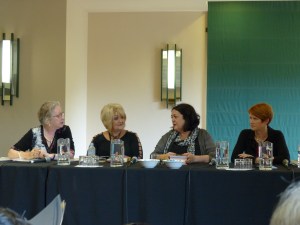
Linsey Knight, Kaz Delaney, Wendy Harmer, Jesse Blackadder

Linsey Knight, Kaz Delaney, Wendy Harmer, & Jesse Blackadder

The next session I attended was ‘Kate Forsyth in Conversation‘, a wonderful hour where Magdalena Ball discussed with Kate her creative journey as well as retelling fairy tales, and writing best selling works based on fables and fairy tales. So many wonderful lessons were learnt in this session, so many excellent quotes about writing, about fairytales and about creating I could hardly write fast enough to capture and remember it all.

Kate read to us from her novel Wild Girl, gave us insights in her research and her ideas, and even gave us a sneak peek into her new story that she was starting once the festival was over. For Kate immersing herself in the research was important, knowing about every detail about her characters was important, whether it was what they ate, believed, or how they peed. She also explained her four stages of writing, how she developed and planned her ideas, and the influences writing one novel can have on another.

Kate told us that if you have the compulsion to form life experiences into words than nothing should stop you, but she also said you cannot give someone the gift of writing, you may be able to teach it, but it is not the same. This was something I heard later in the weekend as well, and certainly something I hadn’t considered before.

Listening to Kate tell stories about how she started as a writer, how she writes and the work she puts into her books was inspiring, I have seen her a few times now over the years and every time she manages to amaze me more. Once again, more books were bought and signed.

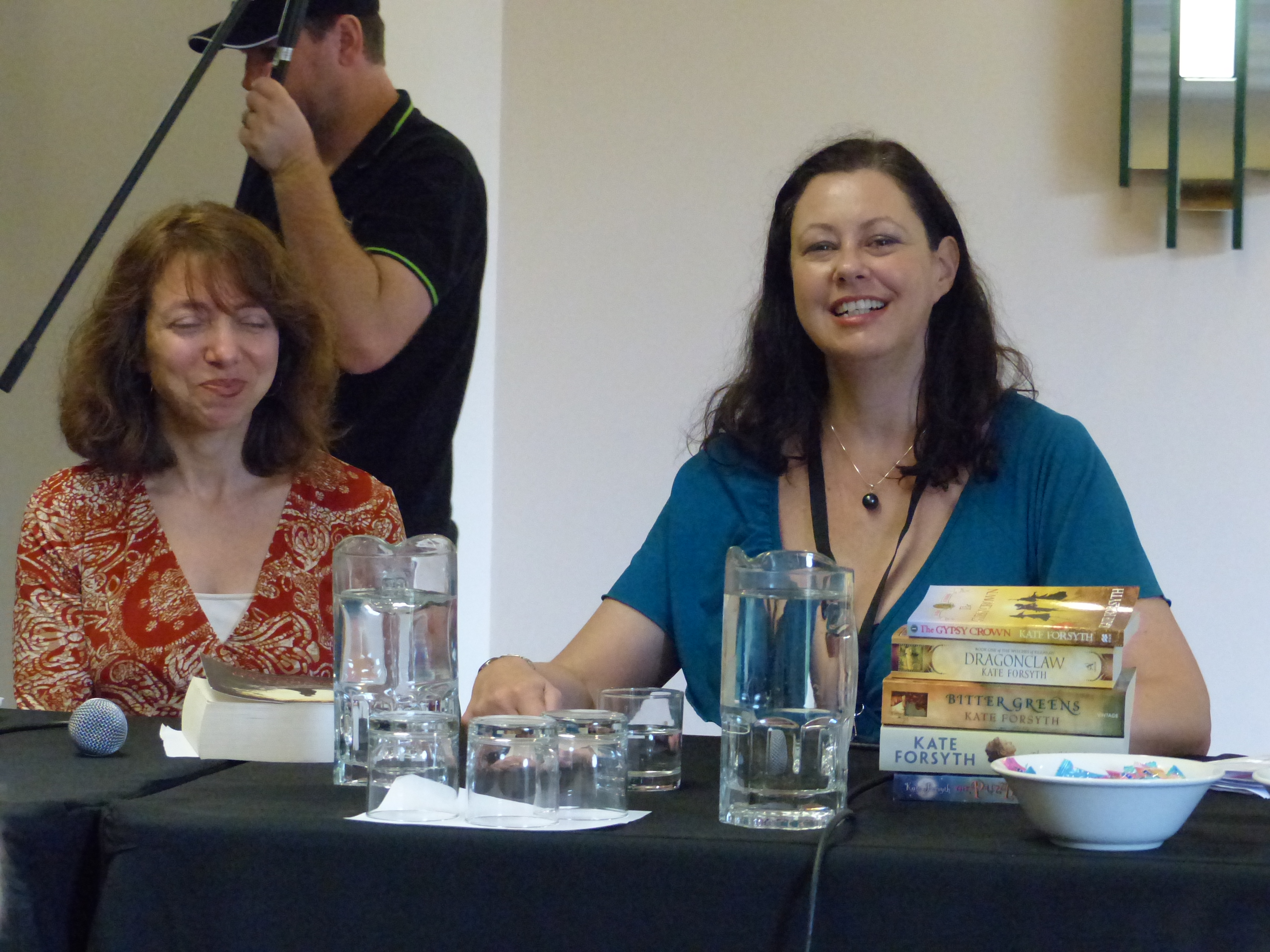
Magdalena Ball & Kate Forsyth

Magdalena Ball & Kate Forsyth

My last session was ‘Once Upon a Time: Exploring myths, fables, and fairy tales‘, again with Kate Forsyth but with John Hughes as well and Jenny Blackford moderating. Discussing the idea of reinventing fables and fairy tales into new inventive stories is something I adore doing and love reading about. John and Kate immediately addressed the incorrect notion that fables and fairytales are just for children, not to mention how and why these stories have lasted for millennia.

Kate said she believes that a story is retold if it is a story of longing and need and some kind of dilemma, and the stories that are retold and retold and shape shift really touch a core in the listeners. As she beautifully put it, she feels like a relay runner carrying on this beacon of stories, behind her is centuries of storytelling. I thought that was a wonderful way to describe it.

This was another session of excellent quotes about us as people, about our need for stories and love of them. From the cleaning up of darker tales in the Victorian era, and the Grimm’s changing the stories as well it was clear that these stories have been evolving for awhile. Naturally Disney poked its nose into this discussion about it taming down of fairytales further, but Kate wisely pointed out that Disney probably is the true source of the fairy tale revival, and that they did a wonderful service by keeping stories alive that may have been forgotten. John also pointed out that you cannot say these stories can only be used for high literature purposes and no other. It is really up to the person telling the stories how they want to do it. As Kate said, with each retelling of a tale the teller brings their own concerns to it. By the end of the session I has learned so much and gotten so many new ideas and motivation to write my own stories. After the session was over, yes, many books were bought and signed once more.
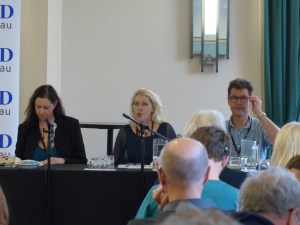
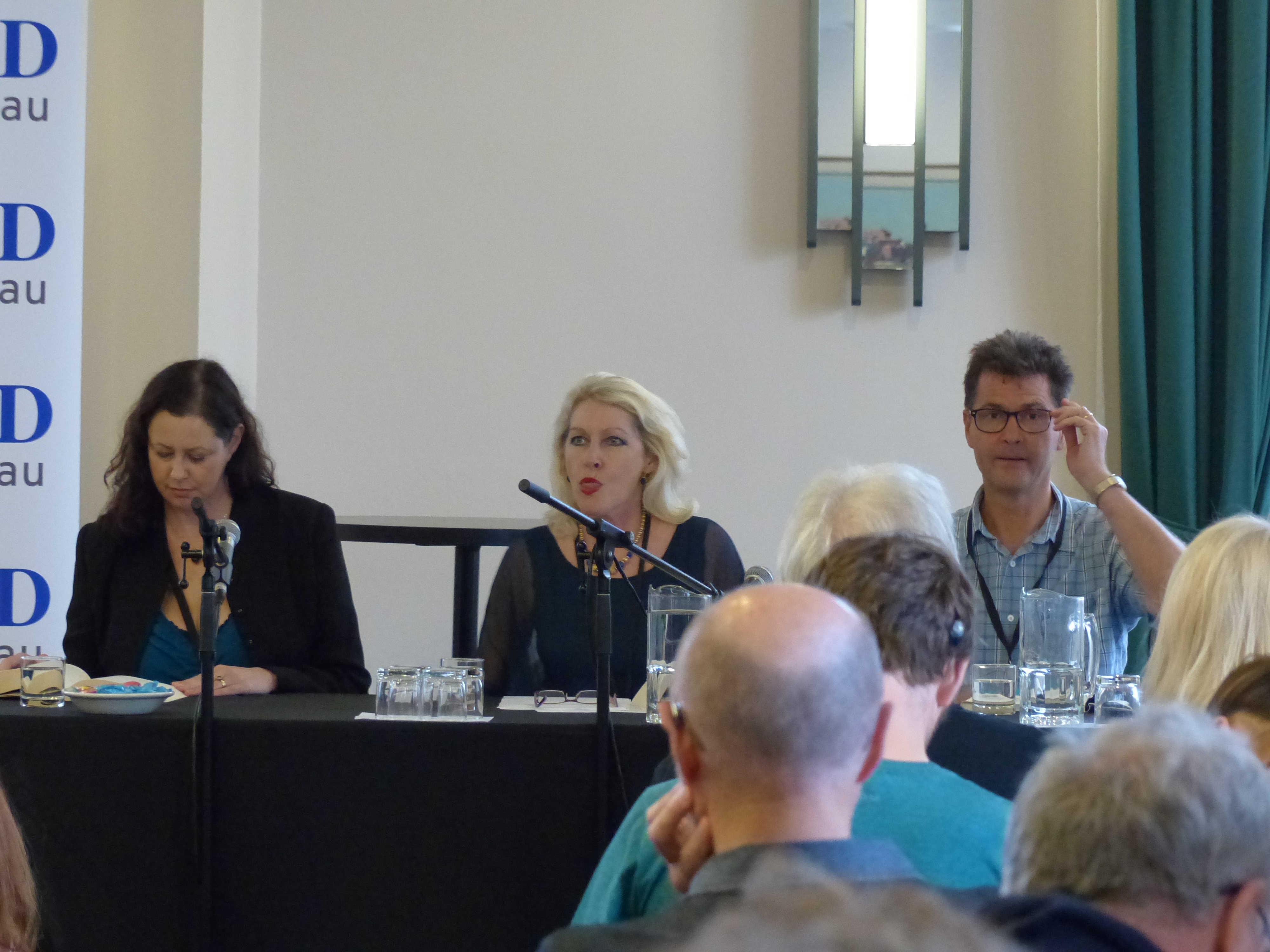
Kate Forsyth, Jenny Blackford, & John Hughes

Kate Forsyth, Jenny Blackford, & John Hughes

At the end of a very long first day I was on a buzz of knowledge and awe and just general happiness to be there. This is what I love, learning about how people write, where their inspiration comes from, but also the chance to broaden your own mind and gain new perspective and welcome new ideas and challenges. I truly adore this (and other) writing festivals. Not only do you learn so much but you also get exposed to great authors you may never have noticed or even considered before.


Runaway Joe by David Hight

Published: February 8th, 2014
Goodreads badgePublisher: Self Published
Format: Ebook
Genre: Literary Fiction
★   ★   ★  – 3 Stars

Note: I was asked for a review by the author

Runaway Joe is the story of a young drifter who has isolated himself from the rest of humanity, both physically and emotionally. Until in the summer of 1972, he meets an exceptional young woman, who introduces him to the magic and power of theatre, taking him on a journey through his own mind, and healing his spirit in the process. 
There’s a huge cast of characters that revolve around Joe’s story, and they’ll guide you through tales that run the gamut of human emotion and ethics.
 
Tragedy and sorrow, as well as triumph and joy are well represented. Grace and elegance, compassion and courtesy are there too. But it’s not all flowers and sunshine, there’s despair so deep, it’s crippling, there is maliciousness, manipulation, unconscionable villainy and horrifying insanity.


The story is about Joe, Vietnam Vet, now a wanderer who sells arrowheads and artifacts he finds in his travels. We’re introduced to Joe as he is heading to the east coast of America, hoping to arrive alongside a mystery letter he has mailed. Through the early chapters we grow to understand Joe through his reflections and flashbacks on his father and his childhood and we begin to understand who he is and why he is in the situation he’s in. These are very powerful chapters I felt, as they show the relationship and impact a parent can have on their child, as well as the lessons that stay with them years later.

Understanding who Joe is entirely is revealed in snippets as he chats to people who offer him a lift or through further reflections, flashbacks, and conversations sparked by events around him. The types of people and the conversations that happen with those who offer Joe a lift are certainly interesting; some people are very open in discussing their entire lives, while others are a key reason why no one should ever hitchhike. Ever.

Writing about the past is no doubt a hard task, trying to write about an era that has already happened with the knowledge and history of the years afterwards influencing how something is written. The social changes and opinions of the present day are established and by talking about the past the tendency to add a philosophical and prophetic tone to the narrative is tempting and it can also make it appear too reflective.

From early on there are many philosophical discussions and moments with characters, between Joe and his father, with Joe and strangers who offers him lifts, and eventually between Joe, Tom, and Laura, a father and daughter he gets to know after arriving in a small town. These discussions were an interesting aspect, for some characters it suited the context and worked well, while others seems out of place, either because of the character speaking or the context.

Whether it is the 70s setting, the United States location, or the literary fiction genre, I found the dialogue on occasion slightly tedious. I thought that sometimes the characters were saying more things than were necessary and occasionally it sounded out of character or unnatural as a realistic conversational tone.  Character conversations often sound like narrative rather than believable conversation, especially when it does not always uphold this tone throughout. In doing so it makes the characters seem more than what they are portrayed to be, and when it returns to normal conversation it reads as stilted, I never got comfortable with the conversation tone that was depicted, no matter how casual it was intended to sound. I will admit though that like the philosophical discussions, these in-depth and detailed long conversations worked with some people and scenes and not with others.

Joe is usually very reserved but speaks with experience from what he has seen, and on occasion with an acceptable ignorance, Tom on the other hand speaks in a way that I thought didn’t suit his nature, for a man who holds many jobs in a small town he was often preachy and spoke like someone who knew everything about the world. Though being Police Chief, Judge, as well as running a farm could be explained for Tom’s manner, seeing what he does and having age and experience on his side, but with an air of judgement in his subtle lectures to Joe it always felt slightly patronising.

This highly philosophical and in-depth style of conversation worked well for Tom’s daughter Laura though. I saw her as a girl who was very talkative and passionate, very much the philosophical 70s girl who was going to university to be a playwright and actor and was going to be a star. After awhile the intense dialogue and philosophy lessens and conversations become slightly more natural though remain occasionally stiff and stilted. I never felt entirely convinced that there was a casual nature in the conversations but this perhaps could just be a result of genre.

The plot covers a short space of time, slightly longer if you included the extensive flashback in the middle, and in this space of time the development and evolution of Joe’s character is evident. Under the guise of Laura producing her play for the town we see changes in Joe, influenced by the theatre and the lessons learnt through Tom’s guidance and see him on the verge of becoming the man we are greeted with in the opening pages. He is a seemingly calm person but there is a darkness about him that gets him into trouble and as we see him change there are no quick solutions but an eagerness to try and redemption is clearly visible.

With the understanding this is a literary fiction book, which of course comes with certain tropes and expectations, some of these were a bit too prominent I found. In terms of narrative there was a lot of description, not even necessarily about certain people and their clothes which is common, but more in terms of actions. Every action was mentioned, often in extreme detail, and what could be told in a sentence was dragged out, almost tediously sometimes.

One aspect I found interesting was Laura’s play within the story. I find it rather commendable when authors include other unrelated stories within their stories, the act of creating not one workable story but another entirely different one within it is no doubt a challenge. They are also interesting to assess for quality, is it based on how good the reader thinks it is, or as we supposed to be influenced by how it is received by other characters in the book? Either way, the use of the play was a great marker as it allowed a lot of events and character developments on all sides to stem from this one event.

Overall I enjoyed the story. I understand the intention Hight was going for and the nature of the message that was trying to be conveyed, and in some respects I feel these were achieved, but overshadowed perhaps by difficult dialogue expression, over description, and maybe too little plot expansion, and quick fixes and explanations in some cases.

Previous Older Entries Next Newer Entries