Jane Eyre by Charlotte Brontë

Birthday

Today we wish
Charlotte Brontë happy birthday, she would have been the ripe old age of 197 so we are honouring this with a look at Jane Eyre.
Brontë was born on April 21 1816 and there were six Brontë’s altogether, five daughters and a brother. Charlotte was one of the three Brontë sisters who tried their hand at writing, and set forth the future where I forever get names mixed up. When I was younger I could never remember if Jane Eyre or Charlotte Brontë was the name of the book (I blame Jane Austen for adding to this confusion, but I am in part thankful for the other Brontë sisters for making me remember there was multiple Brontë’s) But that was teenage me, adult me read this book and was able to see Brontë has encapsulated rather well the life and thoughts of Jane.

It is interesting to see who gets remember from the family and for why. I must say I always forget about dear Anne, who had works published like her sisters, yet she does not seem to be as remembered. The sad thing about the Brontë family is that out of the six children, three died within ten months of one another. This was after the two eldest girls Maria and Elizabeth did not make it to adulthood. After that tragedy brother Branwell and sisters Emily and Anne all passed away, they were only in their late 20s or early 30s at the time.

Charlotte had Jane Eyre published in 1847, two years before the death or her siblings. What I found interesting about Brontë when I first was introduced to her was that she wrote Jane Eyre under the pen name Currer Bell. You don’t get many people using pen names these days, though I can name exceptions. But there is also not as much need these days, certainly not for the simple fact that a woman was writing a book. This was not her only pen name she had others as well, as did her sisters. Charlotte did reveal hers later on though, apparently as rumours spread the sister’s works were written by the same person.

Published: February 4th 2003

Goodreads badgePublisher: Penguin
Pages: 507
Format: Book
Genre: Literature
★   ★   ★  – 3 Stars

Orphaned into the household of her Aunt Reed at Gateshead, subject to the cruel regime at Lowood charity school, Jane Eyre nonetheless emerges unbroken in spirit and integrity. 
She takes up the post of governess at Thornfield, falls in love with Mr. Rochester, and discovers the impediment to their lawful marriage in a story that transcends melodrama to portray a woman’s passionate search for a wider and richer life than Victorian society traditionally allowed.

The novel is written as a first person autobiography of a young girl through her years at school and to her older years working as a governess. Jane tells her story from her child years where she lived with her aunt and cousins and was abused, her education at Lowood school, her work as a teacher in the same school, and her move to become a governess at Thornfield Hall; all with the social commentary, emotional reactions, and themes of family, religion, forgiveness, and gender relations woven in-between.

I didn’t love this book and think it was amazing, but I enjoyed it and I can see how everyone says how powerful it is. People say being forced to read Jane Eyre is the worst way to be introduced to it, and really appreciate it. I didn’t study this in school, I studied it at University, so technically that was by choice. And I enjoyed all, well most, books I had to study so that can’t be why I don’t seem to adore it. Perhaps a reread will be needed to give it more appreciation, who knows.

Jane Eyre has also been classed as a romance novel and I do not see this at all. It is a realism novel and what little romance in this novel, is barely romance. What it is is a weird relationship between Jane and Rochester that has a strange affection and romance about it, but I still wouldn’t classify it as a romance novel. Besides, the ending seems like Brontë had to find a way to finish it with the conclusion she wanted, despite the peculiarness of it.

Jane writes, “Most true is it that ‘beauty is in the eye of the gazer.’ My master’s colourless, olive face, square, massive brow, broad and jetty eyebrows, deep eyes, strong features, firm, grim mouth, — all energy, decision, will, — were not beautiful, according to rule; but they were more than beautiful to me”. For Jane, Rochester had an effect on her in a different way, his features were full of interest, an interest that overcame her.

I won’t be too harsh, they do have a good relationship, it is honest and classy and proper. It is a relationship about who you are as a person rather than the idea of you or what you look like. There is a line in there that says “I am not an angel, and I will not be one till I die: I will be myself”, and that is what these characters are: they are themselves. That is why I find this a realism novel, it is a snippet of Jane’s life and who she meets and what she does, all the thoughts and feeling of a diary entry with Jane’s knowledge that people are reading it. She is writing her story for us, and that is more wonderfully grand than romantic in my mind.

Anyone who has read The Eyre Affair by Jasper Fforde and the early sequels can see an excellent discussion about the ending of Jane Eyre, along with the fact Fforde can confuse the life out of you and what you thought you knew about Jane Eyre. He makes you doubt your own memories of the book, that is part of its brilliance, but he also addresses an excellent explanation for the end of this book, filling in the gaps of the mystery and, magically I suppose, part of the ending, which to me felt like a deus ex machina without the presence of a deity. But I do understand how it was supposed to be powerful and “romantic” but it just was weird.

What I found remarkable when I first read this book was that Brontë/Jane addresses the reader in her work. Jane is writing her story and she is writing it as if people are reading it (are they not?) but I remember thinking how at the time of publication that it must have been different, or perhaps reading at that time was different and that acknowledging your reader was normal, however I have found it in few others to see this possible. To give it credit, there are some amazing quotes that can be taken from this novel, the one that I always remember is the first line of the last chapter, won’t tell, big spoiler, however there are others, a favourite was always “I would always rather be happy than dignified”.

As a character and love interest Rochester isn’t the most handsome of people, this is brought up through the novel, about his looks. This I think holds a lot because of how Jane and Rochester’s relationship develops from her arrival to Thornfield. She sees him as a person, she is never smitten on his looks, and she is there for her job. I particularly liked Jane’s first meeting of Rochester, the way they meet gives nothing about their positions held, their duty to one another, or at least her to him. Jane never said he is unattractive however she says say of their first encounter “I felt no fear of him, and but little shyness.  Had he been a handsome, heroic-looking young gentleman, I should not have dared to stand thus questioning him against his will, and offering my services unasked”. He even asks her later if he is hideous and she tells him “Very, sir: you always were, you know”. This simple act of Brontë’s shows the kind of person Jane is very well, she is strong, honest,  and independent of course, but she is also not afraid to speak what she thinks, and yet not in an obnoxious and forward manner either.

Jane narration is very descriptive; she has an excellent turn of phrase about her environment and the people she meets. This helps you create a rounded image of where Jane is at all the stages described in her life, as well as the people she interacts with. And of course must remember she narrates her whole life, the stories of her life with her aunt, and at school are a little bit confronting and painful, also a bit emotionally and confronting, but they are her memories, it was her life and that makes it easier to read, she is telling her story, and being a first person narration lets Brontë get away with giving her character a hard life. I didn’t intend on making this just about Jane and Rochester, there are so many more characters and stories she tells, but in the end I suppose it does come down to the pair of them. But I want you to know there are other characters and stories in jane’s life that make her who she is and influence her life. I may need another review one day to cover them, but for now we fell into the Jane/Rochester trap.

So it is on this day we say happy birthday Charlotte Brontë once more, thank you for Jane Eyre, it is a great book, people have loved it, I’m sure there are those out there who did not, but there is no mistaking it is a classic. We are here for the review but also for Charlotte, for the tough life she had losing all her siblings but she powered on, she kept writing and she has instilled herself in our minds, with characters that hold power and influence in the messages she was promoting, however intentional they were.
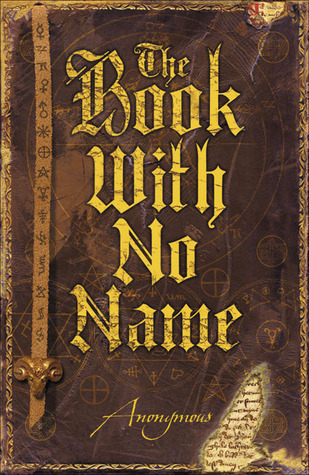
The Book With No Name (#1) by Anonymous

Published: May 28th 2008
Goodreads badgePublisher: Michael O’Mara Books
Pages: 379
Format: Book
Genre: Fantasy/Paranormal
★   ★   ★  – 3 Stars

Detective Miles Jensen is called to the lawless town of Santa Mondega to investigate a spate of murders. This would all be quite ordinary in those rough streets, except that Jensen is the Chief Detective of Supernatural Investigations. The breakneck plot centers around a mysterious blue stone — The Eye of the Moon—and the men and women who all want to get their hands on it: a mass murderer with a drinking problem, a hit man who thinks he’s Elvis, and a pair of monks among them. Add in the local crime baron, an amnesiac woman who’s just emerged from a five-year coma, a gypsy fortune teller, and a hapless hotel porter, and the plot thickens fast. Most importantly, how do all these people come to be linked to the strange book with no name? This is the anonymous, ancient book that no one seems to have survived reading. Everyone who has ever read it has been murdered. What can this mean?

The Book With No Name, by Anonymous. The title alone made me pick this book up from a book sale and while it wasn’t the greatest book I have read, it was creative, interesting, and definitely unique.

This is the first book in a series called The Bourbon Kid, and I have to say, while I wouldn’t rush out to get the sequels, if I came across them I would read them. Maybe if I leave it long enough my curiosity will peak and I will track down a sequel and see what happens next, but for now I am enjoying that it was a rather good story.
As soon as the story begins we are introduced to the mystery that is the Bourbon Kid, this prologue starts the novel off as the mystery and foreboding doom this man brings haunts a town. Meanwhile, Detective Miles Jensen has arrived in town to investigate a spate of unusual murders, two monks have left their monastery, a mysterious blue stone begins to cause havoc for all those who wish to possess it, there is also a hitman in town who thinks he is Elvis, an amnesiac woman who has woken from a coma, the boyfriend, and the local crime boss. What could possibly go wrong?

There are a lot of people involved in this narrative, and the author switches character perspectives quite a bit so we get to see the story from everyone’s perspective. I’d say seamlessly but I say with caution. Certainly there are no jarring moments, but you can find yourself reading a new paragraph and become confused, only to realise that you’re following a new character with different thoughts.

These switches occur a lot, and truly not always in a confusing manner, but you do have to pay attention and you will get used to it after awhile. I did find, which was quite clever, that because there were so many characters and storylines to follow, by breaking it up for each character and moment you get these kinds of mini scenes, almost like a collection of short stories which are connected to one another in terms of the bigger picture and have been woven together.

In terms of narrative it was drawn out considerably. Not a lot actually happens for the first 3/4 or so of the book, however you did have a sense that it was all necessary by the time you’ve finished. As you read you kept thinking that the next chapter would be where it all erupted and everything fell into place. This does happen in the end but it is a lot to remember and keep track of while you’re getting there. A lot of it was also character introductions, having so many people involved it does start to fill up pages. And while we never get any real back story or history on a lot of the characters, you are provided with a clear representation of their personality and character that eliminates a need for a history to understand them.

Surprisingly with so many characters in play you do not get lost which I thought was amazing, but you do have more people to become potential suspects in whatever is going on which does your head in if you try and figure it out on your own. Of course everyone basically in this novel is suspicious, as well as guilty of many a thing, but whether they are guilty of what you think they are is where the mystery lies.

I will give credit to the author, I liked the reveal when it came, and I liked that after such a long wait the ending was ideal. I didn’t think that anything had been wrapped up quickly, all the pieces suddenly fell into place and started to make perfect sense, just when you didn’t think there could possibly be a reason and connection for everything. That part was rather impressive.

There is violence in this book, but while describing scenes of death and brutality I didn’t find myself revolted or turned off. I put this down to clever writing and the ability to tell a gruesome scene without having to go in explicit detail which can push it into the grotesque and unreadable. But yes, be warned there is a large amount of violence in the book, and swearing, but swearing goes with the setting of the novel, whereas the violence goes with the narrative.

One way around the amount of violence is the supernatural element, not an overbearing amount, but it is there and, like everything and everyone, it is connected as well. It was worrying in the beginning when the possibility was first brought up because I was unsure how it would fit within the established narrative, but as more information was revealed it turned out alright, and you begin to accept that this is just how it is, and you do not spend a lot of time focused on these supernatural elements. This could be because there are so many extreme moments and aspects of unrealism that the extra dose does not really make that much difference.

Two of my favourite quotes, both obscure and seem rather bizarre, but like the book there are plenty of sentences and aspects of dialogue that feel awkward but not enough to be a real concern.

He had been shot in the stomach at point blank range by a man toting a double barrel shotgun. It had hurt terribly, and the wound was still bleeding a little, but it would heal. His wounds always healed, although he had come to accept the fact that gunshots did tend to leave a mark.”

Audrey had no tolerance for mess, but today there was blood everywhere.”

It is these kinds of sentences that make this book charming amongst its faults, quirky lines that seem obvious and almost unworthy of comment, yet it is provided anyway. Some of the phrasing seems a bit awkward but over the course of the book you do not really notice it after awhile, the story gets you in, despite the ambiguity and prolonged revelations.

Finally, we must briefly mention the title and author. I loved that it was mysterious and when I finished the book I loved it even more. I will say no more about it.

Welcome to Santa Mondega, enjoy the ride.

The Austere Academy (#5) by Lemony Snicket

Published: August 8th 2000
Goodreads badgePublisher: HarperCollins
Pages: 221
Format: Book
Genre: Junior Fiction
★   ★   ★  – 3 Stars

Dear Reader,

If you are looking for a story about cheerful youngsters spending a jolly time at boarding school, look elsewhere. Violet, Klaus, and Sunny Baudelaire are intelligent and resourceful children, and you might expect that they would do very well at school. Don’t. For the Baudelaires, school turns out to be another miserable episode in their unlucky lives. Truth be told, within the chapters that make up this dreadful story, the children will face snapping crabs, strict punishments, dripping fungus, comprehensive exams, violin recitals, S.O.R.E., and the metric system. It is my solemn duty to stay up all night researching and writing the history of these three hapless youngsters, but you may be more comfortable getting a good night’s sleep. In that case, you should probably choose some other book.

With all due respect,
Lemony Snicket

The Austere Academy is book number five in the Unfortunate series. After the Baudelaire children leave the mill they are shipped off to a boarding school by the horridly annoying sneezer, banker, and default guardian Mr Poe. School has been rather absent in all these adventures but we return now to the very dull and cruel school where just being an orphan is punishable pretty much. The change of scenario is
great after being stuck in this loop Snicket has had us in of repetitiveness and obscurities and abuse. The leap is not as far as you would like but you do get a lot more new story before it reverts back to the same old stuff. Again Snicket ruins the ending fairly early on but by now you are just in it for the story, not for the suspense or mystery. Having said that book five is where he decides to add some proper mystery.

There are good parts to this story, the siblings finally get some friends their age who try and help them solve all their problems. The Quagmire triplets (of which there are only two it seems) use their own skills to help with these problems that arise. By introducing new characters Snicket finally manages to progress in this saga as some questions begin to be answered. Well, no. More questions are asked and revealed and only snippets of information and clues are revealed which is the beginning of the mystery.

With Snicket changing things up a bit it certainly takes these books in a new direction. There is the first sign of a real cliffhanger, not dire, but certainly one that makes you want to read the next in the series. Where before we just hopped from place to place with Olaf and his idiotic schemes, there is a hint of a greater mystery unfolding. With so many books to go whether this is solved in the next one or dragged out we don’t know.

Oh, and for once we can give some kudos to some sensible, albeit dull, adults and Mr Poe tries his best to come through for the children. In a rare moment for him he actually tries. Maybe this is a turning point for the banker.

The Miserable Mill (#4) by Lemony Snicket

Published: April 5th 2000
Goodreads badgePublisher: HarperCollins
Pages: 194
Format: Book
Genre: Junior Fiction
★   ★   ★  – 3 Stars

Dear Reader,

I hope, for your sake, that you have not chosen to read this book because you are in the mood for a pleasant experience. If this is the case, I advise you to put this book down instantaneously, because of all the books describing the unhappy lives of the Baudelaire orphans, THE MISERABLE MILL might be the unhappiest yet. Violet, Klaus and Sunny Baudelaire are sent to Paltryville to work in a lumbermill, and they find disaster and misfortune lurking behind every log. The pages of this book, I’m sorry to inform you, contain such unpleasantries as a giant pincher machine, a bad casserole, a man with a cloud of smoke where his head should be, a hypnotist, a terrible accident resulting in injury, and coupons.  I have promised to write down the entire history of these three poor children, but you haven’t, so if you prefer stories that are more heartwarming, please feel free to make another selection.

With all due respect, 
Lemony Snicket

Predictable was going to be my first criticism. I was starting to dread the rest because I am trying to enjoy these but they don’t change. The story is interesting enough but every one of these books so far all follow the
same plot and when you know what is going to happen, as Snicket keeps telling us, you don’t really find a need to read the rest after that. If you just read 1 and 13 you probably can get the gist. But we won’t, we started now we must finish and I think four was not that bad compared to the rest, nor as dull as I was expecting.

There are a few differences which was refreshing, the circumstances are different, there are different characters. Ignoring the unchanging and annoying narrating style and looking at the content, book four starts off rather dull and you do as the children do and try and play a game of ‘spot count Olaf’. Though when it isn’t who you expect it gets a little better for awhile as you wait for him to appear. The children aren’t as stupid this time round, they are finally catching on to the trickery and deceit which is a change. The story really picked up about halfway through and I think being in such a peculiar settings adds something to the overall story and reception. I do have to say though that it is rather hard accepting what these kids do, especially around the obvious toddler who only had four teeth. It is a weird reality where whether two or ten you are all treated the same. As I say, ignore all this and focus on the fact that it is a different story and it is pretty good. You have to give Snicket credit for being creative even if he is repetitive and outlandish, which when used in this context means strange and peculiar.

We finally see the children actually react reasonably and realistically to what they are subjected to which was also a nice change, even if only temporary. As a series there is definitely a slow but strong single narrative developing underneath these scenarios; Count Olaf tries to get the Baudelaire fortune and the three siblings are put in strange situations that only get weirder, more unrealistic, and irrational as each book continues through this narrative. There is violence and abuse in this book, like the previous ones, but in the Snicket manner they are brushed aside and not focused on in great detail for them to be gruesome or traumatic (though they seriously should have been). Ignoring the unrealistic nature, and accepting that this is how the world works, it was a nice little adventure to progress the story. Snicket is consistent if nothing else and being a series of unfortunate events there are no bones about it, which is a phrase meaning to say clearly what you think or feel about something, (see how that could be annoying through an entire book? Every book!), he does it very well.

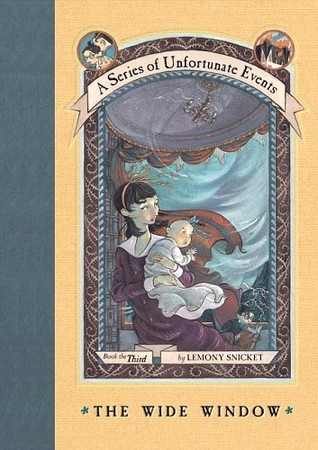
The Wide Window (#3) by Lemony Snicket

Published: February 25th 2000
Goodreads badgePublisher: HarperCollins
Pages: 214
Format: Book
Genre: Junior Fiction
★   ★   ★  – 3 Stars

Dear Reader,

If you have not read anything about the Baudelaire orphans, then before you read even one more sentence, you should know this: Violet, Klaus, and Sunny are kindhearted and quick-witted, but their lives, I am sorry to say, are filled with bad luck and misery. All of the stories about these three children are unhappy and wretched, and this one may be the worst of them all.If you haven’t got the stomach for a story that includes a hurricane, a signalling device, hungry leeches, cold cucumber soup, a horrible villain, and a doll named Pretty Penny, then this book will probably fill you with despair.I will continue to record these tragic tales, for that is what I do. You, however, should decide for yourself whether you can possibly endure this miserable story.

With all due respect,
Lemony Snicket

Book three of Unfortunate Events begins much the same way as we are introduced to guardian number three, Aunt Josephine. She is a dull sort of woman, scared of everything and has an unstable living arrangement. This book was a bit more interesting than because there was a longer focus on the time with Josephine than previous guardians. It is more action packed I guess, there is almost a sense of ‘will she survive? Won’t she survive?’ except that Snicket tells us she won’t, again quite often. but it does have its moments of suspense and what will happen. So in that sense it was a good book for that, as a character Josephine is annoying but what can you do. There is a great plus side, there is a reference to the movie Flying High in there which made me laugh. I’m sure it must be intentional, if not it is a pretty big coincidence.

New plan. Instead of this annoying and insipid trend of Grammar Nazi’s roaming the internet we start calling them Aunt Josephine. If you’ve ever come across a person who corrects everything you say because to them you are saying it grammatically wrong then you know Aunt Josephine. And as annoying it is to hear, it is tiring to read, but not so bad if you put it down to an eccentric character trait among her many others.

What I have discovered about A Series of Unfortunate Events, is that they are all rather similar. The children get a new home and guardian, Olaf comes in at some point disguised, the children recognise him, the adults don’t believe them, guardian vanishes, Olaf is exposed, the surviving adults apologise for not believing the kids and the whole things starts again. What I am discovering about these books as an adult reading these books fit for twelve year olds, is that there is nothing to figure out. You are told straight away that unfortunate things will happen to these kids, and Snicket is not shy about using violence and threats and describing them in a blunt and matter of fact manner which acts to almost subdue the serious violence and issues they actually are. And this I am assuming will go on for the remaining ten books in an ongoing cycle.

What I think all we are supposed to take from this is just how unfortunate these kids are and we just have to go for the ride with them as more unfortunate events happen to them and to those around them. There is no mystery, no ulterior meaning. Snicket just says ‘They won’t live happily ever after, they will be threatened and have horrible things happen to those around them, they’ll be fine and not be affected so let’s pop on over to the next person and see what misfortune befalls them’. It’s sort of like a sadistic humorous story that brings out kids fascination with death and violence and evil people in a nice funny and calming and charming way. Oh Mr Snicket you are sneaky.

What is also good is that there is a love of books in this series. The three children are always looking through books and they always find a large library collection wherever they go. I did learn something about Alexander the Great and Gordium knots so that was nice. I’m beginning to think, even though these kids only seem to stay at their new homes for a matter of days or weeks at best that by the end Violet will be of age and at the end of book thirteen she’ll just buy a house for her siblings. Let’s see how we go with that prediction.

Previous Older Entries Next Newer Entries