“Shakespeare – The nearest thing in incarnation to the eye of God. “
– Laurence Olivier
 The funny thing about Shakespeare is that as well known, famous, and everlasting he is, there is so much still unknown about him, scholars aren’t even 100% on his birth date. There are two primary sources about him where we draw our information from, his works and the legal documents that have survived.
What is known is that Shakespeare was born in 1564, most likely on 23 April. At the time, it was customary for babies to be baptised three days after they’re born, and church records show Shakespeare was baptised on 26 April. Born to John Shakespeare, a glover and leather merchant, and Mary Arden, daughter of an affluent farmer, William was one of eight children, with only five surviving to adulthood.
At school it is theorised he studied Greek mythology, Roman comedy, Latin, grammar, rhetoric, and ancient history which is no doubt where he got the inspiration and context for some of his plays. At age 18 he married Anne Hathaway, a woman eight years his senior in what was a shotgun wedding of sorts as Anne was three months pregnant at the time. Together they had three children, Susanna (1583), and twins Hamnet and Judith (1585). It is after their births that little is definitely known about Shakespeare, and what has been referred to by scholars as the “lost years”.
Shakespeare appears on records again in 1592 as a playwright and an actor. There is evidence of envy by fellow playwright Robert Greene who refers to Shakespeare as “…an upstart crow, beautified with our feathers, that with his Tiger’s heart wrapped in a player’s hide, supposes he is as well able to bombast out a blank verse as the best of you: and being an absolute Johannes fac totum [Jack of all trades], is in his own conceit the only Shake-scene in a country.”
1594 saw Shakespeare become a shareholder in the Lord Chamberlain’s Men, one of the most popular acting companies in London. A company which he remained a member of for the remainder of his career, and often playing before Queen Elizabeth I and her court. It was around 1595 that Shakespeare was wrote a lot of his plays, writing Richard II, Romeo and Juliet, A Midsummer Night’s Dream, and The Merchant of Venice. These plays were very successful and as a result in 1597 Shakespeare bought the second largest home in Stratford, despite continuing to live in London.
With the Lord Chamberlain’s Men he helped established the Globe theatre in 1599, and in 1608 when King James came to the throne Shakespeare and the group were issued a royal licence dubbing them the King’s Men. During James’ reign, Shakespeare wrote his most popular plays about court and power including King Lear, Macbeth, and Antony and Cleopatra. From 1609-11 his sonnets were published and his First Folio of plays was published in 1623 though he did not survive to see this.
Aged 52 when he died Shakespeare died on 23 April 1623, his alleged birthday. No source explains how or why he died, and he described himself as being in perfect health only a month beforehand. A vicar, some 50 years later, wrote that a fever contracted after a night of drinking may have been the cause, not impossible, but no further evidence exists.
Shakespeare was buried in the chancel of the Holy Trinity Church two days after his death. His epitaph includes a curse which warns against moving his bones, which even during the restoration in 2008, were carefully avoided. The epitaph reads:
Good friend, for Jesus’ sake forbeare
To dig the dust enclosed here.
Blessed be the man that spares these stones,
And cursed be he that moves my bones.
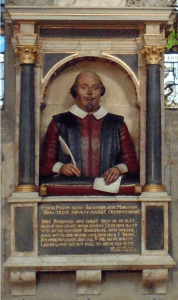
Funeral monument at Holy Trinity Church, Stratford-upon-Avon
The memorial bust at the church in Stratford is considered one of the two authentic likenesses, approved by those who knew him. The second is an engraving by Martin Droeshout. This is probably the most famous likeness of the Bard, which was used on the title page of the First Folio publication in 1623.

Martin Droeshout’s Engraving
There is so much more about Shakespeare and his life, family, and work that I haven’t mentioned. I’ve added a bunch of links and sources of where my info comes from, as well as some additional details I didn’t have room to include. Now that you’ve been introduced to the Bard, for the remainder of the month I will bring you posts about his plays, his sonnets, and fill you with a myriad of fun facts plus so much more!
Links
The Life of William Shakespeare
Shakespeare’s Funeral Monument
Shakespeare Infographic Timeline

 Peter chose self publishing because he wanted his book on sale now, not years down the track which was a possibility. He does a lot of promotion himself and with three books under his belt he is pleased with his success so far. Self publishing is a misnomer in Peter’s mind, because you don’t do it all by yourself, you need to contact someone for help whether it is the beta readers, distributers, or self publishers who will help with print on demand and other production components. Peter also warned that not all you’re offered is what you’ll need, or worth what you’re charged. His advice is when in doubt ask questions and if you can’t do something, find someone who can.
 This was not the first event, but it was the first big event. Flannery spoke about where his passion for science and discovery came from, from the first fossil he found as an 8 year old to discovering species in New Guinea. He told stories about seeing effects of climate change first hand and told us what needs to be done to save not only Australia but the world with coal being our biggest problem right now. What was interesting is that Flannery used his English degree to tell the stories of science. Scientists, Flannery said, never appreciate how to write, writing novels helps you tell stories, converting to complex science into an understandable language.
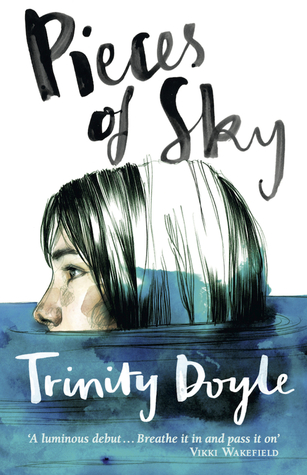 Lucy’s life was going as smoothly as any teenager’s could. She was in the local swimming club, and loved it; she lived with her parents and her brother, Cam, in the small coastal town she’d known all her life. She had friends, she had goals – she had a life. Now Cam is dead, her parents might as well be – and Lucy can’t bear to get back in the pool. All she has to look forward to now is a big pile of going-nowhere.
 Like a lot of people who studied Shakespeare in high school I didn’t have the best appreciation for it. I remember being in primary school and being fascinated and saddened that he died on his birthday, but that was as far as my childhood Shakespeare experience went. My distaste in high school initially was because the texts we had to study weren’t that interesting and of course how it was taught to us wasn’t that engaging. In Year 9 we studied Romeo and Juliet as well as Richard III. I remember sitting in class while my teacher had a tape player on her desk of someone reading Richard III aloud and I promise you it was as boring as it sounds. We also watched a movie adaptation which wasn’t great either. Because of this I have not read Richard III since because of my first impression. I have though found it interesting discovering just how false a lot of it is and how inaccurate Shakespeare was and why, but still that isn’t enough to make me read it again.

 Taylor and Sierra have been best friends for their whole lives. But Taylor’s fed up. Why does Sierra always get what – and who – she wants? From kissing Taylor’s crush to stealing the guy they both met online for herself, Sierra doesn’t seem to notice when she hurts her friends.