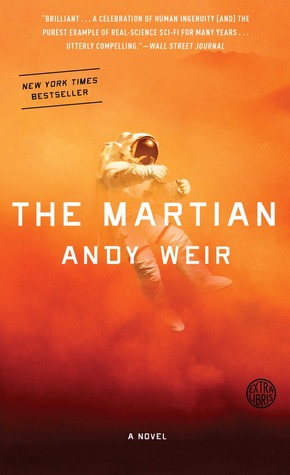
The Martian by Andy Weir

Published: 28 October 2014Goodreads badge
Publisher:
Random House
Pages: 387
Format: Paperback
Genre: Science Fiction
★   ★   ★   ★   ★  – 5 Stars

Six days ago, astronaut Mark Watney became one of the first people to walk on Mars. 

Now, he’s sure he’ll be the first person to die there. 

After a dust storm forces his crew to evacuate the planet while thinking him dead, Mark finds himself stranded on Mars’s surface, with no way to signal Earth that he’s alive. And even if he could get word out, his supplies would be gone years before a rescue could arrive. 

Chances are, though, Mark won’t have time to starve to death. The damaged machinery, unforgiving environment or plain-old “human error” are much more likely to kill him first.

Armed with nothing but his ingenuity, his engineering skills–and a gallows sense of humor that proves to be his greatest source of strength–Mark embarks on a dogged quest to stay alive. But will his resourcefulness be enough to overcome the impossible odds against him?

I love this book. I knew before I started I would love this book. It’s funny and clever, and I love it. You don’t need to know anything about space or Mars or NASA because Weir writes in such a way that it is all official and practical, but it isn’t bogged down the technical language. You know what is happening at all times and it makes you amazed. This is helped along by Watney’s logs, he is a character who is fun and light-hearted so he makes jokes, and enjoys himself, even when he is in dire situations.

The events in the novel take place over a couple of years, switching between Mars and Earth. The book starts right in the middle of crisis mode on Mars. Watney is presumed dead and the team have left him behind. From there we see his struggle to survive and eventually we get to see their journey home with the knowledge he’s died and can’t be brought home. Watney is the main narrator, he gets first-person control. But there’s ample third-person narration that comes in a few chapters in where we see the NASA side of things and how various characters contribute and are dealing with the Mars Situation. I liked the characters Weir compiled to create his not so distant future NASA (the year is never actually stated but it can be worked out and the answer is online). They’re clever and tough and take no backchat. But they’re also good at their jobs and excited about what they do which makes it fun for the reader to experience alongside them.

One criticism: Didn’t like Annie. I know we don’t have to like all the characters but she actually didn’t come across as A Character We’re Not Meant To Like. She was fine until she started making fun of the ‘nerds’. Really Weir? Are you telling me, NASA’s Director of Media Relations would be making fun of the NASA scientists for liking LOTR? The brilliant NASA scientists who are working on saving a man left on Mars? Is Annie just some random reporter who likes making fun of “nerds” despite them being in NASA herself and who deals with important things like sending people to space. Is that a nerdy thing? I don’t know. I have steered this off the review but it annoys me so much that we still feel the need to make these jokes in movies and books. Can we never let go of the stereotype of making fun of people for liking things other people deem uncool? Anyway, rant over. Back to the awesome book which is awesome despite Annie. (Also it’s very hard to emphasise the importance of NASA when it is already in capitals).

What I also loved about this was nothing was rushed. You see Watney’s full time on Mars albeit a few months here and there. You see his slow progress working things out and taking the time to travel outside the HAB. None of it drags out, because Weir needs to explain Watney’s process makes it seem plausible, and because it’s Watney it’s fun and interesting and hilarious. No kidding, there is so much humour in this book it’s amazing. I predominantly chose to read this book because of one hilarious snippet I saw posted online and that got me in (the biggest outrage was this scene was not in the movie!). Watney tells his story through journal entries which vary in length so you will get an entry of a few pages or you may get one a few paragraphs or one line. It really mixed u the flow of the story and breaks up the story nicely into these snippets of events and times when things happen.

You would think that having to describe the day to day goings-on would be tedious and repetitive, but it isn’t. Weir balances it out perfectly. We root for Watney and his struggles. We see him succeed and we see him fail. Weir makes us enjoy checking in on potato crops and solar panels because of the environment it is happening in. We’re enjoying seeing Watney succeed/struggle, but we are also fascinated that it’s happening at all. I could not fault this book. From beginning to end it was wonderful. I adored the ending and Weir never takes his foot off the pedal when working out logistics of everything while still making it enjoyable and understandable.

I genuinely could have started this book again the moment I finished. Instead, I watched the movie and marvelled how actually very true it was to the book. They included all the important points and any minor changes made no real difference whatsoever. It’s one of the better film adaptations in my opinion. This does account for the 2.5 hour runtime though.

If you do see the film instead of reading the book I suggest you read it as well. You miss out on some of the hilarity and Watney ruling Mars by himself is a delight to behold on the page.

You can purchase The Martian via the following

Dymocks | Booktopia

Wordery | Book Depository

Fishpond | Amazon

La Belle Sauvage (The Book of Dust #1)

Published: 19 October 2017 Goodreads badge
Publisher:
David Fickling Books
Pages: 560
Format: Paperback
Genre: Young Adult
★   ★   ★   ★   ★  – 5 Stars

Eleven-year-old Malcolm Polstead and his dæmon, Asta, live with his parents at the Trout Inn near Oxford. Across the River Thames (which Malcolm navigates often using his beloved canoe, a boat by the name of La Belle Sauvage) is the Godstow Priory where the nuns live. Malcolm learns they have a guest with them; a baby by the name of Lyra Belacqua . . .

For over ten years I have been waiting [im]patiently for this book to finally be published. From 2005 when Pullman first really mentioned he was working on it I have waited. I’ve check update after update, any little mention from 2005, 2007, 2012 when Pullman said he was taking over a year off everything just to work on it. When the “late 2016” possible publication was announced I was excited but also doubtful, when that got pushed back to 2017 I was heartbroken. When that 19 Oct date was announced in February this year I may have lost my little mind. Then I had to wait, but it finally happened. I finally got it, I finally read it, and I have to say, my word was it worth the long wait.

The Book of Dust is everything I possibly imagined it to be and more. It is a beautiful and magnificent book that draws you right back into Pullman’s world, so much like ours but still completely different. It’s familiar, but not too familiar because it takes place away from the Oxford we know but still feels like slipping into a well-loved pair of shoes. I fell in love again almost instantly and the more I read the more drawn in I became. Every turn of the page I was almost in tears of happiness and I loved this new side of this world we got to explore. (As I said, I have a slight obsession with this series and I have been waiting a long time for this book, so no judgement please).

Pullman’s new characters are as fully formed and unique as his existing ones, and those we’ve met before (technically) are also introduced as if we’re meeting them for the first time, such is the benefits of having a new point of view to focus on. Malcolm Polstead is a great voice to tell this story; he is young, can come off as a little simple or naive, but shows strength and determination when needed. His loyalty and friendship for others, and his love and protection over Lyra is his driving force. His sense of what is right and what’s wrong is clear, and he has wonderful guidance around him to direct his curious mind.

I loved Malcolm. I loved his love of Lyra, and I love his childlike wonder and innocence. Having only really seen Lyra’s interactions with Pan as the example of child/dæmon relationship, it was great seeing Malcolm and Asta’s connection. Pullman also includes subtle and brief bits of information about the daemons through the story, and uses childlike curiosity to cover any questions, much as he did in His Dark Materials.

What I found interesting was that Lyra’s role is so small, she is just a baby after all, and yet she is the entire point of the book as well. One thing I adored, and actually had never thought about before was babies and baby daemons. There’s plenty of children’s daemons in the trilogy, but babies not so much. Seeing baby Lyra and baby Pan interact was joyous, and every time they’re mentioned I found myself aging them forward to the wild girl and dæmon ten years on and thinking of all the great things they were going to achieve.

Important things to note, there is some swearing in this book, one of the Big Ones I guess you could say is said by a few characters. Pullman has used them well so they work, but it was a surprise when they appeared. Also, there is a darker story here, it’s a bit more brutal at times, nothing too explicit, but just darker. Pullman has also said numerous times this is not a sequel or a prequel, he calls it an equal, a companion piece. I would agree in as much as it is separate from the trilogy, and even separate in part from the follow up books he did. But my opinion is you do have to read the original three first. Very much like Star Wars you need to have experienced all that there is in the originals before you go back to the Before. Knowing what it all means and to know the grandeur and power it holds is more impactful as you read this book. Secrets from the trilogy are openly discussed, mysteries are no longer mysterious as they play out before you. All of which is fantastic mind you, but knowing that they have been secrets means that reading the trilogy after this will not have the same effect at all in my opinion. Though I would be interested to speak to someone who does read this first.

When I finished reading I did find myself with a few tears. Not so much for what happens but for all of it: for the big, gorgeous new story, for Lyra and Pan and Malcolm and his beloved canoe. For the strength and love Malcolm has, and the beautiful innocence and unbridled sense of doing what is right. And of course, because who can read any book about this world and not end up in beautiful tears of happiness? When I finished that last page I wanted to hug the book close to my chest because it was perfect in all the ways that mattered. Pullman brought long time devoted fans the book they’ve been longing for for over ten years. He made us wait, but for what has come of that waiting I couldn’t ask for anything more. I can only imagine what is going to come in the next two volumes, and I’m sure Pullman will come up with something much better than I ever could imagine.

In a Sydney Morning Herald article Pullman said that the second book is written but not yet edited. With a hopeful release date of next year I have something to look forward to that’s much less vague than it has been. If you’re interested, it’s a great article, Pullman talks about his Australian connection to parts of La Belle Sauvage, and his experience with the whole writing experience.

You can purchase La Belle Sauvage via the following

QBD | Dymocks

Booktopia | Book Depository

Amazon | Publisher

Audible | Wordery

Harry Potter and the Prisoner of Azkaban (#3) by JK Rowling

Published: 8th July 1999Goodreads badge
Publisher: 
Bloomsbury Publishing
Pages: 371
Format: Paperback
Genre: Fantasy
★   ★   ★   ★   ★  – 5 Stars

Harry Potter’s third year at Hogwarts is full of new dangers. A convicted murderer, Sirius Black, has broken out of Azkaban prison, and it seems he’s after Harry. Now Hogwarts is being patrolled by the dementors, the Azkaban guards who are hunting Sirius. But Harry can’t imagine that Sirius or, for that matter, the evil Lord Voldemort could be more frightening than the dementors themselves, who have the terrible power to fill anyone they come across with aching loneliness and despair. Yet despite the relative safety of life at Hogwarts and the best efforts of the dementors, the threat of Sirius Black grows ever closer.

This is the book where we start to see the books getting longer as more detail is included. This is of course a good thing because with book three so much of the basic wizarding rules have been established and we’re secure in what we know about the world. With this story Rowling really takes advantage of this and takes on such a deep and detailed journey, not only through the expanding wizarding world, but into the past, learning more about the war and more information about Harry’s family.

As always with a Potter book there are surprises and unexpected twists, even now rereading it for the umpteenth time I still get nervous and worried as I read, despite knowing full well what is about to happen. Rowling immerses you so deeply into her world that you feel like you are falling into them as you read, surrounding yourself with the events on the page.

I always love reading about the daily schooling life, something the movies don’t focus on very much which is a shame but understandable. There’s also so much history and backstory revealed, as well as the typical Rowling hints that something is going on but we aren’t sure of what yet, no doubt to be revealed in a later chapter or even book.

There is a great sense of action and thrill through this book, the killer on the loose angle is paced wonderfully, and as I say, the twists Rowling throws in there are enough to keep you reading intently no matter ow many times you’ve read the same words before.

Fun Facts

It is the third longest book at 107,253 words.

First published 8 July 19999

Cover art is by Cliff Wright

Rowling started to write Prisoner of Azkaban the day after she finished Chamber of Secrets.

Sold more than 68,000 copies in the UK within three days of publication, which made it the fastest selling British book of the time

Won the 1999 Booklist Editors’ Choice Award plus numerous others

Most of the reviews were favourable, however one reviewer, Anthony Holden, who said that the characters are “all black-and-white”, and the “story-lines are predictable, the suspense minimal, the sentimentality cloying every page”

An illustrated edition will be released 3 October 2017, with illustrations by Jim Kay

Harry Potter and the Chamber of Secrets (#2) by JK Rowling

Published: 2nd July 1998Goodreads badge

Publisher:
Bloomsbury Publishing
Pages: 251
Format: Paperback
Genre: Fantasy
★   ★   ★   ★   ★  – 5 Stars
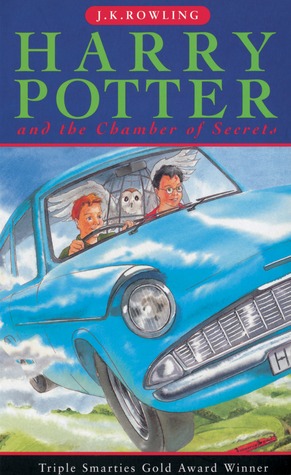
The Dursleys were so mean and hideous that summer that all Harry Potter wanted was to get back to the Hogwarts School for Witchcraft and Wizardry. But just as he’s packing his bags, Harry receives a warning from a strange, impish creature named Dobby who says that if Harry Potter returns to Hogwarts, disaster will strike.

And strike it does. For in Harry’s second year at Hogwarts, fresh torments and horrors arise, including an outrageously stuck-up new professor, Gilderoy Lockhart, a spirit named Moaning Myrtle who haunts the girls’ bathroom, and the unwanted attentions of Ron Weasley’s younger sister, Ginny. But each of these seem minor annoyances when the real trouble begins, and someone, or something, starts turning Hogwarts students to stone. Could it be Draco Malfoy, a more poisonous rival than ever? Could it possibly be Hagrid, whose mysterious past is finally told? Or could it be the one everyone at Hogwarts most suspects: Harry Potter himself?

What I think is good about Harry Potter, is that Rowling manages to add new details and information that lead you in to the next book without you realising. It isn’t until a second or third reading you notice how new bits of information help the story in the following book. The writing is very easy to manage, the books do get longer but the language and writing style is simple but detailed and filled with meaning and substance which just adds to the greatness. This was not one of my favourites initially, there are others that trump it, but it has an immense amount of charm on its own merit. I think certain things like characters swayed my dislike initially, but I think given it’s been so many years since my first reading that they have all grown on me with odd appeal, but it’s still my least favourite overall.

One great thing about it is we get to see more of Hogwarts in this second book, we learn more about character histories, where they began and how they ended up as they are. Everything is being released slowly in trickles which keeps you engaged and give rise to a multitude of additional questions where only a few have been answered. Having knowledge of future books is interesting as you go, but I do remember being very curious as I struggled to try and piece everything together and guess where book three would lead me.

You certainly cannot read these out of order I don’t think, though there is enough basic recap in the first few chapters to warrant a basic understanding if you don’t. By book three I imagine it would be almost impossible to follow, but also I think going in order just adds to the complete world and story Rowling is trying to convey.

Reviewing these after becoming so familiar with them over the years is an odd experience. I know I probably am not doing it as I normally would, but these are only mini reviews and I feel like I am preaching to the choir, though I know people out there haven’t read the series. I think if you enjoyed the movies, the books are a must, there is such a depth and fascination of story and character that Rowling conveys, even in these shorter books, that are just a marvel to experience.

Fun Facts

It is the second shortest book at 85,141 words, but it’s the longest of the films.

First published 2nd July 1998.

Cover art is by Cliff Wright.

The Ford Anglia is actually the same color and model car that Rowling and her best friend from school used to ride around in when they were younger. She used the car for the book out of her fond memories driving in it.

Upon publication it immediately took first place in UK best-seller lists, displacing popular authors such as John Grisham, Tom Clancy, and Terry Pratchett, making Rowling the first author to win the British Book Awards Children’s Book of the Year for two years in succession

Listed among the 2000 Notable Children’s Books by the American Library Association

In 1999, Booklist named Harry Potter and the Chamber of Secrets as one of its Editors’ Choices and put it in its Top Ten Fantasy Novels for Youth.

Shortlisted for the 1998 Guardian Children’s Award and the 1998 Carnegie Award.

Was the inaugural winner of the Children’s Book Award by the Scottish Arts Council in 1999.

An illustrated version was released in October 2016, with illustrations by Jim Kay.

This book has a strong connection with book six, with many crucial items first appearing in it. In fact, Half Blood Prince was the working title of Chamber of Secrets.

The novel implies that the story takes place in 1992/1993

Riddle’s name changes in translations so that an appropriate anagram could be formed, which results in Voldemort being called wonderful names like Martin and Trevor:
In French, his name is Tom Elvis Jedusor, which becomes Je suis Voldemort
In Spanish, his name became Tom Sorvolo Ryddle, which transforms into Soy Lord Voldemort
In Dutch, his name is Marten Asmodom Vilijn, which is an anagram for Mijn naam is Voldemort
In Turkish the name is Tom Marvoldo Riddle, which makes up Adim Lord Voldemort
In Brazilian Portuguese the name is Tom Servolo Riddle, which makes up Eis Lord Voldemort
In Danish, his name is Romeo G. Detlev Jr., which makes up Jeg er Voldemort
In Italian his name is Tom Orvoloson Riddle, which makes up Son io Lord Voldemort
In German his name is Tom Vorlost Riddle, which makes up Ist Lord Voldemort
In Icelandic his name is Trevor Délgome, which makes up Ég er Voldemort
In Swedish his name is Tom Gus Mervolo Dolder, which makes up Ego sum Lord Voldemort (which is actually in Latin)

Harry Potter and the Philosopher’s Stone (#1) by JK Rowling

Published: June 26th 1997Goodreads badge
Publisher:
Bloomsbury Publishing
Pages: 223
Format: Paperback
Genre: Fantasy
★   ★   ★   ★   ★  – 5 Stars

Harry Potter’s life is miserable. His parents are dead and he’s stuck with his heartless relatives, who force him to live in a tiny closet under the stairs. But his fortune changes when he receives a letter that tells him the truth about himself: he’s a wizard. A mysterious visitor rescues him from his relatives and takes him to his new home, Hogwarts School of Witchcraft and Wizardry.

What Rowling has managed to do from her very first book, is create an entire world, history and character base, but she has also sneakily then refused to divulge any of it. Instead, we get snippets and trickles of information and acts, we learn as Harry learns, but we also get blocked when he does. What Rowling does not want us knowing, what Rowling does not need to tell us, we do not find out. This leads you very eagerly into the sequels I assure you.

What makes Harry as a character so charming is his age I think, but also his innocent naivety and contrasting instinct that he has to help. It’s a weird thing, this 11 year old, who never knew abut magic, the wizarding world, or about the feared He-Who-Must-Not-Be-Named, yet he still leaps almost instantly into saving it. It is the wonderful courage he has and the deep down sense that he should be doing it and it is his role. We certainly see enough of this reasoning later on.

There are clues hidden throughout, laughs and emotion, always a good combination. But we also get so much more than a basic introduction into a new world, we get enough but not everything, but we also get so much more than you probably ever expected.

The characters are quirky, charming, hilarious, and even the ones you dislike you enjoy reading about. There’s mystery but there’s also exploration of this new wizarding world as Rowling opens the reader up to all the possibilities while not overloading us. It’s the ideal balance of story and information, with more than enough left over to entice us to keep reading, mixed together with seamless precision. As an introduction to a series and a whole complicated world, Rowling has done an impeccable job.

Fun Facts

Written in numerous cafés around Edinburgh, including one called The Elephant House which has a plaque commemorating this.

Is 76 944 words, making it the shortest of the series.

Written between approximately June 1990 and some time in 1995.

First published 26 June 1997 by Bloomsbury Children’s Books.

Cover art was by Thomas Taylor. You can read a fascinating post about him and the cover here.

Called Harry Potter and the Sorcerer’s Stone in the United States because US publisher Scholastic thought that a child wouldn’t buy a book with the word “philosopher” in the title. I mean, really.

The novel won most of the British book awards that were judged by children.

Reached the top of the New York Times list of best-selling fiction in August 1999 and stayed near the top of that list for much of 1999 and 2000.

It has been translated into at least sixty-seven other languages, all of which have gorgeous covers you can see here. (I particularly love the Italian one. Is there a scene where there is a moment with Harry wearing a giant rat hat? I also love the Spanish version because it makes Harry look like a child, unlike the English one where I’ve always thought he looks about 30.)

An illustrated version was released in October 2015, with illustrations by Jim Kay.

Prices for first edition first printings go up to around $6,500 with a selection between $4,000 and $5,000.

A first edition copy containing a rare typo is expected to fetch up to $34,000 at auction.

Previous Older Entries Next Newer Entries