Gone Girl by Gillian Flynn

Published: 24 May 2012 (print)/24 May 2012 (audio) Goodreads badge
Publisher:
 Broadway Book/Orion Publishing Group
Pages: 415/19 hours 18 minutes
Narrator: Julia Whelan, Kirby Heyborne
Format: Audiobook
Genre: Thriller
★ – 1 Star

On a warm summer morning in North Carthage, Missouri, it is Nick and Amy Dunne’s fifth wedding anniversary. Presents are being wrapped and reservations are being made when Nick’s clever and beautiful wife disappears. Husband-of-the-Year Nick isn’t doing himself any favors with cringe-worthy daydreams about the slope and shape of his wife’s head, but passages from Amy’s diary reveal the alpha-girl perfectionist could have put anyone dangerously on edge. Under mounting pressure from the police and the media—as well as Amy’s fiercely doting parents—the town golden boy parades an endless series of lies, deceits, and inappropriate behavior. Nick is oddly evasive, and he’s definitely bitter—but is he really a killer?

There have only been a few books that I felt cheated by, genuinely cheated by. These include The Last Battle by C.S Lewis, The End by Lemony Snickett, and to a very small degree To All The Boys I Have Loved Before by Jenny Hann. Being cheated by a book is more than disliking it, it is where I feel the author themselves have cheated me as a reader by building up my expectations and leading us to a point, only to dismiss our investment in their characters and turn the entire thing on its head with no point or purpose, ignoring everything that has come before.

Granted, each of these books cheated me in different ways, but Flynn’s crime here is not only making the book boring to read, toxic characters or not, but also because there is no satisfaction in anything that happens. The reader is not rewarded for dealing with this story, nothing to reward us for getting to the end of this long and tedious book. I don’t need a happy ending, make it as messed up as you like, but there was frustration in that conclusion, not a decent conclusion to the nonsense I had to sit through.

Irony could have played a great part, karma, justice, all these things. Instead, we’re left with these characters who I hated from page one and hated even more by page 400. It just got worse and then even when it got interesting it was still terrible. The writing was terrible which makes you hate the story they were telling. They were both poorly written, poorly expressed, and I think even though Flynn tried to give Nick some emotional baggage, the fact it is poorly explored means it all comes to nothing.

Surprisingly, the audiobook was also a bit terrible, Heyborne’s odd emphasis of some words catch in your ear and every time he said “my wife” (which, again, poor writing, is said A LOT), he sounded like Borat. I couldn’t escape into the story because having it read aloud highlights the problems even more. There is repetition, both characters constantly compare things to how it’s done in a movie, and they whine. They might have been decent characters if their story was better written.

When I hit part two I groaned because there was another chunk of this book. But luckily it somehow it managed to get more interesting. Predictable, but interesting. I got the result I expected, I was impressed that Flynn went the direction she does, but it didn’t remove the issues. The fact Nick’s narration is infuriating, and the language Flynn uses is repetitive, sexist, and boring. Even in the “exciting” part it is boring and monotonous.

When Part Three came, I rolled my eyes and prepared myself for another long boring section of this book. I can see the plan to make the ending some tragedy, some Shakespeare tragedy for us to wallow over, but it didn’t work. I could think of three better endings for this book and I wish any of them had been picked. I know this is apparently a psychological thriller in concept, it is not in execution. How Flynn has managed to make this story unentertaining is beyond me. The framework is there for a thriller, you get inside character minds and see their motives which was intriguing, but it wasn’t enough to save the story.

You can purchase Gone Girl via the following

QBD | Booktopia | Book Depository

Angus and Robinson | Dymocks | Wordery

Fishpond | Amazon Aust | Amazon | Audible


Long Lost Review: Paycheque by Fiona McCallum

Long Lost Reviews is a monthly meme created by Ally over at Ally’s Appraisals which is posted on the second Thursday of every month. The aim is to start tackling your review backlog. Whether it’s an in-depth analysis of how it affected your life, one sentence stating that you only remember the ending, or that you have no recollection of reading the book at all. 

Published: 1st April 2011 (print)/1st November 2012 (audio) Goodreads badge

Publisher:
 Mira/Bolinda Audio
Pages: 416/11 hours 4 minutes
Narrator: Jennifer Vuletic
Format: Audiobook
Genre: Romance
★  – 1 Star

Claire had almost forgotten her country roots. She is a city girl with an adoring husband, a chic townhouse and a high-flying corporate career. But when the police knock on her door one night with tragic news, her world is thrown into turmoil and she heads back to her family’s farm.

There, in the rugged beauty of the Adelaide Hills, Claire starts to rebuild her life with her friends, her father and his beloved racehorses, including a promising colt called Paycheque. But just as she starts to find happiness, and perhaps even love, she is faced with a life-changing decision… 

This probably doesn’t qualify for a long lost review because I couldn’t actually finish it. I listened to one and a half discs of the audiobook and gave in. I couldn’t get into the story, I thought the language was cliche and overly descriptive and flowery at times. I tried to imagine it as I was reading it whether it was the audio part I didn’t like, but I’ve been able to look past a bad narrator (and this one was tolerable) and I couldn’t get past the story. I try very hard not to give up on books so I feel bad about this but I couldn’t make myself keep going. Even after all this time I don’t feel compelled to try it again so I may have to give this one up as  abandoned.

It had an interesting enough premise, typical country born girl goes home and gets caught back up in the small town life she left. Even the promise of racehorses couldn’t keep me going, I don’t even think I got to the point where she actually goes back to the farm. I don’t think this will turn me off Fiona McCallum’s books, but it was the one that made me realise I don’t have to sit through boring books because there’s a lot more great things to read out there.
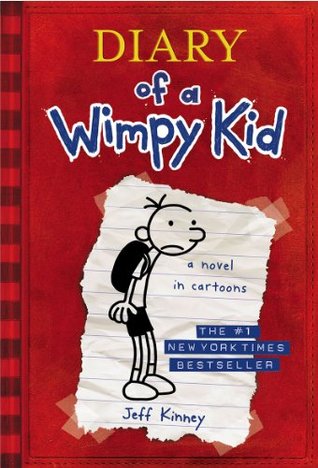
The Diary of A Wimpy Kid by Jeff Kinney

Published: 1st April 2007 Goodreads badge
Publisher:
  Puffin
Pages: 217
Format: Paperback
Genre:
 Junior Fiction
★  – 1 Star

It’s a new school year, and Greg Heffley finds himself thrust into middle school, where undersized weaklings share the hallways with kids who are taller, meaner, and already shaving. The hazards of growing up before you’re ready are uniquely revealed through words and drawings as Greg records them in his diary.

In book one of this debut series, Greg is happy to have Rowley, his sidekick, along for the ride. But when Rowley’s star starts to rise, Greg tries to use his best friend’s newfound popularity to his own advantage, kicking off a chain of events that will test their friendship in hilarious fashion.

As I was reading it I thought Greg was a horrible friend and mean, at first I told myself it was just typical young boy “I’m always wronged and my brother is a pain” kind of stuff, a young boy who is a bit self-centred, a bit stupid at times, but not too terrible. But the further I went the worse it became. Greg is a horrible kid, like a proper terrible friend and person.

I have ZERO sympathy for him, I thought this book was about a poor kid who was as it says, wimpy, and who had a hard life trying to fit in or whatever. Turns out he’s a terrible friend, a bully, a liar, and an all round selfish unrepentant bad person.

Through the course of this book Greg does one terrible thing after the other, and even when (and if) he is punished he doesn’t learn.  I cannot believe people love this book. Greg has no conscience, no remorse. He is rude, selfish and a jerk to everyone. He is manipulative and a liar and never once redeems himself even the one time he thinks he does, and all of this is under the guise of it being “funny”. There really isn’t even any humour to fall back on. Is the humour Greg being mean to his supposed best friend? For being relieved some other kid is being bullied and not him (though it was essentially his fault)?

I can’t believe people praise this book. For what? For teaching kids about throwing things at girls with no real consequence? Being mean to your friend because he succeeds when you don’t? This entire book is filled with Greg never once learning his lesson. Maybe, MAYBE if he had been a bully and then learnt some remorse or lesson or learnt SOMETHING then you could make an argument, but there is nothing to be gained from this book except a diary of a kid with no empathy or morals.

I get it, books don’t need morals to make book enjoyable, but this is truly sending the worst message to kids about how to behave and what is acceptable. There are much better books and series out there that are ten times as enjoyable and worthy of being read. I was going to keep reading this series but after finishing it I won’t be rushing out anytime soon.

You can purchase Diary of a Wimpy Kid via the following

Fishpond | Dymocks | BookDepository

 A&R BookWorld | Booktopia

Wordery | Amazon Aust | Amazon


The Farmer’s Wife (#2) by Rachael Treasure

Published: 1st April 2013Goodreads badge
Publisher:
Bolinda Audio
Narrator: Miranda Nation
Format: Audiobook
Genre: Rural Romance
★  – 1 Star

She got her fairytale ending — but life had other plans …

The Deniliquin Ute Muster had always been on Rebecca’s wish list, but with the farm and babies, she’d never managed to make it. Tonight, she decided to reclaim herself.

After ten years being married to larrikin Charlie Lewis and living on her beloved property, Waters Meeting, Rebecca is confronted by a wife’s biggest fear, a mother’s worst nightmare and a farm business that’s bleeding to death.

Can Rebecca find the inner strength she once had as a young jillaroo, to save everything she cherishes? Or is life about to teach her the hardest lesson: that sometimes you simply have to let go.

I leapt into The Farmer’s Wife after reading Jillaroo and I am so sorry that I did because it ruined everything that made Jillaroo wonderful. I listened to the audio book while I was driving which was great because I think I would have thrown the book at a wall more often than turning the pages.

I was aware that Treasure changes the personality of Charlie, does a complete 180 on him, but after finishing this book it was more than a 180, it was a completely new person. It was disgusting, really, having to listen to what he does and what he says, when he is nothing like the person in book one. In the beginning I could see where Treasure was coming from, I still can in a way, but even knowing where she was coming from does little to stop the sickening feeling in my stomach as I listened. I get it, the life with Rebecca isn’t the life Charlie wanted, but as the book goes on, he goes from being a scumbag, angry and rude, to being dangerous and abusive, pretty much a psychopath. It was horrible. I understood the ten year difference, life, kids, a farm, all could take their toll, but the direction I thought Treasure would take was nothing to what she does do.

It wasn’t just Charlie that was the problem, Rebecca had issues as well. She tries to cling onto the life she had, she makes some smart decisions and does the best she can for her kids, but I wasn’t a fan of some of her other decisions. The whole thing seems to go off the rails. I felt Rebecca lost who she was; she wasn’t the fighter she once was, she gives up too easy, and every time you think she is going to fight and pull herself together she doesn’t. The strong woman I fell in love with in Jillaroo becomes this uncertain, lost girl, granted with fleeting moments of strength but other than that, she too was a different person. Ten years on and both of them are unrecognisable as the people I knew in Jillaroo.

It was disgusting at times to listen to, and it was an appalling story. Nothing seemed to fit these characters and I felt there were so many cop outs and explanations and justifications that didn’t sit right. It was such a disappointment, to not even see the same values really that they once had.

Away from characters Treasure uses the book to teach us about the benefits of holistic farming, in detail, something I didn’t actually really mind because I found it interesting, but I can see how that would be annoying, it only kind of worked into the story, more telling than showing I think. This takes over Rebecca’s storyline in a way and you start to root for her again before she lets you down once more.

I liked some parts and put up with other bits, and as I say, felt sick for a lot of it and was confused about who these characters were. I get Treasure wants to show us the Cinderella story isn’t always a dream, but could we maybe have more tension and fights instead of abusive husbands and magic crystals? If you loved Jillaroo like I did. If you loved Charlie and Rebecca together, their story, her story, then don’t read the sequel. Or if you do, be warned, yes it does show you that the Cinderella story does settle into reality, but what Treasure does is so far from I think what’s believable in terms of these established characters, it is too much at times.

If Treasure wanted conflict there was plenty to work without destroying the relationship and characters she had built up so beautifully in Jillaroo. I may just have to reread that story and pretend this one never happened.


The Last Battle (#7) by C. S. Lewis

Published: March 5th 2002 (originally 4 September 1956)
Goodreads badgePublisher: HarperCollins
Pages: 229
Format: Book
Genre: Junior Fiction/ Fantasy
★ – 1 Star

The last battle is the greatest battle of all.  Narnia… where lies breed fear… where loyalty is tested… where all hope seems lost. During the last days of Narnia, the land faces its fiercest challenge – not an invader from without but an enemy from within. Lies and treachery have taken root, and only the king and a small band of loyal followers can prevent the destruction of all they hold dear.

Note: This review is what I wrote the second I finished this book. I put the book down and stormed to the computer and wrote this. I feel it captures my feeling at the time when I read it. I apologise if you liked this book, I understood from the many five star reviews people did, but I saw just as many on my side so I don’t feel too bad about it. I don’t know if you can pick up the anger in my writing tone, it is hard not to, but I was trying to be as civil as possible.

“I hated the ending. Simple as that. I wanted to throw the book across the room, scrunch it into a pile and set it on fire. I get your message Mr Lewis. Don’t shove it down my throat. You managed to slip it in unbeknownst to me in the second book, I don’t know enough of the Bible to know if you did it in any other story except the first and that was tolerable, but when you blatantly spell it out in such an insulting and judgmental manner I get pretty damn pissed off.

The book started off ok, it was a bit sad to see how the once beautiful Narnia had become but it was a new adventure and I accepted it. The whole ape thing confused me and I thought it was weird but I accepted it. Times were tough in Narnia, it was thousands of years since the early days and everyone had evolved, I accepted it. Then the children come back, there is hope yet. Oh not everyone, ok…it might be alright. But no, no it was not. The further this book went I could see the happiness and tolerance metre in my head slowly drop. Then the final part of the book came and I just got angry. I don’t know the last time I got as angry at a book as I did at this. I forgot all the other great books I had read of this series and focused on how Lewis managed to screw up the last book of the series. He almost got through it without making an ass out of himself and causing a divide in the readers. The rest of the books would vary from a few people, but this book would divide one way or the other I could tell.

We effectively rushed through the ending, skipping long explanations and just saying this is what happened and this is what it is now. Let’s all be accepting good Narnian slaves and live forever after in this wonderland and don’t think too much of how you are here. Oh and never mention those who got left behind cause they are the devil incarnate. Thank you Mr Lewis, I hope you’re happy with yourself.”

So that was was my initial reaction and review. I would like to add that almost a year later, and a lot calmer, I wouldn’t change anything because that is how I felt about what happened but I will try and offer a better summary. This is the seventh book in my chronological system, I cannot imagine how this could possible be anything other than last so that is undisputed. We are not given any real explanation why the story begins how it does and so for a lot of it I was confused about what was going on. The ending of The Silver Chair and the past history Lewis used I was expecting a slight continuation, but not having that I thought perhaps we were doing another seemingly unconnected The Horse and His Boy style book. The issue I had with that was that this was supposed to be the final book, the book that concluded all the stories, all the magic, all the crossovers and lives that we had seen; and when that didn’t seem to be happening I was very confused. The ape thing I mentioned was were my anger sort of began. Maybe not anger but I think having come from this succession of great Narnia history and beauty, seeing it being tampered with felt disrespectful. I don’t want to make any connection between the ape/human debate because I can’t entirely see how that is relevant considering what we have seen, but knowing Lewis’ ability to throw in symbolism at every turn it wouldn’t surprise me.

As I say not a lot was explained so there were times where I was reading and going along with it because I could not figure out where any of this was headed. I know Lewis had a tendency to add religion into his books. I got the message in The Magician’s Nephew, this, somehow, was a lot worse because it was not even using the imagery and the metaphor and symbolism that that book had, and even The Lion, The Witch and The Wardrobe was subtler (for me anyhow). I won’t tell you not to read it, not at all, and I know this is simply my view on the book, other people have loved it, bear that in mind and don’t go into this book expecting the worst. I just want you to know that for me, this book is very different than the previous ones. Lewis seems to take things to another level, perhaps if he had been gradually building throughout this series the book would not have been such a shock, but for me it seemed unexpected and extreme considering where we had come from. There had been no indication that those sorts of things were possible nor that they would happen. I may have to reread some reviews to understand why people loved it, and I have an inkling, but I am willing to try.

Previous Older Entries Next Newer Entries