The Very Hungry Caterpillar Day

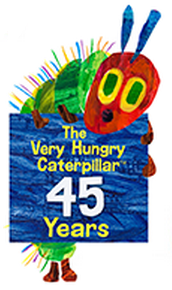
caterpillarMarch 20th has become The Very Hungry Caterpillar Day which I think is just beautiful. This year marks the 45th anniversary of Eric Carle writing The Very Hungry Caterpillar and in that time that little caterpillar has become much loved all over the world.

The Very Hungry Caterpillar was published in 1969 and the story behind it is rather cool. According to Carle, “One day I was punching holes with a hole puncher into a stack of paper, and I thought of a bookworm and so I created a story called A Week with Willi the Worm.” But how did we get to the caterpillar? Willi was a bookworm, but apparently Willi would not be a great protagonist as a green worm, then Carle’s editor suggested a caterpillar, which made Carle think of a butterfly and there you go. So in a sense we can all now say that very hungry caterpillar’s name is Willi.

On his 84th birthday last year I did a Birthday Book Bonanza with Carle, I also reviewed The Very Hungry Caterpillar, a very fun review to write for such a short children’s book. What I always loved about the book was not just the story, but it was the first time I remember seeing a book be more than just normal pages. This book had holes in it, and you could interact with the book itself in a new way. Of course there would be more and better interactive books as I got older, like Patrick and the Hungry Puppy, Karen and the Little Lost Kitten, and The Jolly Pocket Postman series which was brilliant, but they came later.

What was good about The Very Hungry Caterpillar was it taught you things while being fun, gorgeously colourful, and a great little story. Fun fact! Carle does his own illustrations, and those gorgeous illustrations are the result of tissue paper, paint, and a skill at collages. On his official website (link below) you can find out all about how he does it, as well as all the other Eric Carle books that get overshadowed by The Very Hungry Caterpillar, plus a whole heap more. I’ve linked in the video of Carle discussing The Very Hungry Caterpillar where he talks about the 40th anniversary and also tells you about Willi the worm’s brief moment in the sun.

So to celebrate this great little day you could read The Very Hungry Caterpillar, relive the delight, introduce it to someone new, or even try making your own tissue paper collage. It’s hard to imagine a book so seemingly simple could still be here 45 years later. But just where would we be if that little egg on the leaf, sitting in the light of the moon, had not gone POP and given us the tiny, very hungry caterpillar. I wouldn’t want to know.

Goodies
Official Eric Carle website
Eric Carle discussing The Very Hungry Caterpillar on its 40th anniversary
Eric Carle Museum of Picture Book Art
Eric Carle’s Blog


Nocturnes by John Connolly

Published: February 28th 2007
Goodreads badgePublisher: Hodder
Pages: 486
Format: Book
Genre: Short stories/Horror/Fantasy
★   ★   ★   ★   ★  – 5 Stars

 A dark, daring, utterly haunting anthology of lost lovers and missing children, predatory demons, and vengeful ghosts. In these stories, Connolly ratchets up the tension to almost unbearable — and irresistible — levels. Nocturnes is a deliciously chilling collection from “one of the best thriller writers we have” (Harlan Coben)

John Connolly’s short stories in this book are dark and magical and monstrous, in so many different ways. All monsters are different, not all monsters can be seen, and there is always something lurking in the dark. There are 17 stories in this collection, each of them revealing something terrifying and eerie. The variety Connolly comes up with are amazing, and the fact we do not always find out what exactly is hiding in the shadows is what adds to the delight. What isn’t told leaves a lot to your own imagination to fill in the gaps, and what is told is just haunting enough to stay with you even as you move onto the next story.

With the opening story, The Cancer Cowboy, you know that these stories may not be entirely pleasant or uplifting, but with the other stories varying from being less dark and tragic to being simply eerie, or on occasion humorously tragic, you are given a wide variety in which to challenge your nerves and keep you awake at night.

Connolly writes with a wonderful descriptive simplicity. We are given details and basic information, but there are things we aren’t told as well. What we are told is what we need to be told for the story to progress and for us to understand. Anything else is revealed gradually in conversation, or implied through something else, or we don’t need to know it at all. The joy of the short story, and the art I suppose, is trying to capture a life within less space than normally provided. Connolly gives us characters that are as developed as they have to be for the roles and situations they are placed in. You do not always need to know everything about them, but we are not left with any husks of characters that we have no sympathy for and for what is happening to them or around them.

The title Nocturnes comes from one of the stories within the book, a story about things that come out in the dark, that haunt you, and hide in the shadows; the very name suitable to cover the nature of these stories. Nocturnes can be defined as “a work of art dealing with evening or night”, something these stories do, mixed together with the creepy and scary.  Connolly draws you in as you read with the mystery and unknown, but also compassion for the characters involved; of the innocent parties, the guilty, and even an admiration for the monsters. The extent of what he has created is of such variety it must be said it isn’t all darkness and shadows, but the daylight monsters are no less unnerving than anything that Connolly creates in the night time shadows I assure you.

One stand out addition was the Charlie Parker novella The Reflecting Eye towards the end. Even this manages to suit the theme Connolly has going rather well. Charlie Parker is from Connolly’s detective series, with this novella being between the fourth and the fifth in the series.  I have yet to read any of the Charlie Parker novels; I suppose with this novella I have had a taste now to reignite my desire to start reading them.

From the man who wrote the beauty of The Book of Lost Things, seeing the darker side was very revealing. The Book of Lost Things had its own darkness certainly, but the darkness and monsters hiding inside Nocturnes, whether they are treated with a distracting light heartedness like some, a mysteriousness that remains not entirely revealed, or one that brings a twist, is something that I found very exciting, and a wonderful surprise. Perhaps it was because we don’t always know what is happening, we only see snippets of events and what happens, or perhaps it is because it shows that darkness can breed anything and anywhere, and no one is exempt from its talons.

Make Good Art by Neil Gaiman

Published: May 14th 2013
Goodreads badgePublisher: William Morrow
Pages: 80
Format: Book
Genre: Non Fiction/Inspirational
★   ★   ★   ★   ★  – 5 Stars

This book is for anybody looking around and thinking, now what?

 In May 2012, bestselling author Neil Gaiman stood at a podium at Philadelphia’s University of the Arts to deliver the commencement address. For the next nineteen minutes he shared his thoughts about creativity, bravery, and strength: he encouraged the students before him to break rule and think outside the box. Most of all, he encouraged the fledgling painters, musicians, writers, and dreamers to make good art.

Make Good Art is a book representation of the commencement address Neil Gaiman made in 2012. It is his advice and experience in a short book that he gave to the students at Philadelphia’s University of the Arts. There is so much I love in this book, the message for certain, but I also love the way it is presented. The design and layout of this book is done by Chip Kidd, a graphic designer and writer, and while it may be unconventional, I believe it is just the right way to express the message Gaiman is trying to put across in his speech.

People talk about it being a pain and how it makes this book lose its message a bit, but I think how Kidd has converted this is wonderful. I understand the early pages can be hard as the words move about the page, but this settles down as you progress, while maintaining the colour and design. The way this book is presented I think only adds to the message Gaiman is making. All art is Art. His words are reinforced by how Kidd has presented them and shows there are no rules in getting your message out.

I know some people may feel that there are enough motivational speakers and people should just know what to do or do what they want, but having someone reinforce your own ideas and desires, especially someone you admire and idolise reaffirming and assuring you it is going to be ok is sometimes the right thing a person needs to hear. And when they are discussing something you’re passionate about is much better, everyone offers something new and different based on their own experiences and history.

Gaiman talks in his speech about his own journey and his own learned lessons in his career. He talks about how the world is changing, about how art is art regardless, and how there should always be a time for making art, whether your cat has exploded or not. There are so many lessons and inspiring messages that can be taken from this speech, one I think that will benefit even those who are not involved in creating art. Anything you strive to do, anything you dream about doing Gaiman tells you you can make it happen if you want it, you just need to find the right way of doing it.

I will never tire of hearing commencement speeches. I adored the two I was able to hear at my own graduations, as well as at friends graduations, not to mention the ones other people have done like Tim Minchin, and now Neil Gaiman. I watched the video of this speech when it was first released and the effect it had on me then was the same one evoked from reading the words. You can still watch the video here if you have 19 minutes 54 seconds to spare, you won’t regret it. There is something wonderful though about also reading the speech, there are many wonderful snippets that can be great inspirational quotes just when you need them to reassure you or to motivate you. It is a quick read, but it manages to capture to feeling of his speech so well.

One message is that “People will tolerate how unpleasant you are if your work is good and you deliver it on time. They’ll forgive the lateness of work if it’s good, and they like you. And you don’t always have to be as good as the others if you’re on time and it’s always a pleasure to hear from you.” This does not apply to art alone, and while it is directed and focused on the arts, it is a great speech about succeeding in life as well. And there are so many others to inspire people to create and find their place and voice in the world, no matter what format.

What is certain that the message you are left with when you finish is to leave the world more interesting for your being here.

The Weight of a Human Heart by Ryan O’Neill

Published: May 1st 2012Goodreads badge

Publisher:
 Black Inc.
Pages: 238
Format: Book
Genre: Short Stories
Weight: 242 grams
★   ★   ★   ★   ★  – 5 Stars

Sometimes comic, sometimes tragic, this collection turns the rules of storytelling on their head.

A series of graphs illustrates the disintegration of a marriage, step by excruciating step.
A literary stoush – and an affair – play out in the book review section of a national newspaper.
The heartbreaking story of a Rwandan boy is hidden within his English exam paper.
A young girl learns of her mother’s disturbing secrets through the broken key on a typewriter.

Ranging from Australia to Africa to China and back again, The Weight of a Human Heart heralds a fresh new voice in Australian Literature.

I fell in love with Ryan O’Neill at the 2013 Newcastle Writer’s Festival, partly because of the sessions I sat in on where he spoke, and partly because of his Scottish accent I’m not gonna lie. I had looked at this book in the shop beforehand but after hearing him speak I snagged a copy at first chance and got it signed. I am still annoyed it has taken me this long to get around to reading his book. It has been sitting patiently beside my bed for months, not forgotten but continuously bumped back.

In this collection of short stories O’Neill “redefines the boundaries of what is possible” to quote Patrick Cullen’s quote on the front cover. And it is completely true. I saw things in this book I did not even know was allowed in writing until now, and the fact that they are has changed the way I think about what books are capable of.

The beauty of all of O’Neill’s stories is that they seem to start so innocently, and in the space of a few pages can change your mood completely, whether to sadness, joy, amazement, or just pure admiration for his impressive skill in storytelling.

His stories show the power and impression parents have on their children, as well as the impact of an adult’s reflection on these impressions. There is also a diversity which I love about all of them, no two are alike but there are common themes running through each of them if you know where to look. There is also a poignant and bittersweet emotion that you develop as you read which consumes you, making you want to take a moments reprieve but you find yourself unable to let go of the book. You have to keep going even as you feel it pulling at all your emotional strings.

One of the real joys though of reading each of these stories is the chance I got to learn something. In Four Letter Words I learnt about a range of word origins, in The Cockroach and Africa Was Children Crying I learned about just some of the traumatic events in Rwanda, in The Examination I learnt about the English language and in The Eunuch in the Harem I saw something seemingly impossible work brilliantly.

Even away from the gorgeous stories, you have to admire O’Neill’s ideas and his creativity. Not to mention the obvious work and effort that has gone into writing some of them. The different styles and formats that are mixed through this book are so unique, and certainly nothing I have seen before. I know John Green’s An Abundance of Katherines used graphs through it, but what O’Neill has done is far beyond simple graphs. Each story is something different and that is just part of the charm, after awhile you just don’t know what to expect from the next story but you welcome the surprise.

The way O’Neill plays with ideas within a story is also brilliant. It shows not just the types and ranges he is capable of in presentation, but in doing so he still manages to tell a complete and understandable story. It just works so well, something you may not believe upon a first glance, especially for a few of these stories but by the end you are so caught up in the narrative that you almost look pass the unique presentation, but still revere it in the back of your mind and see how it is flawlessly used to aid the storytelling.

After I had read the first story, I remarked on Twitter that even after only being one story in I already felt that my life had changed just that little bit. Now, having finished the book I stand by this statement. I did not know what to expect from these stories but I could not have asked for anything better.

I implore you to read this book, find these stories and read them yourselves. The stories will move you and educate you about so many things, about life, family, the English language, the ranges and impacts of the printed word, and the variety of people that exist in this world: good, bad, ignorant, and indifferent. You become involved in these short, complicated snippets of these people and their lives and it shows you that stories do not need to be long to capture an entire lifetime and bring about emotion. It can also show you that there are so many other ways to tell a story besides the basic formatting we’re so used to in stories. Even if these stories were not as wonderful as they are, you cannot fault O’Neill on his pure imagination and creativity about how some of these stories have been presented and told.

One of the things I loved about O’Neill at the festival last year was the way he spoke about characters. He said it was easier, or at least more fun, to write stories with miserable characters rather than happy ones. There are some miserable characters in this book, but the best part is that every character does not have the same level of unhappiness, nor are all kinds of unhappiness the same. There are levels of unhappiness O’Neill plays with and the depth, nature, and cause of this unhappiness differs for each character and each story.

He also said that if you have an interesting storyline then that can create an interesting character, and his characters are definitely all interesting. For a short story you manage to understand them completely, in simple actions or words you can see who they are as people and I feel that is a real skill O’Neill manages wonderfully.

From the 21 stories in this book A Short Story and Seventeen Rules for Writing a Short Story have to be my favourites, though A Story in Writing is also up there. Though I really could start just start listing the contents in its entirety because in their own way I loved, adored, and admired every single one.

I assure you, the next Ryan O’Neill book I get my hands on will not be sitting on a shelf until I have gone from cover to cover. I am still trying to find all the words in the word search.


You can purchase The Weight of a Human Heart via the following

eBook

Booki.sh

iBookstore

Google Play

Amazon Kindle

Kobo

Paperback

Penguin Books Australia

Booktopia

Bookworld

Amazon

Book Depository

Green Eggs and Ham by Dr Seuss

Birthday

10500516_792284587518837_642003267089225361_nA very happy birthday to the delightful Dr Seuss today. Today is Seuss’ 110th birthday, and at the time of this posting I am very disappointed there is still no sign of a Google Doodle commemorating this. The man who is most commonly known as Dr Seuss was actually born Theodor Seuss Geisel in 1904 and was an American writer, poet, and cartoonist. Son to Theodor Robert and Henrietta (Seuss) Geisel, he was also the grandson of German immigrants. Geisel lived in Springfield, Massachusetts, where his father ran a brewery and it was a street in this town that Geisel used as an inspiration for his first book as Dr Seuss, And to Think That I Saw It on Mulberry Street. Geisel is mainly known for his children’s books written under his pen name Dr Seuss, though this was not the only pen name he used, in college he had written under Dr. Theophrastus Seuss and later used Theo LeSieg as well as Rosetta Stone. Through his life Geisel published a total of 46 children’s books, his most celebrated being The Cat and the Hat, as well as Horton Hears A Who!, How the Grinch Stole Christmas!, The Lorax, as well as One Fish, Two Fish, Red Fish, Blue Fish plus many others. Seuss’ works are known for their imaginative characters, rhyme, and frequent use of anapestic metre. His works have been adapted into many forms, including 11 television specials, four feature films, a Broadway musical, and four television series. As a cartoonist and illustrator, Geisel published works in advertising campaigns, and also worked as a political cartoonist in New York. In World War ll he put his skills to work in the animation department of the United States Army, and later won an Academy Award in 1947 for his film, Design for Death. It is hard to think of Geisel as anyone other than Dr Seuss, he has flooded out culture in so many ways as Seuss it is hard to see him as anyone else. He was an interesting guy though, and he contributed a lot more than just his work as Dr Seuss, but there is not doubt the impact those books have had on children as well as society as a whole. The term Grinch has become infiltrated into our culture, and many of his books and characters are as loved today as they were when they were first released. You can read more about Geisel here, and if you’re feeling particularly jovial and adventurous, check out Seussville.


Published: August 12, 1960 Goodreads badge
Publisher:
 Random House
Pages: 62
Format: Book
Genre: Children’s Picture Book
★   ★   ★   ★   ★  – 5 Stars

When people think of Dr Seuss I think the one book that immediately comes to mind is The Cat in the Hat. I was never a huge fan of The Cat in the Hat, I liked many of his others though, I did always like Green Eggs and Ham. I like Green Eggs and Ham because it is not only a great book and very clever, but also because it has one of the best stories behind its creation, one of those great trivia stories about the origin of songs and books and all those things. The story of Green Eggs and Ham involved Seuss and his publisher Bennet Cerf, who after receiving a book of Suess’ of 225 words, made a bet he could not complete one containing only 50. The result is Green Eggs and Ham and it goes to show that you do not need a lot of words to make a story. It is a great idea; there is also an excellent Hank Green song that is similar where he sings a minute and a half song using only the same ten words. It isn’t the same as a story I grant you, but it very cool all the same. Green Eggs and Ham is a conversation between the unnamed narrator and a man known only as Sam-I-Am. Sam-I-Am continually pesters the narrator to sample the dish known as green eggs and ham, following him to various locations and asking him once more. It is a very simplistic story, but one that offers a range of great catchphrases and a joy in the fact the premise is so simple and jovial. The best part was that this simple story, containing only fifty different words, managed to get on the Banned Book list in People’s Republic of China. Much like The Lorax that people thought it was against loggers of some such nonsense, in 1965 Green Eggs and Ham was deemed to be considered a “portrayal of early Marxism”. This banning lasted until 1991 where it was lifted after the death of Seuss. Another fun fact, apparently in September 2013 it was read aloud in the US Senate as part of a Texas Senator’s 21 hour long speech advocating defunding the Patient Protection and Affordable Care Act (also known as Obamacare). I won’t ruin the ending for you, and as engaging as the story is there isn’t a lot of character development though. We don’t get the typical back story about who Sam-I-Am is nor our mysterious narrator, but there is a suspense about the book which only adds to the enjoyment. It is a wonderful book, and I think everyone should read it, and other Seuss books, find their own favourites and read them regardless of who you are.

I wish Theodor Geisel a very happy birthday, and I hope Dr Seuss, no matter where you are whether here or Katroo, that the Birthday Bird throws an amazing party for you.

Oh, also, for those who are not sure how to pronounce Seuss, here is a rhyme to help.

“I’m sad to report, I’m sorry to say That Seuss is not pronounced at all in that way.
You choose to rhyme Seuss with goose juice and and moose juice
But that is not a pronunciation Seuss himself would choose
If he was here today and still had a voice
You would clearly hear him say “My name is Dr SOICE!”

And finally, just a quick note to say, do you know how weird it is to keep writing “I like Green Eggs and Ham” when that goes against everything you have heard!? It messes with you a small bit, it really does.

Previous Older Entries Next Newer Entries