News: Farewell But Not Goodbye

ImageSo tomorrow is the big scary day, the holiday. I am sharing the terror and the anxiety with the eagerness and excitement, all of which switch dominance as the night progresses. But aside from that we have announcements. Since I will be travelling and having a right good time I fear there will be a break in the postings.

Yes, I hear you, there have been some breaks already, but holiday planning is time consuming, and life is time consuming and things have been time consuming and I apologise. But rest assured things will pick up upon my return.

What I am going to try and achieve (she says with so many intentions of trying to do), is that while I am gone I will probably only be able to get birthday posts up, because there are some great authors birthdays, but I can’t promise anything, but I do wanna try. I am taking books with me for the long flight so who knows, I may get a nice new review up, that’s something to look forward to, nice quiet reading time at last.

In my absence don’t forget that my giveaway is still running, the close date isn’t for another three weeks, so you can still get your entry in. There are two entry options if one doesn’t work.

Other than that I can’t really offer much else except behave yourselves while I am gone, read something spectacular, and I will see you in a more permanent and less sporadic manner in three weeks.

UK here I come! *squeal*

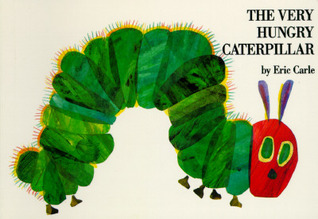
The Very Hungry Caterpillar by Eric Carle

Birthday

A very happy birthday to Eric Carle today, author and illustrator of so many delightful books, who is 84!

Carle was born in 1929 in New York to German parents but went back to Germany when he was six years old. After harrowing experiences through the war, Carle returned to America in 1952 where he got a job as a graphic designer for the New York Times and later at an advertising agency.

The work of Eric Carle is easily recognisable, his artwork and illustrations are unique and his books tell of nature and the world. Carle himself said that with his books  “I attempt to bridge the gap between the home and school. To me home represents, or should represent; warmth, security, toys, holding hands, being held. School is a strange and new place for a child…I believe the passage from home to school is the second biggest trauma of childhood; the first is, of course, being born…The unknown often brings fear with it. In my books I try to counteract this fear, to replace it with a positive message. I believe that children are naturally creative and eager to learn. I want to show them that learning is really both fascinating and fun.”

The way Carle makes his art is fascinating. I had never really thought about it before, I assume it was just paintings but apparently his work is created like a collage using hand painted papers that are cut and layered to form the images. There are also other techniques such as die-cut pages, and actual twinkling lights and noises in some books as well. All very high class compared to the felt puppets and faux fur I remember from my books.

My favourite book of Carle’s is of course The Very Hungry Caterpillar. I read this so many times as a kid it’s great. Yet another example of interaction and creative book creation, there are holes in the book, the pages are different sizes, it is amazing. It seems growing up Carle was familiar with different shaped books in Germany. I understand the reasons why but we need more books here that are weirdly shaped.

The Very Hungry Caterpillar was published in 1969 and the story behind it is rather cool. According to Carle, “One day I was punching holes with a hole puncher into a stack of paper, and I thought of a bookworm and so I created a story called A Week with Willi the Worm.” But how did we get to the caterpillar? Willi was a bookworm, but apparently poor Willi would not be a great protagonist as a green worm (poor Willi), then Carle’s editor suggested a caterpillar, which made Carle think of a butterfly and there you go. So in a sense we can all now say the very hungry caterpillar’s name is Willi. This must be made known to the world.

I must say, this was a fun review to write, short books, especially children’s books can bring out a silliness you really can’t get away with for big, long, serious books. If you don’t know the story of the very hungry caterpillar you may not want to read ahead, but even if it spoils it, which is will because there is nothing much else to talk about in there, then I half apologise and half demand you go read the book.

Published: September 29th 1994
Goodreads badgePublisher: Puffin
Pages: 26
Format: Picture Book
Genre: Children’s Picture Book
★   ★   ★   ★   ★  – 5 Stars

This is a story of suspense and tension. The main character of this story is born into a world in constant hunger and we follow him as he devours food at an alarming rate, never able to quench his hunger. Day after day he does nothing but eat, eating more and more as the days go by. He tries to be healthy in the beginning but as the days progress his hunger drives him to junk food and after all that cake and sugar and cheese…well, that’s right, he becomes ill. The suspense was amazing. Was this finally the way to stop this hunger machine before he ate through his world of food? Could this tummy ache be enough to stop his rampage on the food? Would there still be enough to support the remaining population? I had to read on to find out.

After having eaten so much this character had become so large he hides himself from the world. So large in fact he must built a house around himself to shield the judging eyes of the neighbours and those who come across him. Housebound, and living off the vast amount of food he’d consumed in his lifetime, this character is sheltered from the world. Until one day, after probably taking a good long hard look at what he’d become, had an instinctual desire to change himself, become a new and brighter person. After emerging slowly from his custom built house to this new world he was no longer a very hungry caterpillar, he was a beautiful butterfly (or he’d eaten himself into a food coma and was delusional about his true butterfly abilities. Either way).

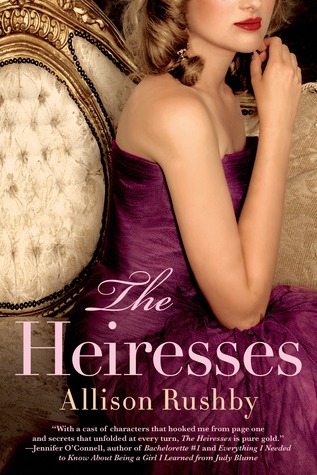
The Heiresses (#1) by Allison Rushby

Published: May 7th 2013
Publisher: St. Martin’s Press
Pages: 352
Format: Book
Genre: New Adult Historical
★   ★   ★   ★   ★  – 5 Stars

When three teenage girls, Thalia, Erato and Clio, are summoned to the excitement of fast-paced London–a frivolous, heady city full of bright young things–by Hestia, an aunt they never knew they had, they are shocked to learn they are triplets and the rightful heiresses to their deceased mother’s fortune. All they need to do is find a way to claim the fortune from their greedy half-brother, Charles. But with the odds stacked against them, coming together as sisters may be harder than they think.

I discovered this book when I read a guest post by Rushby on S.I.K Book Reviews and a giveaway was running for her book. I loved how exciting and intriguing this book sounded and so I entered…and I then maybe went blog stalking where others had the giveaway to enter on their blogs as well. Needless to say this blog stalking and persistence paid off because I won myself copy. And I was so glad I did, it was excellent.

Set in 1920s London, The Heiresses follows these three young women who are growing up, discovering their lives are not what they thought them to be, and fighting to claim what is rightfully theirs. The premise of the story and introduction to the world is done well; within the first few pages you are able to capture a mystery and a great confusion that tells you that there are a lot of answers and things to discover. The prologue sets up the story well, we are shown a snippet of the past, but all of the things that are not said make up for the rest of the novel where you are searching for answers.

The idea of The Heiresses is really good. In an age before DNA, with aristocracy and titles, riches and reputation to consider, making sure the right heirs are given the right privileges is imperative. The process the three girls go through in order to find the truth is very clever but also personal and emotional as well.

The journey the girls have in finding more about this family they knew nothing about and in a new environment of London and society is great. We see how the three react, adjust, and cope in the new life with ties to their former home being severed or being used to pull them back again. There is a lot of history in the book, the suffragettes and the modern age is developing and the social consequences are paramount.

Their aunt, Hestia, is a modern woman with her own ideas and her own home, which helps the girls, but hinders them at the same time. The darker sides of the twenties are also shown but nothing is spelled out exactly which is creative. In a very clever approach Rushby implies a lot, or makes brief references without having to state things outright. This is quite effective because it allows the reader to make connections themselves and gives them credit to read between the lines.

Because of the historical era we are also exposed to the wonderful fashion and technology that 1920s London was experiencing. Rushby uses these things, especially the fashion and the motor cars, as a device to show us not just how London was as a city, but to demonstrate further who these three teenagers are. As a result we get a great sense that these eighteen year olds are starting their adult life and finding their place in this new world.

A lot of the book is the relationship and life the three girls have rather than directly focusing on the Charles issue which was interesting. As the book went on I was unsure where this would lead since there were no dramatic conflicts and strong focus on what I thought was the main reason the girls were brought together for. Of course there are conflicts, and I suppose this reflects the reality aspect a lot, there are times when you cannot go in guns blazing ready to fight. In that regard I think Rushby portrayed it well.

As the pages start to lessen and you start to think that the ending will be rushed or somehow the sequel will have to continue this aspect of the story but no. Rushby manages to wrap up the novel beautifully without rushing. Everything is answered in a satisfactory manner and when it finishes you get a sense of where everyone is going.

We get the sense that these characters will be ok in the lives they have created for themselves and after passing through the mess of jealousy, drama, greed, and secrets, isn’t that all you can hope for for them. I look forward to reading the sequels and seeing what else is in store for these siblings.

You can also read an interview with Rushby did with Bookish Comforts about her book.

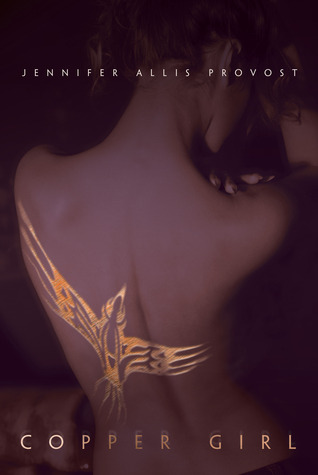
Giveaway (US & Aust only) + Copper Girl by Jennifer Allis Provost

Published: June 25th, 2013

Goodreads badgePublisher: Spence City
Pages: 248
Format: Book
Genre: Romance/Fantasy
★   ★   ★  – 3 Stars

Sara had always been careful.
She never spoke of magic, never associated with those suspected of handling magic, never thought of magic, and never, ever, let anyone see her mark. After all, the last thing she wanted was to end up missing, like her father and brother.
Then, a silver elf pushed his way into Sara’s dream, and her life became anything but ordinary.

I was given an ARC copy of this book by the publisher.

Copper Girl is the story of Sara, from the blurb we know nothing except that she had always been careful, never spoken of magic, and never revealed her mark. Then, a silver elf called Micah pushes his way into Sara’s life, a mysterious elf who knows things others don’t, and her life becomes anything but ordinary. We watch as Sara learns more about her family, her world, and herself, and in doing so reveals that the start of something important is about to begin.

The hint of hidden magic draws you in and with no explanation why, aside from a missing father and brother, your mind begins to deduce and create its own answers before you even begin. The answer I was creating was not what I expected from this book. Provost has done a great job in creating this world, this dystopian world where magic has become something to be hidden, something wars have been fought and lost over, and something that is punishable by those who now run the government.
On the opening page we are introduced by a standalone sentence that suggests the coming action has created a problem. This sets you up immediately waiting to see what this problem is, and when it arrives with no clear indication it is a problem, that just creates more mystery, making you keep going. From this beginning though I felt the follow up was a little strange, and as the story began it took me awhile to completely understand what was going on; the explanations are scattered and you have to keep track and recognise what is information that must be remembered and what isn’t. Terms and phrases are used in conversations that are important, and you realise that they are important yet you don’t know what they mean or have any understanding of what they are.

One of the main aspects that I was confused with was the switch between regular and italicised text. The story is told from Sara’s point of view, but while she narrates her life there are also moments where the narrative halts while something is explained, whether it is her job description or telling us about the war. These remain in Sara’s voice, but they definitely feel like it is a paused moment in the story to add information, then the story continues. These italic sections are not always for explanations sometimes they are dreams and memories that are part of the narrative, small tangents like the mind wandering off topic so they seem to hold different purposes; in the end I found it easier to just read them without thinking of them as something separate and I found that after a few chapters the italics sections disappear.

The good news is that after this bump in the beginning a pretty great story emerges. The idea that Provost has created with this dystopian world, hidden and banned magic, and a monotonous and yet highly regulated existence, is rather enticing. The post war environment was not apocalyptic, more highly run with contraband, curfews, and strict regimes and routines that should be adhered to to keep things running smoothly. It is a bother but with Sara being used to it, you get the idea that people just do what they do and get on with it, with just an occasional comment at its unfair nature. The magical aspect with the Otherworld, the concept of ‘Metals’, as well as the secrets and capabilities of those who possess magic is also engaging and leads itself to being explored at greater length and from multiple angles in the series.

Trying to understand the relationship between regular humans and the magic was interesting, but not hard to comprehend. The coexisting worlds were well explained, as was the outcome of the conflict. From what I understood of the War and the world that existed before it was that it seemed to be very similar to the X-Men. Humans and those with magic coexisted until those without became paranoid, fearful, all the usual responses, thus creating war and sending magical people underground or into submission. The resulting society is not explained completely, but we catch glimpses as Sara makes reference or certain events reveal the life they all now lead.

There was uncertainty about the nature of the world, the same with the other parts in the beginning, but the confusion I got is soon smoothed out as the story goes on. The slow reveal technique has its advantages and disadvantages; the key is I think to know what works best and where. Certainly secrets and mysteries can be revealed in the narrative slowly, however the set up of the world and the systems in place perhaps could have been explained earlier than it was. Once we were given this information there was a greater understanding of the society, which in turn supported and aided the characters and plot nicely.

The characters in the novel are good. They are unique, each with their own personalities and peculiarities that are humorous and mystifying. Sara is a great character, she has a wit and a sarcasm about her that makes her enjoyable to read. She is a young adult from what I could determine and she is caught up in these two worlds, all of which bring out her character really well. Micah is a strange character, he is very forward, a tad annoying at times, though his reasons for his behaviour are understandable. As the love interest I felt that his relationship with Sara happened very quickly and with little or no questions. He comes on very strong and she falls fast. The issue I had about their fast affection is explained towards the later part of the book which was ok, having an explanation makes it much more understandable.

Aside from Sara, and partially Micah, most of the remaining characters are not explained with a lot of depth. Their past, history and nature are revealed as the plot requires, or within family dynamics and other relationships, but being the first book in the series one can hope that they are developed further as the series progresses.

When the real world and the other realm truly combine it is quite late in the book, with the relationship between Micah and Sara taking up a lot of the book. The relationship is interesting, Provost explains the emotions and the hold they have over one another, yet a few aspects such as dream walking seemed unexplained, resulting in the idea to be pieced together as the story continued. This was ok, but considering there were clear moments where we’re told a history or something, a longer explanation would not have gone astray.

I did like that Sara existed in a world, and came from a world where magic was known, and she herself was magical. This reduced the level of surprise when it is reintroduced into her life and makes this different than stories where an issue of a non-magical person having to come to terms with being magical or understand magic is hard to do properly. Even with her existing knowledge Sara is still naive, she tells us that she was very young when the war happened, and she grew up with no magic and was not old enough at the time to be introduced to the world entirely. This situation of her being half in the door means that she is learning some things alongside us, but without the need to accept the entire concept, just filling in a few blanks about history and certain elements. I think this is where the unbalance about what is told and what isn’t happens. Having a character knowing so much results in too much telling to catch up the reader and leaves nothing for us to piece together ourselves, but on the other hand without any information we can become lost due to lack of telling. Provost switches between both, some information is unnecessarily included, left out completely, or told at just the right time.

As the reader who knows nothing, a lot still seems a bit unanswered, with enough history given, yet not enough at the same time. I felt like I had missed something or that the fleeting explanations were not enough. It didn’t hinder the story exactly, I knew what was going on, however the information and world Provost hints at seems so rich with history and magic that I wanted a grander introduction to it all. Perhaps slowly revealing bits and pieces throughout is enough, and maybe it was just my desire to have the complete history that was on my mind. I can only assume that more is to be revealed in the coming books.

The ending was very well rounded, there was no direct cliff hanger, but there was enough to see where the story could grow. We are given an introduction into this world and enough to peak curiosity about where it is headed, but we are not left in the middle of a scene or without real answers to leave us unfulfilled and impatient for book two. I look forward to the second in the series to see how this plays out and hopefully to get a greater understanding of the intricacies of the society and otherworld complexities.

Copper Girl comes out 25 June thanks to Spencer Hill Press and Spence City.

GIVEAWAY (US & Aust only)

Thanks to Spencer Hill Press and Spence City I am offering some goodies to celebrate Copper Girl coming out. Those who enter go in the draw to win

 A token (replica from the book)

$10 Barnes and Noble gift card

T-Shirt

Update: Now, there is a Rafflecopter widget but WordPress is against them being in posts but I have been fiddling and I think we can get it to work another way, so you can continue with the first tweeting/commenting combo, or you can hopefully click the  link and open the widget up and enter that way. Let’s see how that goes. If it doesn’t work, let me know and I will revert back to only original set up. Those already entered via comments are still included in the draw.

Options
1) Enter via the Rafflecopter widget

OR

2) Tweet the book’s Goodreads link and you get two points towards winning. Once you tweet the link, provide your name and your Twitter name in the comments of this post so I can check your entry.

Example tweet:

“Tweet a link to Copper Girl’s Goodreads page to enter the competition over at @lostinagoodbk http://wp.me/p3x8rS-8i http://www.goodreads.com/book/show/16193519-copper-girl?ac=1”

Entries close on 24 July. Good luck!

Where the Wild Things Are by Maurice Sendak

Birthday

Happy Birthday Maurice Sendak! It was a sad day when the world lost him last year, yet we know his stories will live on. So, in honour of his birthday, I am reviewing my favourite book of his, Where the Wild Things Are.

Maurice Sendak was born in 1928, the same year as Mickey Mouse, and he had an interesting life. His extended family were killed in the Holocaust which naturally exposed him to concepts of mortality and death, and he had health problems as a child. It was these health problems which confined him to his bed that developed his love of reading, and it was watching Disney’s Fantasia that made him want to be an illustrator (who wouldn’t that film was phenomenal).

His first illustrations were published in a textbook called Atomics for the Millions and he spent a lot of time illustrating other people’s works before beginning to write his own. He is quoted as saying “My gods are Herman Melville, Emily Dickinson, Mozart. I believe in them with all my heart”; but there were many other sources of inspiration from painters, musicians, authors, and a key influence was his own father and the stories he told him.

The impact of Sendak is clear when you look at what people said about him when he died last year. The New York Times called Sendak “the most important children’s book artist of the 20th century.”
Darling Neil Gaiman said “He was unique, grumpy, brilliant, gay, wise, magical and made the world better by creating art in it.” And even the delightful Stephen Colbert said that “We are all honoured to have been briefly invited into his world.” I wholeheartedly agree with them all. He did have other books, his final book, Bumble-Ardy, was published eight months before he died, and there was a posthumous picture book, titled My Brother’s Book, published in February 2013, 50 years after Where the Wild Things Are. It is hard sometimes to remember there are more books out there when Where the Wild Things Are is so loved and cherished.

Sendak wrote Where the Wild Things Are in 1963 and from a rocky and critically negative start it has grown to be one of the most beloved stories of all time. Author Francis Spufford said that the book is “one of the very few picture books to make an entirely deliberate and beautiful use of the psychoanalytic story of anger”, and I think this is entirely true, part of what makes it wonderful.

I am not sure how many of you have read Where the Wild Things Are, and it is a fairly short book so I probably will be giving a variation of a spoiler so here it is, the spoilers warning just in case because there is not a lot to cover. But even so, you should read the book regardless of me spoiling it a smidge.

Published: May 4th 2000
Goodreads badgePublisher: Red Fox
Pages: 37
Format: Picture Book
Genre: Children
★   ★   ★   ★   ★  – 5 Stars

One night Max puts on his wolf suit and makes mischief of one kind and another, so his mother calls him ‘Wild Thing’ and sends him to bed without his supper. That night a forest begins to grow in Max’s room and an ocean rushes by with a boat to take Max to the place where the wild things are. 

As a kid, I adored Where the Wild Things Are and I still do. I think everyone needs to read it at some point in their life (I am not telling you not to watch the 2009 film but…I am not 100% convinced about that yet, it made me slightly ill at ease and a bit grumpy when I watched it but I can see what they were doing. It looked nice, that’s something). The book had been adapted several times before the movie, including an animated short in 1974 (with an updated version in 1988) and a 1980 opera.

Where the Wild Things Are tells the story of Max, a boy who puts on his wolf suit and gets into mischief. He was a Wild Thing and so he goes and joins the other Wild Things, sailing away in a private boat until he reaches the land of the Wild Things where his many adventures can begin.

The absolute best bit I think is the ending, and all of it, and really what this whole story is. Sendak shows us the story of Max, but while it looks like we are looking from the outside, it is actually Max who is telling us this story, it is all from Max’s point of view. We see him take control of these Wild Things, he rules them, sends them to bed without supper, he becomes the one in charge. I certainly do not want to be psychologically breaking down this story because that is the first step to ruining something wonderful, but as clear as it is, it shows you the power of Max’s mind, and what is entirely possible if given half the chance.

We need to take a moment to mention the pictures, Sendak did the pictures himself and they are stunning. They are displayed filled with colour, but have a dark mystical element as well. There are pictures that sit on white pages, there are pictures that sit above text strips, and there are wonderful full page and two page illustrations that require no words at all; truly beautiful.

These images, as a lot of children’s illustrated books do, support the story, and tell the story so limited words are needed. There is an argument in the scholarly world that illustrations lead children’s minds and makes them unable to create images on their own but I think there are exceptions, this is one. You can still use the images Sendak gives you to create a fuller story, you can imagine the dancing and the sailing and everything, the illustrations are your starting point.

This is a beautiful book and a great story that lets you enter the world of the Wild Things; and if Max’ mischief isn’t enough fun, than the majesty that Sendak puts into the Wild Things through image alone is pretty darn amazing, I always wanted one based on those illustrations alone. A truly amazing story, by a truly wonderful person, author, and illustrator who wrote and illustrated many more books you should check out, and I think you should all experience Where the Wild Things Are if you haven’t.

Maurice Sendak Goodies

1983 Disney CG Animation of Where the Wild Things Are – it ends abruptly and seemingly in the middle but it is still rather cool

Maurice Sendak reading Where the Wild Things Are

10 Fascinating Interviews via Flavorwire

Another Interview

Previous Older Entries Next Newer Entries