Peter Pan by J. M. Barrie

Birthday

A huge happy birthday to James Matthew Barrie, author of the wonderful Peter Pan! I loved this book, I love that Barrie creates this world and these characters that are wondrous and engaging, but he also writes the story with heart and sometimes blunt truths, there is no real romanticising about life, Neverland is the wonder away from the rest of the world and that is why it is marvellous.

In Kensington Gardens in London there is a status of Peter Pan honouring Barrie. Peter is playing his pipes and has animals at the base; it certainly lends itself to the theory that Peter Pan has a connection somehow to the Greek god Pan. I know him best for the novel Peter Pan, but J. M. Barrie had dozens of others works before and after of both stories and plays, right up until his death in 1937. He was knighted in 1913 for his literary work and in the same year became Rector of St Andrews University. His other successes include becoming the President of the Society of Authors, a title which he took from Thomas Hardy which is cool.

I never knew he was knighted, but I do remember that when I was studying Barrie and Peter Pan at university, it became very clear that he was certainly peculiar, or at least lived a strange life, one that no doubt impacted on him. He was not all strange though, he knew some excellent writers of the time including Robert Bernard Shaw, H. G. Wells, and Robert Louis Stevenson.

He was the ninth child out of ten, two having died before he was born, and as an adult he was only 5″ 1′ (about 155 cm). When he was young his brother David, who was the next eldest and his mother’s favourite, died just before his 14th birthday. It devastated his mother and Barrie then it seems devoted himself to trying to fill David’s place, to the extent that he even dressed in his clothing. Barrie wrote a biography of his mother called Margaret Ogilvy, and in it he discusses his mother’s reaction to David’s death, as well as his attempts to please her afterwards. If you want to read it it is available from Project Guttenberg for free.

There was a wonderful theory that we heard in class that Barrie wanted so badly to be David and be the “son who never grew up” for his mother that he developed psychological problems and even managed to stunt his growth and proper adolescent development. This does not seem to have any grounds in fact I think he was just short, but he was no doubt strange enough that he probably tried. His innocence that he held until adulthood made him the perfect candidate to write a story like Peter Pan, he never properly grew up, and loving to write and tell stories probably helped this, he could stay young and innocent forever through words. He was initially discouraged from becoming a writer, I for one am very glad he chose to write, where would we be without Peter Pan to fill our dreams and fantasies and to fly us to Neverland in the middle of the night?

Peter Pan has many influences, but the main ones that inspired the play and the characters of the Darlings was the connected to Mr and Mrs Llewelyn-Davies and their boys George, John, Peter, Michael, and Nicholas. And before the legends and did you know facts appear, no he did not create Wendy, it was a name prior to the first appearance of Peter Pan, Barrie simply popularised the name.

There is truly so much going on with Barrie, his relationship to the Llewelyn-Davies family that helped create this Peter Pan world, not to mention the sad fate that many of them had. The entire history and environment and life of Peter Pan is absolutely fascinating I could write forever on, but I won’t, I will however review Peter Pan, one of the greatest books, certainly became established in society and popular culture, and definitely a classic for all ages.
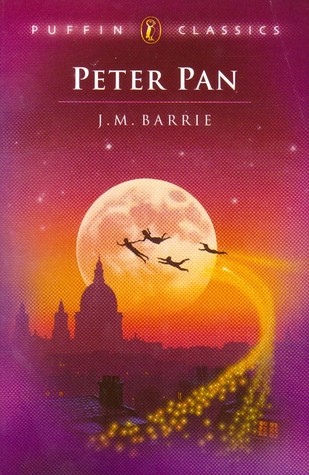

Published: January 1st 2002

Goodreads badgePublisher: Puffin
Pages: 242
Format: Book
Genre: Junior Fiction
★   ★   ★   ★   ★  – 5 Stars

The boy who refuses to grow up teaches Wendy and her younger brothers how to fly. Then it’s off to magical Neverneverland for adventures with mermaids, Indians, and wicked Captain Hook and his pirate crew.

Everyone seems to know the story of Peter Pan, the boy who wouldn’t grow up, Tinkerbell and Wendy, and the mystical world of Neverland. I first knew of this story through the Disney version, but I also had a video of an Australian cartoon version which I also loved. Many of the versions of this story keep a lot of the same elements in it, there is no Peter Pan without pirates, Indians, or mermaids, but there are certainly some varying elements compared to the book.

The story of Peter Pan first appears in The Little White bird, a story written in 1902 by Barrie and was intended for adults, not children. The first real sighting of Peter is in the stage play in 1904 where it was titles Peter Pan, or the Boy Who Wouldn’t Grow Up. The novel version, which is probably the most well known version (aside from the movie interpretations), was extended from the original play and published in 1911 as a novel.

With the extended novel there is a chance to expand on character and ideas. There is also a lot more story within the book compared to what people know from the popularised Disney film. There is a lot more involvement of Mr and Mrs Darling in the book, and they come home as their children are flying out the window and know that their children are missing. Wendy, John, and Michael’s visit to Neverland happens in real time, and the time they spend there with the Lost Boys, Peter and Tinkerbell is time passing back in London. We get to see the reaction and life Mr and Mrs Darling have while their children are gone.

Barrie actually opens Peter Pan telling us the story of Mr and Mrs Darling, it is all very sweet. This also helps you understand them as people and parents, they are not just the parents with the story focusing solely on the children and their adventure, it is about the whole story sequence, not just the characters, but in the same wonderful way it is also so much about the characters.

I remember when I first read this story and realising that having a dog as your nanny was not a Disney invention of movie quaintness, it is actually in the book. Nanna it seems gets to have opinions about things and is a very good nanny. There is no first person narration for any of the characters, but Barrie does tell us what everyone thinks when it is required. Though this is not the only strange thing, there are other peculiarities, Mr Darling literally spends time in the doghouse out of guilt for his missing children, neighbours walking by and judging and everything. That was rather strange, but it has its humorous sides as well. It isn’t so much an absurd, only very strange at times.

There are many great moments in this book, even just reading about flying, the journey to Neverland and the adventures that await them. There is a little violence in this book regarding pirates and fairies, but it isn’t described in great detail, but it is still there. Peter helps this a little, in his own childlike way, brushes over things and quickly moves on to the next thing, always chasing another adventure as we are told. Tinkerbell speaks in the book, and there are additional characters and variations of scenes which make it that much better. A lot of Peter’s character is seen in his actions and his leadership. He can change from being proud and selfish to being rather noble and sweet very quickly.

Peter Pan is certainly not the exact character that the movies portray him as; in the book Peter Pan has much more selfish childishness as well as the naivety and cockiness. It is actually mentioned one of the reason Hook hates Peter so much is that he is always so cocky.

Peter is not the only bunt one, Barrie does enough of his own in his narration and explaining, it is very matter of fact, but Barrie expands on what needs to be told and what does not. The voice Barrie uses is one of a storyteller, you get the feeling he is speaking to readers as he recounts the lives and adventures of Peter and Wendy, this certainly adds to the magical nature, like a tale of times that once were.

Barrie definitely brings us some memorable characters in this book, not to mention quotes like “Second star to the right, and straight on till morning” and particularly “To die will be an awfully big adventure”, which is one that has stayed in my mind for years. It is rather telling of Peter’s mind when he says this. He has such a carefree attitude, never worrying and is not typically one to fret over anything. He definitely has a child’s mind, he moves from one thing to another, and quickly forgets things if they are over or no longer concern him. Though the connection and relationship he has with Wendy is sweet, you can feel that he loves the idea of having a mother and being cared for, but he wants things his way in his land, being the child forever.

The ending of Peter Pan and the events in the final chapter I found to be some of the most heartbreaking moments in this book, and certainly was not something I was expecting. I think it is a brilliant ending, but I felt such a pain as I read because it was so innocent, but also so sad at the same time; Barrie did an excellent job. There are entire moments of brilliance in this book, heartfelt, magical, and all round beautiful. You take the abruptness and the selfish Peter and you see him and others in so many other lights that it is all part of the magic and wonder that is Barrie’s story. There is so much to gain from reading this over a movie, the movie can bring you to the book, but the book can give you the soul of the story.

The Viking’s Apprentice (#1) by Kevin McLeod

Published: March 28th 2013
Goodreads badgePublisher: Self published
Pages: 125
Format: eBook
Genre: Junior Fiction/Fantasy
★ ★ ★ ★ ★ – 5 Stars

What happens in Campbell’s Cove, must remain in Campbell’s Cove. 

Campbell’s Cove is a town steeped in a rich history of dragons, witches and brave warriors. History tells of one Viking warrior who rose above them all to claim the ultimate prize. Hundreds of years later strange things start happening in the town. Could the Viking stories be true? Has the evil returned? Who can protect the people?

When school friends Peter and George take their summer holiday with Peter’s Granddad it turns into an adventure that they will never forget. Peter must face a future he could never have dreamed of and learn of a past that has been kept secret for hundreds of years. A fight for friendship and survival and a struggle against an ancient evil that takes them into the Caves of Campbell’s Cove and beyond.

The Viking’s Apprentice is the debut novel for author Kevin McLeod and as soon as I read the plot and saw the cover I went hunting for this book. When I realised it was an ebook only I downloaded the necessary apps and away I went head first. This is an excellent book, just as it looked like it would be. What McLeod does is he has created a world of mystery and magic within our own and even in this first book, for even as I read I could tell there would be a second, is he has engaged readers. He uses stories of an ancient time, seemingly simple, but with so much hidden meaning and history behind it, to reveal the past, explain a story and begin an adventure. However it is the way in which he does this is what was wonderful: by using characters to do the work for him he enables readers to learn alongside the children as they too hear the wild adventures of the past, hearing tales of heroics of Vikings and warriors, dragons and battles.

The story begins with Peter and his friend George going to stay with Peter’s Grandad at Campbell’s Cove for the holidays. We learn that Peter does this often and what we know of Grandad is he is a teller of stories, stories about the Cove’s history, rich in dragons, warriors, and witches. The descriptions in this story are wonderful, but it also allows the reader to create their own images. The images created as you read Grandad’s stories to the boys about when dragons were fought and villages were under threat are excellent. In so few words seemingly complete stories can be told. This is another clever trick by McLeod; readers are given the same position as the children in the beginning, we, as they, sit impatiently while Grandad recounts his stories. This is where our knowledge comes from and we must wait, unless you start speculating like I did, but McLeod gives nothing away until you and the children need to know.

In other books like Fforde or Colfer or Nix where you know the authors like to play with you so readers only get what the author wants them to have until they’re ready, McLeod does this as well, and uses the children wonderfully to do so. They are not exactly withheld information, but within the story characters respect the relationship between the boys and the Grandfather, and when questions are being asked the main response is, ‘I think it would be best for your Grandad to tell you, or ‘he wants to be the one to tell you’. I liked that part, we are being held filled with suspense about what exactly is going on, but there is a reason for it that you know will be better to help gain a full idea of the story.

That is not to say we stick with the children the entire time through this story. McLeod gives us both sides of this saga, and the ambiguity and secretive unspoken and unexplained snippets about the coming danger is very creative. This is where we are treated as a reader away from the children; there is no information though, only secrets and mysterious figures. What I always like is that there are unexplained actions that occur but we see no explanation of meaning we are left to try and figure it out for ourselves. For a book suited at this age and audience, it is rather intricate and mysterious, something I applaud.

Where this story begins to grow in excitement is when these two stories we’ve seen combine and the past seems to return, and perhaps the Vikings and dragons of Grandad’s tales are become less of a story and more of a reality. I am offering no spoilers so don’t even try, but I will say that I adored how this was revealed and how it played out. I really liked though that McLeod was able to capture the urgency in the story with his writing, you definitely feel that things have become chaotic, or have calmed down, or that there is an eerie feeling. This certainly helps create feeling of a story without actually making it blatantly obvious and announcing it to readers. By the end of this book you are hanging out for the next one, McLeod has set up this story very well and he adds just enough to make you want to keep reading about these characters and see the effects and consequences o the events in this book. I look forward to continuing this series.

The Scarecrow and His Servant by Philip Pullman

Published: November 3rd 2005
Goodreads badgePublisher: Corgi Yearling
Pages: 230
Format: Book
Genre: Junior Fiction
★   ★   ★   ★ – 4 Stars

One night there was a thunderstorm. A tattered scarecrow stood in the wind and rain, taking no notice . . . until a bolt of lightning struck his turnip head. The scarecrow blinked with surprise and came to life.
So begins the story of the Scarecrow, a courteous but pea-brained fellow with grand ideas. He meets a boy, Jack, who becomes his faithful servant, and they set out to journey to Spring Valley together. Along the way there’s no end of excitement – battle and shipwreck, brigands and tricksters – and it’s up to Jack time after time to save the day.

After yesterdays grand post I feel a nice short one is in order. I also cannot believe I haven’t reviewed a Pullman book yet! This must be rectified. And since we are making it nice and short, no Dark Materials this time, but they will come I assure you; maybe not today, maybe not tomorrow, but someday.

The Scarecrow and His Servant is an absurd story but it is fun and light-hearted even when it covers the occasional unpleasant topic. These unpleasant topics are not adult or grotesque in any way, but rather have the ability to be blunt on occasions. This is masked I suppose by the madness and jovial absurdness in characters, and also in the occasional sentimental and touching moments as well, all combining to make the story realistic (as it can be) within the created narrative.

The story starts with the creation of a scarecrow and the discovery of this scarecrow by a young boy. Together they have adventures and get into trouble and become friends. The scarecrow is a combination of grand optimism, ignorance and simple dimwittedness. The young boy Jack has some sense in him, and is often having to talk the scarecrow out of trouble he’s gotten in to. And, naturally because everyone is as mad and absurd as each other, his strange explanations are perfectly acceptable.

There is a fairytale quality about this story which Pullman is brilliant at doing, he adds magic and surrealism to real life places and circumstances that tweaks reality a little but keeps everything else alone. I rather enjoyed this book, it was different and curious, but there was moments in the story that seemed so obscure and strange that you just had to go along with it. Some moments in the scarecrow and Jack’s adventures are heartwarming, while others are dangerous and seems quite stupid. It is best to remember that this is in fact a scarecrow and a child, no matter how in control either of them seem to be. And the fact no one notices/minds the walking talking scarecrow is another thing you don’t really notice until you think about it and then it just becomes something you accept.

I particularly liked the ending, after the mystery and tangents and questions it was nice to see some form of resolution. With all the characters and friends the scarecrow and Jack come across it is a fitting ending given their strange journey, and Pullman manages to bring the story round from its madness very well indeed. Despite being a children’s book I think with its twists and turns, adventure and suspense the story is engaging for everyone and it adds a bit of silliness which, when done as well as this, is never a bad thing.

Artemis Fowl and the Lost Colony (#5) by Eoin Colfer

Published: May 31st 2007
Goodreads badgePublisher: Puffin Books
Pages: 376
Format: Book
Genre: Junior Fiction/Young Adult Fantasy
★ ★ ★ ★ ★ – 5 Stars

Ten thousand years ago, humans and fairies fought a great battle for the magical island of Ireland. When it became clear that they could not win, all of the faeries moved below ground—all except for the 8th family, the demons. Rather than surrender, they used a magical time spell to take their colony out of time and into Limbo. There they have lived for decades, planning their violent revenge on humans.

Now the time spell is unraveling, and demons are beginning to materialise without warning on Earth. If humans were to find out about them, all faeries would be exposed. To protect themselves, the faeries must predict when the next demon will materialise. But in order to do so, they will have to decipher temporal equations so complicated even a great brain like Foaly can’t understand them. But he knows someone who can: Artemis Fowl.

So when a confused and frightened demon imp pops appears in a Sicilian theatre, Artemis is there to meet him. But he is not alone. Someone else has unlocked the secrets of the fairy world and managed to solve complex mathematical problems that only a genius could. And she is only twelve years old…

I adore this man, how can you not adore this man!? Why is it that he has the ability with a handful of words to change everything and make everything wonderful and beautiful and spectacular and astonishing and imaginative and poetic all at the same time! No matter what the situation there is time for quick witted jokes which makes it even better, and just when you think you finally have it sorted it out, the narrative is in place, and the ending is near, Colfer, in the space of a few words, changes everything! And I love him for it.

Artemis Fowl and the Lost Colony begins with one thing, moulded into another and then changes completely. You do not even realise this until you finish the book and you think about the incredible journey you have just been on. Every time I picked up this book it was by force I put it down again, especially in the final chapters.

It begins as all Artemis adventures do with the smooth charm that keeps you going, and then we merge into strange fascination, and then you are thrown into this experience where you just keep your eyes on the page, pay attention and use all your willpower not to skip ahead a few lines because as beautiful as Colfer’s sentences are, and how great his story can be, you just want to know what happens.

You know you may have read a few Artemis Fowl books when you start to know what will happen before it is revealed. Not a lot before I assure you, only by a line or so, Colfer isn’t that willing to give up his secrets and twists. In a way I’m proud because I can still enjoy Artemis’ genius in what he has in store and what decisions and risks he takes; it has in no way become predictable.

We are introduced in this book to a possible new foe and competition for Artemis, a younger, equally smart competition called Minerva. Colfer writes on the blurb that he is glad Artemis finally has some competition, I myself was wary, but Colfer handles it well, as does Artemis. Surprisingly, while you think Minerva is going to be the main point through the book, she isn’t.

This introduction and seemingly proposed issue of a new intellectual conflict does not last long and the magical world takes priority once more. I enjoyed how Colfer gave us a new perspective with a new world and characters, as good as it was that he had been changing up the existing world, it was nice to see that there are other worlds out there. Similarly as he had done when we first learned of the LEP and the People, we are given a decent introduction of the world rather than a hurried and fractured welcoming through Artemis’ interaction or some other form.

This new world is known as Hybras where a colony of demons and imps reside, living in isolation, awaiting the day they can take revenge on the humans who it seems are responsible for their exile. Despite all being equal to a degree, Hybras is ruled by Abbot, the wisest and most legendary figure in the land. All adore him and his warrior stories, all except one: No.1. No.1’s story is one we follow and discover that he is different from the others, and he doesn’t know why; that is until Artemis Fowl comes into the picture and changes everything. I liked No1, his innocence and naivety is balanced by enthusiasm and curiosity, and there is a lot plot wise that helps bring out the best in him, which makes him a great character.

Along with the new, the same faces return, though not as frequently. I was rather surprised and excited with Colfer’s approach on this one, phrases and snippets referenced beforehand suddenly make a lot more sense at the end, and it reveals a lot about how important people can be in others’ lives. We had seen this in previous books around other characters but this I was not expecting; it was intricately clever and well done.

The setting of this novel is mainly set in Hybras adding another nice change. With the initial introduction we are given further exposure through the actions of Artemis and friends. The events and risks taken in this novel bring great excitement to the story, as does the continual cryptic puzzles and problems that arise. Magic plays its hand once more in influencing and impacting on Artemis and in a few ways slightly more permanently. I know I am being deliberately vague about this entire thing because first of all, where do you even begin to talk about what happens in this book, and secondly, some of the surprises and twists are too great not to enjoy first hand. There isn’t a lot to talk about without revealing something wonderful so all you’re getting is vagueness and emotion. That hopefully is enticing enough.

You can love these books for Artemis’ wit and charm and everything else but the end of this book I think was so unexpected I think it almost outweighed the delight about everything else. I simply adored the ending! I adored it! It freaked me out, it worried me, it confused me, and I am so eager and anxious to leap into book six I just don’t know whether to wait and calm down or power on through before the curiosity is the end of me. It opens the way well for the following book and the cliff hanger he provides is definitely going to be a game changer I feel. There is something about sudden and dramatic changes that can either change things for the better or worse, but knowing Colfer he has a plan up his sleeve and whatever happens is not going to be ruined or rushed, and handled with excellent care that we have seen before.

As a character I am trying to decide which Artemis I prefer. I can’t say I prefer this Artemis over the ones we see in the earlier books, all are charming (he is always charming!), and as he nears my own age it becomes less weird that I have such an affection for him. Right? Though I do love all the sides of Artemis, especially when he tries to fight the things he can’t change, and how no matter what he is doing he still manages to think systematically and plan ahead. The fact we see Artemis grow and develop through the books is wonderful, you see the child grow emotionally while still keeping the same sharp wit and intellect of the twelve year old. Seeing his character in the next book will be a treat I feel, especially as a result of the events in this book.

A fun thing though I did notice while reading was that on the back of my cover (and now I must check all other covers) is a small disclaimer by Artemis himself. It reads: This man is NOT my biographer. He is a fantasist, writing sensationalist stories about me. I will neither confirm nor deny anything that appears between these covers. However, my lawyers – and my bodyguard – are watching. Signed Artemis Fowl ll. I love this as well, reminds me of the bits in Unfortunate Events where Snickett includes himself in the story.

There is no real, logical reason to stop following Artemis Fowl, you can never tire of him, and Colfer has yet to lose appeal if this book is anything to go by. As long as his imagination, creativity, uniqueness and genius are all in working we have nothing to worry about. Artemis Fowl’s adventures will always be there to document, no matter how unofficial they may be.

Artemis Fowl and The Opal Deception (#4) by Eoin Colfer

Published: April 30 2005
Goodreads badgePublisher: Puffin Books
Pages: 343
Format: Book
Genre: Junior Fiction/Young Adult Fantasy
★   ★   ★   ★   ★  – 5 Stars

The evil pixie Opal Koboi has spent the last year in a self-induced coma, plotting her revenge on all those who foiled her attempt to destroy the LEPrecon fairy police. And Artemis Fowl is at the top of her list.

After his last run-in with the fairies, Artemis had his mind wiped of his memories of the world belowground. But they have not forgotten about him. Once again, he must stop the human and fairy worlds from colliding—only this time, Artemis faces an enemy who may have finally outsmarted him.

I would like to take this moment to quote myself if I may. Ahem, “What’s great is that there are no grand corporate plots, evil nemesis’ and no fairy political struggle infringing on the human world.” I wrote this about book one and I am actually rather pleased it has taken until Book Four to prove me wrong. Book four was always going to be interesting based on the end of book three, but this took it to another level. Artemis is always a fantastic character, but having to deal with the outcome of the last book, it only added to his charm.

Book four sees the return of dear Opal. Poor Opal has not come out of the last LEP encounter all that well but that is not going to stop her. Revenge is the key theme through this book, always a thrilling subject. As I say, I like how we had to wait to see this grand scheme. We were not thrust into it unexpectedly, and we actually got to see the cause before the retaliation which was brilliant. It was not a knee jerk reaction, nor was it rushed and passed over. Colfer thought this out and it paid off. By waiting as he did, really for the opportune moment, it had the impact and the consequences it needed to suit the world and characters it affected. By now we have history and cause, we know all the characters involved rather well, and it gels together so much better once we have become invested in these characters and their lives.

Like all Fowl books The Opal Deception is very intriguing and you only realise, well, I only realised how clever it was once I had finished. You knew it was clever and amazing and sneaky while it was going on, but then you think about it, and the title and the characters and you go, ‘ohhh, that’s quite clever actually’.

We’re given the same great characters as usual, plus some new ones, each with a witty and unique personality that is executed well. Despite visiting the same people each time, it actually doesn’t get old, even if it does sound like that in reviews. Colfer has created these characters that each time is a joy to see them do what they do. And through the narrative and the events that take place, new sides of everybody are revealed and offers that little something different about them. The story offers twists very early on and doesn’t shy away from anything. This is a little bit of a shock but it is also brave and probably necessary. Though I say this seeing how it ended and guessing where it might go next. The internal struggles described and played out in this book were also very well done, and believable, especially for Butler and Artemis I felt.

I approve very much of how Colfer keeps things in real time as it were. Artemis gets older, life goes on and real life happens amidst all this magical and exciting action and espionage. Can we call it that? I don’t see why not. I recall commenting on how enjoyable it was catching glimpses of a new side of Artemis when he is thrown into new situations, and this continues here. Whether it is his age or his experiences there is a new side of dear Arty seeping through and it is a joy watching him analyse and struggle with himself in his typical manner. But what I found great was how Artemis’ past actions had shaped him, and how without them how different he could have been. It makes you realise where he was in book one and how without realising it he has changed.

There is the usual suspense Colfer offers, but in a different form this time I felt, just as intense mind you, but focused on different expectations. I loved it, it was making me anxious trying to cope with the mystery and suspense of where this story was going. Before it was a lot about the mission or the situation they were in, and the same was true here, but there is also an additional personal suspense I guess you could call it. Less about the adventure and more suspense and guessing about characters and the direction they were headed instead; very unexpected but welcomed. Though really, trying to guess where the story is headed and trying to think a step ahead of Artemis is always a challenge and a pleasure when it comes to these books.

I think book four is a very good turning point in the Artemis saga. So much has changed by the time you are finished this book you really have no idea where it will go, again a little like the previous book, but Colfer knows what he is doing, and he directs us and leads us on the new path. I think these changes make book five more inviting because you essentially start a new saga of sorts, but with the same people you have known for what seems like forever. Definitely one of my favourites so far and one I would really like to read again quite soon.

Previous Older Entries Next Newer Entries