The House at Pooh Corner by A. A. Milne

Image result for house at pooh cornerPublished in 1928 this is the sequel to Winnie-the-Pooh. This second volume of stories contains ten chapters, each a story with an adventure of sorts that Christopher Robin and his toys go on. The House at Pooh Corner is important because it’s the book where Tigger is introduced. It’s hard to imagine we may have had Winnieithe-Pooh without Tigger, perhaps it would have been another toy instead if Christopher Robin’s mother had chosen differently. I used to think it was Kanga and Roo who were introduced in the second book but it was actually Tigger. Possibly because Tigger took off with such popularity and Kanga and Roo were less notable that I thought they were later introductions.

I love this book as much as the first one, the stories are beautiful and there are some wonderful important moments about friendship and kindness, and I think Eeyore is so delightful and the relationship between Pooh and Piglet really shines. The game of Pooh Sticks is also created in one of these stories, and it includes a slightly older Christopher Robin, growing up and heading off to school. This is a heartbreaking book in a way, Christopher Robin realises he is growing up and it makes some wonderfully moving monents that make you (me specifically), very teary and emotional.

I think the first book outshines this a bit, or maybe people merge them into one book, but House at Pooh Corner is a grand little book in its own right and deserves to be seen as its own book, not confused and muddled in with all things Winnie the Pooh.

Pooh Corner is mentioned in the famous Kenny Loggins song titled Return to Pooh Corner, and oh my goodness if you haven’t heard it you must. It will crush your heart and make you nostalgic and all kinds of emotional. I adore it to no end and I proper cry everytime I hear it. Not as connected to this book in terms of story but Pooh Corner is where a lot of things happen once it has been created so it deserves a mention (plus it’s a gorgeous song and I need to mention it somewhere). Both this book and the song are wonderful about growing up and being young and carefree and friendship. I’m getting all teary thinking about them both now so I’m going to stop there and resist the urge to listen to the song.

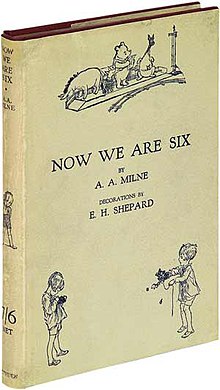
Now We Are Six by A. A. Milne

Image result for now we are sixPublished in 1927 this is the third children’s book by Milne, published after the success of Winnie the Pooh. Now We Are Six contains thirty five verses, with more E. H. Shepard illustrations to accompany them.

The poems have inspired many others; around 1930 Mimi Crawford recorded several poems with music by Harold Fraser-Simson, the title is played upon with the 2003 book Now We Are Sixty, and an anthology by Neil Gaiman called Now We Are Sick. The short “A Poem Is…” was also inspired by one of Milne’s poems entitled “Us Two”.

Illustrations of Winnie the Pooh accompany 11 of the poems, and he is a much stronger focus than he was in the earlier poetry book.

Both this book plus When We Were Very Young were popular during the 1920s and 1930s, and popularity surged again after Milne’s death. Christopher Robin even recorded some of the poems at the suggestion of his mother; this however resulted in incredible bullying for Christopher Robin at school.

Below is a full list of the poems included in this book. You can read these poems and more here.

Solitude
King John’s Christmas
Busy
Sneezles
Binker
Cherry Stones
The Knight Whose Armour Didn’t Squeak
Buttercup Days
The Charcoal-Burner
Us Two
The Old Sailor
The Engineer
Journey’s End
Furry Bear
Forgiven
The Emperor’s Rhyme
Knight-in-Armour
Come Out with Me
Down by the Pond
The Little Black Hen
The Friend
The Good Little Girl
A Thought
King Hilary and The Beggarman
Swing Song
Explained
Twice Times
The Morning Walk
Cradle Song
Waiting at The Window
Pinkle Purr
Wind on the Hill
Forgotten
In The Dark
The End

Kitty Hawk and the Curse of the Yukon Gold (#1) by Iain Reading

Published: 3rd December 2012 Goodreads badge

Publisher:
Amazon Digital Services
Pages: 262
Format: Paperback
Genre: Young Adult/Mystery
★   ★   ★  – 3 Stars

Kitty Hawk and the Curse of the Yukon Gold is the thrilling first instalment in a new series of adventure mystery stories that are one part travel, one part history and five parts adventure. This first book of the Kitty Hawk Flying Detective Agency Series introduces Kitty Hawk, an intrepid teenage pilot with her own De Havilland Beaver seaplane and a nose for mystery and intrigue. 

After leaving her home in the western Canadian fishing village of Tofino to spend the summer in Alaska studying humpback whales Kitty finds herself caught up in an unforgettable adventure involving stolen gold, devious criminals, ghostly shipwrecks, and bone-chilling curses. Kitty’s adventure begins with the lingering mystery of a sunken ship called the Clara Nevada and as the plot continues to unfold this spirited story will have armchair explorers and amateur detectives alike anxiously following every twist and turn as they are swept along through the history of the Klondike Gold Rush to a suspenseful final climactic chase across the rugged terrain of Canada’s Yukon, the harsh land made famous in the stories and poems of such writers as Jack London, Robert Service and Pierre Berton. It is a riveting tale that brings to glorious life the landscape and history of Alaska’s inside passage and Canada’s Yukon, as Kitty is caught up in an epic mystery set against the backdrop of the scenery of the Klondike Gold Rush.

Note: I was provided with a copy of this book for review.

I wasn’t sure what I would think of this book but I was pleasantly surprised. Reading grabs your attention straight away with Kitty in a dire situation, even before we know her we are worried about her, curious how she got in that situation and wondering if she would get out of it. But even outside the drama filled prologue there is an interesting story that is enjoyable to read. Kitty’s journey to study whales in Alaska is something I found really interesting, and Reading details her method and process without making it scientific or unengaging. Even if Kitty was just studying whales I think I would be happy to read about that, but Reading brings us something more than just whales, there is history and suspense, treasure hunting and drama, there’s even a bit of romance snuck in there.

The journey Kitty goes on takes her to real places in Alaska and Canada and Reading brings us along for the journey with wonderful detail that creates vivid images in your mind. Even without knowing the area I could picture the bays and the mountains, teach described rather well through Kitty’s experience and explanation.

Additionally, there are little maps and photos thrown in here and there as well which I thought was a great addition, just a little something to help place where Kitty was, to show her story in these real places. Even without them, though, there is enough detail to picture it in your mind; Reading has done a good job in terms of just enough detail and vivid descriptions.

You can certainly see where the detective agency side of the series comes from, especially based on the events in this book. Kitty is a clever girl, and she works out things fairly quickly and it works out as a great introduction to the series. We see Kitty’s origins, her original intentions and plans. Reading uses Kitty’s voice to explain to us her adventures like a story or report, jokes, jibes, and afterthoughts included. It gives the story a casual nature, more storyteller narration and a chance to be freer with writing style and content.

Kitty is a smart, fearless girl, but she is also curious which can lead to trouble. Her intelligence is shown in numerous situations, as is her resourcefulness, and it was refreshing to see a young girl in command of a machine like a sea plane.

There were some moments that were odd, character wise. Without giving too much away, a few characters end up entirely different I felt from their first introduction. Excuses are there, I understand that, but it seemed such a change, it didn’t really feel like a one off situation and made me confused. Again, not pressing to the story, it just felt odd as I read.

I quite liked this book, the Yukon gold side was intriguing and had enough mystery and twists to make it enjoyable, even enough to create your own conclusions and be surprised at the revelations. I think this is a good start to a series as it provides a great origin story and starts Kitty off in a great direction for following books.

You can purchase Kitty Hawk via the following

Amazon | Fishpond


90 Years of Winnie the Pooh

pooh2

Today marks the 90th anniversary since Winnie the Pooh was first published. 90 years on and Pooh and his friends are just as big as they were when they first made their appearance and there is no sign of them slowing down.

The original stories Milne published in the 1920s are still being printed today and the same words that children and adults fell in love with are being loved all over again in a new century, a new millennium and multiple generations later. Personally, I would love to own a copy of the original edition, see the drawings from Shepard and read the story from the original book. It would awesome but I’m sure for a good copy would be a few hundred at least..

The lasting success of Winnie the Pooh is no real surprise, when it was published it was a best seller. The story of Winnie the Pooh and friends is timeless and is filled with the right balance of wisdom, absurdity, silliness, and heart.

Both the British and American editions (Methuen & Co and Dutton respectively) were published on the same day and went on to tremendous success. Critics hailed the book a masterpiece, all except Dorothy Parker who found Milne’s work pretentious.

pooh-first-edThe first edition was bound in dark green cloth with a gilt border and vignette to the front cover, also with gilt at the top edges of the pages. Originally it also had a dust cover, which is now incredibly rare. Deluxe editions were also published the same year in either blue, green, or red, and had a slip-case replacing the dust wrapper. There were also 350 limited edition copies produced that were signed by both author and illustrator.

In the years since publishing the book has been adapted and translated numerous times, it was even translated into Latin. Translator Lénárd Sándor (Alexander Lenard) from Hungary published the translation in 1958 and it was called Winnie ille Pu. Two years later it became the first foreign language book to be featured on the New York Times Best Seller List, and the only Latin book ever to be featured.

Most of the characters we know and love today were introduced in this first book. Pooh, Rabbit, Eeyore, Piglet and Owl are all mentioned, and one of the later chapters introduces Kanga and Roo. Interestingly Tigger is not introduced until the sequel. All the characters are toys except Owl and Rabbit, Milne called these two his “own unaided work” drawn from the natural world. This is also why they are depicted as real animals, not toys like the others.

A lot of Milne’s inspiration for Winnie the Pooh came from around him, his son, certainly the toys, but the setting is also inspired by real life. The setting of the stories is the 100 Acre Wood which Milne based on the real life Ashdown forest near Sussex. Milne bought a country home near the forest and took regular trips there with his family and stayed there during the spring and the summer. The forest inspired Milne and he used it in both of his Winnie the Pooh books, with many places being replicated as part of the fictional 100 acres.

The book is fairly short, ten chapters/adventures in total and each written in that peculiar Milne way. I have always loved Milne’s writing style, the random capitals when Things happen or Something needs doing, and the cleverness when jokes are woven in there for adults while the kids enjoy a different aspect. It is deceptively simple I think and that is what makes it charming.

One can only imagine what the 100th anniversary will bring for this little book, but with such achievement already surely it is only going to get better from here.

When We Were Very Young by A. A. Milne

While we are here celebrating the 90th year of Winnie the Pooh, it has to be said that it wasn’t Milne’s first book for children. Two years prior he published a book of poems titled, When We Were Very Young. This is the book where an unnamed Pooh Bear appears and features Christopher Robin when he was a small child.

Published by E. P. Dutton the book of poems is as beloved today as it was then. While it is not as popular as Milne’s stories, the poems are still a delightful read filled with innocence and whimsy.

The little book contains 44 poems, written by Milne, and illustrated by E. H. Shepard. Milne asks the reader to imagine who the narrator is and to wonder if perhaps it is Christopher Robin.

Harold Fraser-Simson, the English composer, set a few of Milne’s poems to music. Fraser-Simson set numerous children’s poems to music but is best known for his WWl hit, The Maid of the Mountain.

Below is a complete list of the poems in the book, the most famous being Teddy Bear and Vespers. You can read them all here.

Corner of the Street
Buckingham Palace
Happiness
The Christening
Puppy and I
Twinkle Toes
The Four Friends
Lines and Squares
Brownie
Independence
Nursery Chairs
Market Square
Daffodowndilly
Water Lilies
Disobedience
Spring Morning
The Island
The Three Foxes
Politeness
Jonathan Jo
At the Zoo
Rice Pudding
The Wrong House
Missing
The King’s Breakfast
Hoppity
At Home
Summer Afternoon
The Dormouse and the Doctor
Shoes and Stockings
Sand Between the Toes
Knights and Ladies
Little Bo Peep and Little Boy Blue
The Mirror
Halfway Down
The Invaders
Before Tea
Teddy Bear
Bad Sir Brian Botany
In the Fashion
The Alchemist
Growing Up
If I Were King
Vespers

Image result for when we were very young

Previous Older Entries Next Newer Entries