Liebster Blog Award Nomination

The other night I was browsing the web as one does on a Thursday night, and discovered I had been nominated for a Liebster Award by the lovely Kerry Letheby. I will admit I was ecstatic, I didn’t even know what it was but I was thrilled. I headed straight to Google and managed to find a post by Sopphey Vance who had created a post last year trying to uncover the same answers I was. Having read Sopphey’s post I realised it is a popular but still very mysterious blogging award. According to Sophey’s extensive research this award has changed criteria in a short time. I think Kerry describes it well in her post when she says it is like Chinese whispers, and as people omit details or have slight variations it gets changed each time it is passed around. I did love from my research that so many people begin their posts on this as “From what I understand…”, and I have also seen many variations. Though I am not sure we need a solid idea, I like that it evolves and changes; keeps the mystery origins alive.

 People who are nominated are not required to respond or keep this cycle going, it is just a bit of fun where you can branch out and find some other wonderful people in this little interweb world. From its mysterious origins to today any Google search will tell you it is widespread thing and is a sweet recognition and award for bloggers to let another blogger know they are being pretty amazing with what they’re doing. Alas, there is no physical award, it is essentially a figurative internet delight, but still worthy of brag rights. Following this game of whispers, I will repeat what information I have been given. Who knows, in another year they may have changed again.

Key criteria of the Liebster Blog Award

 1. The nominated blogger must post 10 facts about themselves.

2. They must then answer 10 questions from the blogger who nominated them.

3. Then nominate 10 bloggers and give them 10 questions to answer.

4. Link to your ten bloggers in your blog post.

5. Let the bloggers know you have nominated them.

6. Don’t nominate the blogger who nominated you.


Ten facts about me

1. In high school I was the only one of my friends who was the youngest sibling, yet between my friends I was the oldest

2. I play music very loudly when I am home alone

3. I am slowly collecting one of each of the bad driving experiences

4. I tend not to wear shoes if I can get away with it

5. I do and will always love Disney films

6. If I had a better memory I’d be an astronomer (still a writer too, of course)

7. I am afraid of the dark, and my imagination when I am in that dark

8. I sing when no one is around

9. I get as excited over an author as people do over movie stars

10. Having a Scottish accent pretty much bypasses my filtering system of whether I am going to like you or not.

Kerry Letheby’s Questions

What is your favourite city in the world and why?
I’m tempted to say Edinburgh for no other reason than it is in Scotland, but it also has the comedy festival which I dream of going to one day, and yes, because it is in Scotland.

What was your first job after you left school?
I was working with a maintenance branch of the Department of Housing following up with customers about any work that had been done in their homes. It was…interesting if nothing else.

What was your favourite toy?
I was given a stuffed toy rabbit when I was one and I loved it from that moment pretty much, I played with him so much over the years I have replaced the majority of his original stitching with my own to patch up seam tears.

If you could choose any animal as a pet what would it be and why?
I would have a lion because not only are they adorable as cubs, they are so majestic and powerful as adults, and being able to touch and cuddle in their mane would be amazing.

Which season is your favourite and why?
Summer, because you can feel it; not just being hot, but in part there is a Christmas feel, it brings out your awareness of nature, and the smell of rain on burning road is one of the greatest smells in the world.

Which fictional character would you like to invite to dinner and why?
Just because Billy Connolly is in a book I don’t think that classes him as a fictional character, so I will have to pick Granny Next from the Thursday Next series. She is always so wise and knowledgeable in the books and she has her own secrets that would be wonderful to hear about, plus just learning more about the alternate world she lives in would be great.

Who is your favourite film star?
I am a sucker for Jude Law, but Johnny Depp is also high on the list. But he isn’t Jude Law.

Do you ever lend books to your friends?
Of course, I practically throw books at them demanding they read them because they are remarkable and had an impact on my life and I want to share that with them.

What is your favourite place to have a picnic?
A park would probably be the best place, just some grass, some trees, some cloud watching.

Describe your ideal day in twenty words or less.
Home alone, reading books all day back to back with no chance of being interrupted.


Keeping the mystery going! These are my ten nominated blogs if they choose to accept

The Write Stuff

The Awkward-ness

Drugs Called Books

S.I.K. Book Reviews

What I Like…

Rather Be Reading

Out of This World Book Reviews

Adventures of Life and Literature

Epic Reads

The Creative Forum

Their ten questions

1. What is something you have learnt recently?

2. Have you started reading different books since you started blogging?

3. What was the one book you hated that everyone raved about?

4. What is one of your reading pet peeves?

5. What did you want to be when you were younger?

6. What is the best and worst thing about blogging?

7. Who inspires you and why?

8. What makes you excited?

9. Do you collect anything?

10. Do you have any autograph of any one you admire?

Have fun with your answers if you choose to accept this challenge, keep up the wonderfulness, and read something spectacular!



Waiting for Godot by Samuel Beckett

Birthday

Happy Birthday Samuel Beckett!

In honour of Mr Beckett’s birthday I am reviewing one of his famous works, Waiting for Godot which it itself turned 60 this year. Premiering January 5 1953, Beckett’s play has gone on to become extremely popular, highly debated, and widely interpreted by many. I first read this in 2009 and since then I have adored it. I could read it over and over, and I could watch it being performed all day long. I do not know what it is but there is something in its absurdity that is so engaging and appealling. I loved its obscurity, I loved the fact it goes around in a circle, and I love the meaning and details and messages hidden through it. How people can find this play boring is beyond me.

Published: January 5th 2006
Goodreads badgePublisher: Faber and Faber
Pages: 87
Format: Book
Genre: Play
★   ★   ★   ★   ★  – 5 Stars

“Nothing happens, nobody comes, nobody goes, it’s awful?” Estragon’s complaint, uttered in the first act of “Waiting for Godot”, is the playwright’s sly joke at the expense of his own play – or rather at the expense of those in the audience who expect theatre always to consist of events progressing in an apparently purposeful and logical manner towards a decisive climax. In those terms, “Waiting for Godot” – which has been famously described as a play in which “nothing happens, twice”- scarcely seems recognizable as theatre at all. As the great English critic wrote “Waiting for Godot jettisons everything by which we recognize theatre. It arrives at the custom-house, as it were, with no luggage, no passport, and nothing to declare; yet it gets through, as might a pilgrim from Mars.”

Waiting for Godot is a play, rather on the absurd side, that tells the story of two men, Vladimir and Estragon. We are introduced to these characters as waiting by a tree, for what for we know not. The pair muses the notion that there’s “Nothing to be done”, the implication that nothing is a thing that must be done, and we then go on to watch the pair do it. The cover of this play descibes it as a tragicomedy in two acts, and it is both tragic and comedic in all aspects. The comedy comes from the characters interactions, the dialogue, the mumbling, the circular conversations, the passersby – they are the comedy. And as far as I am concerned the tragedy aspects are the exact same things.

We get our first mention of Godot after Estragon says they should leave – ‘We can’t’ says Vladimir, ‘we’re waiting for Godot’. And thus the cycle begins. The waiting is filled with discussions about religion, hunger, sleeping, hat exchange, and the option of suicide – just to see what happens. The waiting is also interupted by the arrival of visitors through the play, these visitors do little to help the men in their mental assurences about their purpose, past, or Godot, and as a reader you too start to realise that perhaps like Wonderland, every one is mad here. These passerbys help to reveal slightly more about why Vladimir and Estragon are waiting for Godot, but the majority of the time they have their own interests and obscurities to contend with.

To some degree this story is hard to describe, you do have to read it to understand it completely without giving a completely plot breakdown, even then I can’t assure you’ll understand it. But it is well worth it, it gets you thinking, but you also are not entirely sure what about. It’s great. This play has been voted the most significant English language play in the 20th century and I don’t disagree. I know I am not exactly across the ins and outs of what the best of the best, most influential and socially criticising literature works are, but I know that others do, and when you read something you love, that has been acclaimed and loved for 60 years, than who am I to argue? I simply read it, and decided whether I liked it or not. Isn’t that all we can do with any story.

I know people like to think of people like Beckett and Kafka as being some sort of obscurist, high class, meaningful literature that cannot be enjoyed by everyone, but I think they are wrong. People are not so daft that they would not be able to take soemthing away from reading Beckett or Kafka. Whatever the intention and messages woven into these kinds of stories are meaningful, and are often good reflections on ironies and social behaviour, but what you take from any story is going to differ the person beside you, and even in a simple novel people are not always in touch with author intensions to the letter, yet people find their own ideas to take from it.

There are versions of this play being performed on YouTube if you care to see it played out for you, it can give the discussions and the scenes a lot more when you see them being performed. It also can have a greater impact I find. This play is certainly one that stays with you and I will admit, a small laugh escaped me when I say it referenced in a Jasper Fforde book. Good to know Mr Beckett is not being forgotten, happy birthday.

Artemis Fowl and the Lost Colony (#5) by Eoin Colfer

Published: May 31st 2007
Goodreads badgePublisher: Puffin Books
Pages: 376
Format: Book
Genre: Junior Fiction/Young Adult Fantasy
★ ★ ★ ★ ★ – 5 Stars

Ten thousand years ago, humans and fairies fought a great battle for the magical island of Ireland. When it became clear that they could not win, all of the faeries moved below ground—all except for the 8th family, the demons. Rather than surrender, they used a magical time spell to take their colony out of time and into Limbo. There they have lived for decades, planning their violent revenge on humans.

Now the time spell is unraveling, and demons are beginning to materialise without warning on Earth. If humans were to find out about them, all faeries would be exposed. To protect themselves, the faeries must predict when the next demon will materialise. But in order to do so, they will have to decipher temporal equations so complicated even a great brain like Foaly can’t understand them. But he knows someone who can: Artemis Fowl.

So when a confused and frightened demon imp pops appears in a Sicilian theatre, Artemis is there to meet him. But he is not alone. Someone else has unlocked the secrets of the fairy world and managed to solve complex mathematical problems that only a genius could. And she is only twelve years old…

I adore this man, how can you not adore this man!? Why is it that he has the ability with a handful of words to change everything and make everything wonderful and beautiful and spectacular and astonishing and imaginative and poetic all at the same time! No matter what the situation there is time for quick witted jokes which makes it even better, and just when you think you finally have it sorted it out, the narrative is in place, and the ending is near, Colfer, in the space of a few words, changes everything! And I love him for it.

Artemis Fowl and the Lost Colony begins with one thing, moulded into another and then changes completely. You do not even realise this until you finish the book and you think about the incredible journey you have just been on. Every time I picked up this book it was by force I put it down again, especially in the final chapters.

It begins as all Artemis adventures do with the smooth charm that keeps you going, and then we merge into strange fascination, and then you are thrown into this experience where you just keep your eyes on the page, pay attention and use all your willpower not to skip ahead a few lines because as beautiful as Colfer’s sentences are, and how great his story can be, you just want to know what happens.

You know you may have read a few Artemis Fowl books when you start to know what will happen before it is revealed. Not a lot before I assure you, only by a line or so, Colfer isn’t that willing to give up his secrets and twists. In a way I’m proud because I can still enjoy Artemis’ genius in what he has in store and what decisions and risks he takes; it has in no way become predictable.

We are introduced in this book to a possible new foe and competition for Artemis, a younger, equally smart competition called Minerva. Colfer writes on the blurb that he is glad Artemis finally has some competition, I myself was wary, but Colfer handles it well, as does Artemis. Surprisingly, while you think Minerva is going to be the main point through the book, she isn’t.

This introduction and seemingly proposed issue of a new intellectual conflict does not last long and the magical world takes priority once more. I enjoyed how Colfer gave us a new perspective with a new world and characters, as good as it was that he had been changing up the existing world, it was nice to see that there are other worlds out there. Similarly as he had done when we first learned of the LEP and the People, we are given a decent introduction of the world rather than a hurried and fractured welcoming through Artemis’ interaction or some other form.

This new world is known as Hybras where a colony of demons and imps reside, living in isolation, awaiting the day they can take revenge on the humans who it seems are responsible for their exile. Despite all being equal to a degree, Hybras is ruled by Abbot, the wisest and most legendary figure in the land. All adore him and his warrior stories, all except one: No.1. No.1’s story is one we follow and discover that he is different from the others, and he doesn’t know why; that is until Artemis Fowl comes into the picture and changes everything. I liked No1, his innocence and naivety is balanced by enthusiasm and curiosity, and there is a lot plot wise that helps bring out the best in him, which makes him a great character.

Along with the new, the same faces return, though not as frequently. I was rather surprised and excited with Colfer’s approach on this one, phrases and snippets referenced beforehand suddenly make a lot more sense at the end, and it reveals a lot about how important people can be in others’ lives. We had seen this in previous books around other characters but this I was not expecting; it was intricately clever and well done.

The setting of this novel is mainly set in Hybras adding another nice change. With the initial introduction we are given further exposure through the actions of Artemis and friends. The events and risks taken in this novel bring great excitement to the story, as does the continual cryptic puzzles and problems that arise. Magic plays its hand once more in influencing and impacting on Artemis and in a few ways slightly more permanently. I know I am being deliberately vague about this entire thing because first of all, where do you even begin to talk about what happens in this book, and secondly, some of the surprises and twists are too great not to enjoy first hand. There isn’t a lot to talk about without revealing something wonderful so all you’re getting is vagueness and emotion. That hopefully is enticing enough.

You can love these books for Artemis’ wit and charm and everything else but the end of this book I think was so unexpected I think it almost outweighed the delight about everything else. I simply adored the ending! I adored it! It freaked me out, it worried me, it confused me, and I am so eager and anxious to leap into book six I just don’t know whether to wait and calm down or power on through before the curiosity is the end of me. It opens the way well for the following book and the cliff hanger he provides is definitely going to be a game changer I feel. There is something about sudden and dramatic changes that can either change things for the better or worse, but knowing Colfer he has a plan up his sleeve and whatever happens is not going to be ruined or rushed, and handled with excellent care that we have seen before.

As a character I am trying to decide which Artemis I prefer. I can’t say I prefer this Artemis over the ones we see in the earlier books, all are charming (he is always charming!), and as he nears my own age it becomes less weird that I have such an affection for him. Right? Though I do love all the sides of Artemis, especially when he tries to fight the things he can’t change, and how no matter what he is doing he still manages to think systematically and plan ahead. The fact we see Artemis grow and develop through the books is wonderful, you see the child grow emotionally while still keeping the same sharp wit and intellect of the twelve year old. Seeing his character in the next book will be a treat I feel, especially as a result of the events in this book.

A fun thing though I did notice while reading was that on the back of my cover (and now I must check all other covers) is a small disclaimer by Artemis himself. It reads: This man is NOT my biographer. He is a fantasist, writing sensationalist stories about me. I will neither confirm nor deny anything that appears between these covers. However, my lawyers – and my bodyguard – are watching. Signed Artemis Fowl ll. I love this as well, reminds me of the bits in Unfortunate Events where Snickett includes himself in the story.

There is no real, logical reason to stop following Artemis Fowl, you can never tire of him, and Colfer has yet to lose appeal if this book is anything to go by. As long as his imagination, creativity, uniqueness and genius are all in working we have nothing to worry about. Artemis Fowl’s adventures will always be there to document, no matter how unofficial they may be.

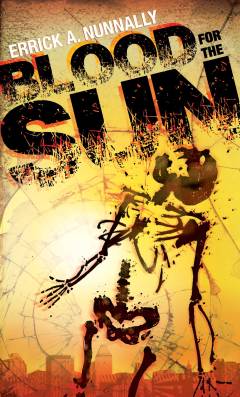
Cover Reveal: Blood For The Sun by Errick A. Nunnally

Reveal

I promised and I have delivered! Time for another cover reveal, this time it is for Errick A. Nunnally’s book
Blood for the Sun. You can grab a copy  in March 2014 through Spence City so keep an eye out for it.

Jacket copy: BloodforthesuncoverAfter more than one-hundred and forty years, Alexander Smith is suffering from memory loss that plagues him like a supernatural Alzheimer’s. He has lasted longer than most by clinging to the love he has for his adopted daughter, the vampire Ana, and puzzling out cases of missing or murdered children. Without them, he wouldn’t be able to ignore the ghost of a child from his guilty past or fight the whispers goading him to kill. On his latest job, he’s stumbled upon a vampire conspiracy that has left a trail of child murders up and down the East Coast—a conspiracy that promises inoculation against the sun. If true, the conspirators’ success would mean a bloody conflict, altering the balance between humans and the supernatural forever. Losing more of his mind every day, Alexander has two impossible tasks ahead of him if the world is to survive: stop the vampire coven and reconnect with his humanity.

About the Author:
Born and raised in Boston, Massachusetts, Errick A. Nunnally served one tour in the Marine Corps before deciding art school would be a safer—and more natural—profession. He always strives to develop his strengths in storytelling and remains permanently distracted by art, comics, science fiction, history, and horror. Trained as a graphic designer, he studies Krav Maga and Muay Thai kickboxing in his spare time. Errick’s successes include: the upcoming publication of his book, Blood For The Sun; a comic strip collection, Lost in Transition; first prize in one hamburger contest; the short story Who Bears The Lathe? in eFiction’s inaugural SciFi issue; the sci-fi short, Legion, in the anthology Doorways to Extra Time; two lovely children; and one beautiful wife.

Newcastle Writers Festival 2013

I have gone to a few author and writers events in the past few years, not as many as some I’ll admit, but those that I have gone to have always been very useful and motivating, not only in learning about why the speaker may write, but where their ideas come from and how they themselves find inspiration. Over the weekend I attended the inaugural Newcastle Writers Festival and for their first year, it was fantastic. Unfortunately I did forget to bring my camera so rather poor quality phone camera images will have to suffice, but I wasn’t just there for the photos, I took pages and pages of notes, each little thing being soaked up from these established, and new authors lucky enough to have broken into the field I aspire to be included in.

I attended the festival with Jess from The Never Ending Bookshelf, and no doubt she will have brilliant summaries of her own; she attended an additional event to me as well so keep an eye on her page for her own thoughts, eloquently written as so many of her thoughts are. I have so much to say about the three seminars I attended I am planning on spreading them out over the next few days so as not to bombard you with a lot of excitement, but also so I can give each author and talk a well earned review.

This is the first time Newcastle has hosted a writers festival, and I must say they did an excellent job. Volunteer organiser and Herald journalist Rosemarie Milsom did a lot of work with all of the amazing volunteers, as far as I was aware the festival went off without a hitch, people were being turned away because practically everything was sold out or full. There has been a multitude of press and radio interviews surrounding it and it is all worthy. I have yet been able to attend any of the past Sydney Writers Festivals (I am aiming for this year however), but there was a distinct cosy and inviting feel with the Newcastle festival that made it seem like a friendly gathering of people rather than a daunting event where people might feel intimidated to approach their favourite authors. In the time I was there I saw many people casually chatting with authors who they had just seen speak in a seminar, and key speakers like Miriam Margoyles were just walking through the festival like everyone else, she too probably had her own seminars she wanted to attend.

I went to three sessions on the Saturday and one on Sunday. I was unable to attend opening night which was a shame, there was talk of an audio going up of Miriam’s speech, if that happens I will post it up. I was also unable stay long Sunday because I had tickets to see The Script in Sydney. But I can’t really complain about that being a reason, they too were amazing. But for those sessions I was able to attend, in each of them I discovered more about the act of writing, becoming published, and just as wonderful: the inspiration of writing. More about those sessions tomorrow!

Before we had even gone to our first session we were eying the array of books that MacLean’s Booksellers had set up; stocked high with all of the novels, the poetry, memoirs, historical books, all the works of all the authors who were attending the festival. I found myself recognising a lot of authors who I have had as creative writing lecturers in the past at uni, a few I had seen at previous writing conferences, and naturally a vast many who I had not heard of. A lot of new books and authors were added to my reading list that day, unfortunately funds meant I could only buy two, but they were the two I really wanted: Tender Morsels by Margo Lanagan and The Weight of a Human Heart by Ryan O’Neill. On the festival website there is a list of all the authors who attended, and I assure you I will be raving about those that I saw and met next time.

I have already pencilled in the dates for next year (April 4-6 2014) and given the success of this year there is no doubt it is going to become a popular event frequented by authors and readers alike. Below are a list of the sites and articles to start looking into information about the festival, all have additional information about the weekend’s proceedings. If you did not go this year there is plenty of time to start planning for next year, though how can you really look ahead when you are still basking in the amazing that was the weekend.

Newcastle Writers Festival

Newcastle Writers Festival Facebook

Newcastle Writers Festival Twitter

Newcastle Herald Article – Authors enthrall fans at festival

1233 ABC Newcastle – Writers Festival a success

Previous Older Entries Next Newer Entries