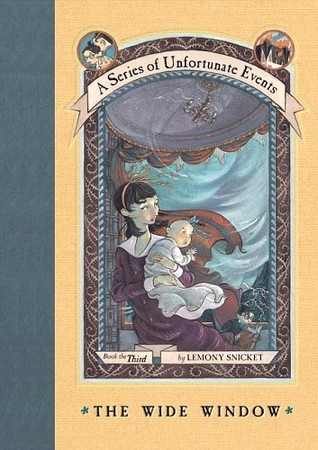
The Wide Window (#3) by Lemony Snicket

Published: February 25th 2000

Goodreads badgePublisher: HarperCollins
Pages: 214
Format: Book
Genre: Junior Fiction
★   ★   ★  – 3 Stars
Dear Reader,

If you have not read anything about the Baudelaire orphans, then before you read even one more sentence, you should know this: Violet, Klaus, and Sunny are kindhearted and quick-witted, but their lives, I am sorry to say, are filled with bad luck and misery. All of the stories about these three children are unhappy and wretched, and this one may be the worst of them all.If you haven’t got the stomach for a story that includes a hurricane, a signalling device, hungry leeches, cold cucumber soup, a horrible villain, and a doll named Pretty Penny, then this book will probably fill you with despair.I will continue to record these tragic tales, for that is what I do. You, however, should decide for yourself whether you can possibly endure this miserable story.

With all due respect,
Lemony Snicket

Book three of Unfortunate Events begins much the same way as we are introduced to guardian number three, Aunt Josephine. She is a dull sort of woman, scared of everything and has an unstable living arrangement. This book was a bit more interesting than because there was a longer focus on the time with Josephine than previous guardians. It is more action packed I guess, there is almost a sense of ‘will she survive? Won’t she survive?’ except that Snicket tells us she won’t, again quite often. but it does have its moments of suspense and what will happen. So in that sense it was a good book for that, as a character Josephine is annoying but what can you do. There is a great plus side, there is a reference to the movie Flying High in there which made me laugh. I’m sure it must be intentional, if not it is a pretty big coincidence.

New plan. Instead of this annoying and insipid trend of Grammar Nazi’s roaming the internet we start calling them Aunt Josephine. If you’ve ever come across a person who corrects everything you say because to them you are saying it grammatically wrong then you know Aunt Josephine. And as annoying it is to hear, it is tiring to read, but not so bad if you put it down to an eccentric character trait among her many others.

What I have discovered about A Series of Unfortunate Events, is that they are all rather similar. The children get a new home and guardian, Olaf comes in at some point disguised, the children recognise him, the adults don’t believe them, guardian vanishes, Olaf is exposed, the surviving adults apologise for not believing the kids and the whole things starts again. What I am discovering about these books as an adult reading these books fit for twelve year olds, is that there is nothing to figure out. You are told straight away that unfortunate things will happen to these kids, and Snicket is not shy about using violence and threats and describing them in a blunt and matter of fact manner which acts to almost subdue the serious violence and issues they actually are. And this I am assuming will go on for the remaining ten books in an ongoing cycle.

What I think all we are supposed to take from this is just how unfortunate these kids are and we just have to go for the ride with them as more unfortunate events happen to them and to those around them. There is no mystery, no ulterior meaning. Snicket just says ‘They won’t live happily ever after, they will be threatened and have horrible things happen to those around them, they’ll be fine and not be affected so let’s pop on over to the next person and see what misfortune befalls them’. It’s sort of like a sadistic humorous story that brings out kids fascination with death and violence and evil people in a nice funny and calming and charming way. Oh Mr Snicket you are sneaky.

What is also good is that there is a love of books in this series. The three children are always looking through books and they always find a large library collection wherever they go. I did learn something about Alexander the Great and Gordium knots so that was nice. I’m beginning to think, even though these kids only seem to stay at their new homes for a matter of days or weeks at best that by the end Violet will be of age and at the end of book thirteen she’ll just buy a house for her siblings. Let’s see how we go with that prediction.

The Reptile Room (#2) by Lemony Snicket

Published: February 25th 2000
Goodreads badgePublisher: HarperCollins
Pages: 214
Format: Book
Genre: Junior Fiction
★   ★   ★   ★  – 4 Stars

Dear Reader,

If you have picked up this book with the hope of finding a simple and cheery tale, I’m afraid you have picked up the wrong book altogether. the story may seem cheery at first, when the Baudelaire children spend time in the company of some interesting reptiles and a giddy uncle, but don’t be fooled. If you know anything at all about the unlucky Baudelaire children, you already know that even pleasant events lead down the same road to misery. In fact, within the pages you now hold in your hands, the three siblings endure a car accident, a terrible smell, a deadly serpent, a long knife, a large brass reading lamp, and the re-appearance of a person they’d hoped never to see again. I am bound to record these tragic events, but you are free to put this book back on the shelf and seek something lighter.

With all due respect,
Lemony Snicket.

This was a good follow up to the first book, you can tell how the rest of the series will go, one unfortunate event after the other until it ends. I liked the story but there were a few more downsides than the first I’ll admit. The stopping to explain words that was a nice element in the first is now unfortunately a little annoying. After the first few chapters it didn’t seem to flow as well and it stood out to much and interrupted the sentence flow among other things. Perhaps the problem is (as it seems to be a reoccurring theme of late) I keep reading these books, aimed at primary school kids, as an adult. I know these words and I know these meanings so I don’t need them explained. But seeing as it worked in the first book, and Snicket managed to weave them comically and easily into the tale, somehow the second time they do not hold up as well so maybe it is not just me.

What was sad was the way Snicket foretells things. Sometimes it works, sometimes in books and stories you can foretell things and then you just have to read and wait for the why, how and when to bring it all together beautifully. For me Snicket’s announcement from the very first pages about the future events, no matter how vague, were a tad depressing. I do see though how his writing style of constantly reminding us about these unfortunate events and telling us we mustn’t think that these children were ever going to get a happy ending does kind of support his constant effort to quash any enjoyment you get from a character, especially when he keeps reminding you how doomed they are. And of course, when the book itself is called “The Reptile Room or, Murder!” (well the copy I have does), you kind of know where the story is heading sooner or later.

There is a greater presence of violence in the second book, and again everyone acts as this is all very acceptable even if it is a bit frightful. This is why you need to take notes sometimes while you read, especially if you are going to review it. If you don’t you forget the little gems and one liners that stand out and when you try to find them again it is a lost cause. This was one of my favourite lines regarding the take on violence and threats – “He would slit the throats of the Baudelaire orphans as easily as you or I might eat a small butter cookie.” Now that is a line that you would not be allowed to probably print now to protect the poor innocent minds of the dear kiddy winks. What no one realises though is this is the stuff they thrive on. They want to be fearful of the man with the knife and they want to be the children who try and outsmart the evil grownups in their world. This is why old kids books are great. I say old, the first one was released in 1999, it wasn’t that long ago.

Anyway. I did like Snicket’s two page long discussion, including one page consisting of just “ever” repeated, about playing with electrical sockets. This was just one of the little moral and handy lessons he included in his books, others being quick one liners about swearing, stealing (or as Snicket describes “casing the joint’) and lying.

The ending was sadder in this book mainly for the events and the children’s reactions. It also makes you think that every adult is stupid in this world and those poor children have no hope, but that is how Snicket likes it. No happy endings and he does it pretty well I must say.

The Bad Beginning (#1) by Lemony Snicket

Published: September 30th 1999
Goodreads badgePublisher: HarperCollins
Pages: 176
Format: Book
Genre: Junior Fiction
★   ★   ★   ★  – 4 Stars

Dear Reader, 
I’m sorry to say that the book you are holding in your hands is extremely unpleasant. It tells an unhappy tale about three very unlucky children. Even though they are charming and clever, the Baudelaire siblings lead lives filled with misery and woe. From the very first page of this book when the children are at the beach and receive terrible news, continuing on through the entire story, disaster lurks at their heels. One might say they are magnets for misfortune. In this short book alone, the three youngsters encounter a greedy and repulsive villain, itchy clothing, a disastrous fire, a plot to steal their fortune, and cold porridge for breakfast. It is my sad duty to write down these unpleasant tales, but there is nothing stopping you from putting this book down at once and reading something happy, if you prefer that sort of thing. 
With all due respect,
Lemony Snicket

In light of Lemony Snicket’s birthday on the 28th I thought I would use the days leading up to review his well known series ‘A Series of Unfortunate Events’. There are 13 in total but they are not overly time consuming to read. It is hard to say whether these books are better than the movie. The movie condensed the first three or four books into one movie so there wasn’t absolute justice done (is there ever), but also these books had their own issues that probably made it easy to watch the film. It probably depends, like most things, left up to the individual. I think Billy Connolly made the movie for me because Jim Carey certainly didn’t.

I liked this book. I enjoy reading books not necessarily for children, but that have children exposed to the dark side of the world. Dahl is also wonderful at this, children in unchildlike situations. I think we are underestimating children by sugar coating stories for them. I have to say Snicket does it slightly differently and not as well as Dahl, but there are the same intentions.

The way Snicket has written this first tale of unfortunate events speaks to the reader personally but also as if it were to a large audience which is very much like a storytelling manner. He also makes personal comments and explains the phrases and words he uses in context of his story. This makes you know he is aiming this at children, but he is not going to dumb it down for them either. It is very clever and he doesn’t treat the readers as ignorant or unworthy of scary tales that are, as it were, unfortunate.

The Bad Beginning is a good introduction to the situation and the characters. When an unfortunate event happens, the Baudelaire children are sent off to live with a mysterious relative and thus the adventure begins. We learn about the three children early on and we know what they like, what they are good at and little details about them that adds that little bit extra. Violet likes to invent, Klaus likes to research, and baby Sunny likes to bite things. There is a focus on these details that help throughout the story in working out what is going on which is clever if one pays attention.

It is a very interesting and well thought out idea that Snicket has created. It is very organised and calm and everyone is very straightforward through this book which was different. It by no means took away from the story or the suspense, but there is something odd and appealing about the calm nature these children handle things as each unfortunate event happens to them. They are mistreated and practically abused but Snicket brushes it off and the children are fed up but they are very accepting as well. This approach was new to me so it took a little getting used to but Snicket made no secrets about the nature of this book so it very much is a matter of it is what it is. This story, and the children within it, are resilient to the end with a hint of cunning, cleverness and surprise, always a good trait for children and books. Definitely makes you want to continue onto book two.

Tuck Everlasting by Natalie Babbit

Published: November 1st 1985
Goodreads badgePublisher: Farrar, Straus and Giroux
Pages: 144
Format: Book
Genre: Historical/Junior Fiction
★   ★   ★   ★  – 4 Stars

Doomed to – or blessed with – eternal life after drinking from a magic spring, the Tuck family wanders about trying to live as inconspicuously and comfortably as they can. When ten-year-old Winnie Foster stumbles on their secret, the Tucks take her home and explain why living forever at one age is less a blessing that it might seem. Complications arise when Winnie is followed by a stranger who wants to market the spring water for a fortune.

Tuck Everlasting is a novel by Natalie Babbit and is set in the summer of 1880. This is a great story about a young girl Winnie who lives opposite the woods, dreams of adventure and stumbles upon a great secret. Being only ten years old she greets things and thinks things through as a child and is quick to access and accept those around her. I love it when authors write children protagonists, and all characters really, to match their ages. There is something great about reading a book and while it may seem illogical and a bit strange as we read, you know it is because it is through the eyes of a child and that is how they think and react. What makes Winnie great also is the era in which she lives. She has the child’s mind but she had the 19th century society influence as well.

While Winnie is trying to have an adventure she meets the Tuck family. This is where the curiosity begins because we are given two conflicting sides. This is soon replaced with a new curiosity as we get to know the Tucks better. Once Winnie is introduced to Mae, Angus, Miles and Jesse, it is from that moment she has her own little adventure all to herself.

The Tuck’s are a very decent family, you can tell the era which they come from in their speech and lifestyle, nothing special in particular about them on the outside. Jess and Miles are young men who like to travel and be adventurous while Mae and Angus are happy just being together. When Winnie stumbles upon the Tucks they are so bewildered and yet glad to have found her and they treat her as one of their own almost instantly, Jesse especially. I did find it a little odd that this seventeen year old boy was so attached and fond of a ten year old. I understand how she was smitten, him being bronzed, curly haired and being “even more beautiful up close” but he practically proposes to her. But aside from that it was a good story, it didn’t go where you thought it would which was a good thing I think. There was surprises and twists and in such a short book that was quite well done.

This was made into a ok movie starring Alexis Bledel of Gilmore Girls fame, but having read the book I think there is slightly more to enjoy in the book. In my mind, and a lot of the time I think I am right, the book trumps the movie. Sometimes they are both as bad as each other, but a lot of the time books come out on top. One of my favourite moments is when you discover a movie you liked was originally a book. Either I will track down the book to see the changes, or hope that it was better, or sometimes, like Hugo, you want to find out if it just as spectacular. I have to say Babbit’s book definitely trumps the movie in this case, but only just. With credit to the film a lot was similar.

Babbit’s idea is not new by any means but they people she placed around this idea were, and they were real and honest people who did not choose this life and were doing their best to protect people from it. It is an honourable and heartfelt book that makes you think, but even without reading anything into it, this story is simply about a little girl who has this wonder in her life and where that wonder takes her. It is as simple as that.

The Lovely Bones by Alice Sebold

Published: 1st September 2006Goodreads badge
Publisher:
Little, Brown and Company
Pages: 323
Format: Paperback
Genre: Fantasy
★   ★   ★  – 3 Stars

Since I mentioned this book in a previous review I thought I should post it up as well. This was another one of those books that tried to get turned into a movie successfully. I won’t say it failed exactly, I rather enjoyed the movie, however when you read the book there is so much more going on, and a lot more gets covered. This, I think, makes it a much better book than movie.

The Lovely Bones is the story about Susie Salmon, like the fish.  It tells the story of a young girl who watches those she left behind struggle to cope and accept her death. This is a touching story, it wasn’t over emotional but it was not heartless either. There are no gruesome descriptions exactly, but there is violence and adult themes.

Having this told through a young girl she sees what she sees and makes assumptions and deductions with no great analysis of an adult. Her insights are still quite sound but there is a hint of the teenager and young girl as well. It does not look like a long book but it covers many years and within that we see a lot change as the world passes Susie by. There are no other points of view but Susie’s focus does follow other people she knew besides her family and watches their lives evolve as well.

It is an interesting concept everyone going into this limbo/heaven place. Susie gets to control where she goes and what she sees, as far as I could tell it could be anything she wanted. There are other people in the world as well and Susie interacts with them, but she does spent the majority of her time watching her family and friends on Earth. We are not told a lot about where she is or whether this is the final place but you do not pay a lot of attention to the why or how, you focus more on watching and seeing everything Susie sees. There is a sense of anticipation, Susie’s death is not an accident and as the days and weeks and years go by you wait and hope to see whether her killer will be punished. As readers we know who has killed her, as does Susie, and we watch with her as clues are given and hidden, and we wait anxiously for justice to be served, if at all, Sebold teases us with where the story goes.

Unfortunately about halfway through the book I found myself waiting for it to end, only to realise I still had a lot more to go. It was not because it was boring or annoying exactly, more the fact it seemed to be dragged out unnecessarily as a space or time filler than a plot requirement. I did keep going and as I neared the actual end I did rethink my early observation and concluded that perhaps while it seemed unneeded it may have actually been just enough. There was a concluding feel that wasn’t rushed, technically if you wanted to, you could say it was always a conclusion from page one, the whole thing was about the aftermath of death and that takes time. It was realistic time and time that was detailed and in-depth so in that sense no you can’t just rush through the middle bits.

Sebold concludes this with respect to the reader who has sat and followed these lives and the ending is satisfactory in my mind. It wasn’t a life changing book, or something spectacular, but it was well done and successfully told.

Previous Older Entries Next Newer Entries