The Austere Academy (#5) by Lemony Snicket

Published: August 8th 2000

Goodreads badgePublisher: HarperCollins
Pages: 221
Format: Book
Genre: Junior Fiction
★   ★   ★  – 3 Stars

Dear Reader,

If you are looking for a story about cheerful youngsters spending a jolly time at boarding school, look elsewhere. Violet, Klaus, and Sunny Baudelaire are intelligent and resourceful children, and you might expect that they would do very well at school. Don’t. For the Baudelaires, school turns out to be another miserable episode in their unlucky lives. Truth be told, within the chapters that make up this dreadful story, the children will face snapping crabs, strict punishments, dripping fungus, comprehensive exams, violin recitals, S.O.R.E., and the metric system. It is my solemn duty to stay up all night researching and writing the history of these three hapless youngsters, but you may be more comfortable getting a good night’s sleep. In that case, you should probably choose some other book.

With all due respect,
Lemony Snicket

The Austere Academy is book number five in the Unfortunate series. After the Baudelaire children leave the mill they are shipped off to a boarding school by the horridly annoying sneezer, banker, and default guardian Mr Poe. School has been rather absent in all these adventures but we return now to the very dull and cruel school where just being an orphan is punishable pretty much. The change of scenario is
great after being stuck in this loop Snicket has had us in of repetitiveness and obscurities and abuse. The leap is not as far as you would like but you do get a lot more new story before it reverts back to the same old stuff. Again Snicket ruins the ending fairly early on but by now you are just in it for the story, not for the suspense or mystery. Having said that book five is where he decides to add some proper mystery.

There are good parts to this story, the siblings finally get some friends their age who try and help them solve all their problems. The Quagmire triplets (of which there are only two it seems) use their own skills to help with these problems that arise. By introducing new characters Snicket finally manages to progress in this saga as some questions begin to be answered. Well, no. More questions are asked and revealed and only snippets of information and clues are revealed which is the beginning of the mystery.

With Snicket changing things up a bit it certainly takes these books in a new direction. There is the first sign of a real cliffhanger, not dire, but certainly one that makes you want to read the next in the series. Where before we just hopped from place to place with Olaf and his idiotic schemes, there is a hint of a greater mystery unfolding. With so many books to go whether this is solved in the next one or dragged out we don’t know.

Oh, and for once we can give some kudos to some sensible, albeit dull, adults and Mr Poe tries his best to come through for the children. In a rare moment for him he actually tries. Maybe this is a turning point for the banker.

The Miserable Mill (#4) by Lemony Snicket

Published: April 5th 2000
Goodreads badgePublisher: HarperCollins
Pages: 194
Format: Book
Genre: Junior Fiction
★   ★   ★  – 3 Stars

Dear Reader,

I hope, for your sake, that you have not chosen to read this book because you are in the mood for a pleasant experience. If this is the case, I advise you to put this book down instantaneously, because of all the books describing the unhappy lives of the Baudelaire orphans, THE MISERABLE MILL might be the unhappiest yet. Violet, Klaus and Sunny Baudelaire are sent to Paltryville to work in a lumbermill, and they find disaster and misfortune lurking behind every log. The pages of this book, I’m sorry to inform you, contain such unpleasantries as a giant pincher machine, a bad casserole, a man with a cloud of smoke where his head should be, a hypnotist, a terrible accident resulting in injury, and coupons.  I have promised to write down the entire history of these three poor children, but you haven’t, so if you prefer stories that are more heartwarming, please feel free to make another selection.

With all due respect, 
Lemony Snicket

Predictable was going to be my first criticism. I was starting to dread the rest because I am trying to enjoy these but they don’t change. The story is interesting enough but every one of these books so far all follow the
same plot and when you know what is going to happen, as Snicket keeps telling us, you don’t really find a need to read the rest after that. If you just read 1 and 13 you probably can get the gist. But we won’t, we started now we must finish and I think four was not that bad compared to the rest, nor as dull as I was expecting.

There are a few differences which was refreshing, the circumstances are different, there are different characters. Ignoring the unchanging and annoying narrating style and looking at the content, book four starts off rather dull and you do as the children do and try and play a game of ‘spot count Olaf’. Though when it isn’t who you expect it gets a little better for awhile as you wait for him to appear. The children aren’t as stupid this time round, they are finally catching on to the trickery and deceit which is a change. The story really picked up about halfway through and I think being in such a peculiar settings adds something to the overall story and reception. I do have to say though that it is rather hard accepting what these kids do, especially around the obvious toddler who only had four teeth. It is a weird reality where whether two or ten you are all treated the same. As I say, ignore all this and focus on the fact that it is a different story and it is pretty good. You have to give Snicket credit for being creative even if he is repetitive and outlandish, which when used in this context means strange and peculiar.

We finally see the children actually react reasonably and realistically to what they are subjected to which was also a nice change, even if only temporary. As a series there is definitely a slow but strong single narrative developing underneath these scenarios; Count Olaf tries to get the Baudelaire fortune and the three siblings are put in strange situations that only get weirder, more unrealistic, and irrational as each book continues through this narrative. There is violence and abuse in this book, like the previous ones, but in the Snicket manner they are brushed aside and not focused on in great detail for them to be gruesome or traumatic (though they seriously should have been). Ignoring the unrealistic nature, and accepting that this is how the world works, it was a nice little adventure to progress the story. Snicket is consistent if nothing else and being a series of unfortunate events there are no bones about it, which is a phrase meaning to say clearly what you think or feel about something, (see how that could be annoying through an entire book? Every book!), he does it very well.

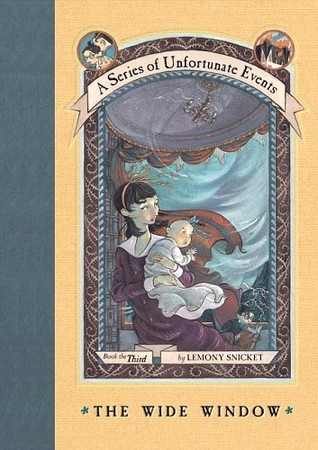
The Wide Window (#3) by Lemony Snicket

Published: February 25th 2000
Goodreads badgePublisher: HarperCollins
Pages: 214
Format: Book
Genre: Junior Fiction
★   ★   ★  – 3 Stars

Dear Reader,

If you have not read anything about the Baudelaire orphans, then before you read even one more sentence, you should know this: Violet, Klaus, and Sunny are kindhearted and quick-witted, but their lives, I am sorry to say, are filled with bad luck and misery. All of the stories about these three children are unhappy and wretched, and this one may be the worst of them all.If you haven’t got the stomach for a story that includes a hurricane, a signalling device, hungry leeches, cold cucumber soup, a horrible villain, and a doll named Pretty Penny, then this book will probably fill you with despair.I will continue to record these tragic tales, for that is what I do. You, however, should decide for yourself whether you can possibly endure this miserable story.

With all due respect,
Lemony Snicket

Book three of Unfortunate Events begins much the same way as we are introduced to guardian number three, Aunt Josephine. She is a dull sort of woman, scared of everything and has an unstable living arrangement. This book was a bit more interesting than because there was a longer focus on the time with Josephine than previous guardians. It is more action packed I guess, there is almost a sense of ‘will she survive? Won’t she survive?’ except that Snicket tells us she won’t, again quite often. but it does have its moments of suspense and what will happen. So in that sense it was a good book for that, as a character Josephine is annoying but what can you do. There is a great plus side, there is a reference to the movie Flying High in there which made me laugh. I’m sure it must be intentional, if not it is a pretty big coincidence.

New plan. Instead of this annoying and insipid trend of Grammar Nazi’s roaming the internet we start calling them Aunt Josephine. If you’ve ever come across a person who corrects everything you say because to them you are saying it grammatically wrong then you know Aunt Josephine. And as annoying it is to hear, it is tiring to read, but not so bad if you put it down to an eccentric character trait among her many others.

What I have discovered about A Series of Unfortunate Events, is that they are all rather similar. The children get a new home and guardian, Olaf comes in at some point disguised, the children recognise him, the adults don’t believe them, guardian vanishes, Olaf is exposed, the surviving adults apologise for not believing the kids and the whole things starts again. What I am discovering about these books as an adult reading these books fit for twelve year olds, is that there is nothing to figure out. You are told straight away that unfortunate things will happen to these kids, and Snicket is not shy about using violence and threats and describing them in a blunt and matter of fact manner which acts to almost subdue the serious violence and issues they actually are. And this I am assuming will go on for the remaining ten books in an ongoing cycle.

What I think all we are supposed to take from this is just how unfortunate these kids are and we just have to go for the ride with them as more unfortunate events happen to them and to those around them. There is no mystery, no ulterior meaning. Snicket just says ‘They won’t live happily ever after, they will be threatened and have horrible things happen to those around them, they’ll be fine and not be affected so let’s pop on over to the next person and see what misfortune befalls them’. It’s sort of like a sadistic humorous story that brings out kids fascination with death and violence and evil people in a nice funny and calming and charming way. Oh Mr Snicket you are sneaky.

What is also good is that there is a love of books in this series. The three children are always looking through books and they always find a large library collection wherever they go. I did learn something about Alexander the Great and Gordium knots so that was nice. I’m beginning to think, even though these kids only seem to stay at their new homes for a matter of days or weeks at best that by the end Violet will be of age and at the end of book thirteen she’ll just buy a house for her siblings. Let’s see how we go with that prediction.

The Lovely Bones by Alice Sebold

Published: 1st September 2006Goodreads badge
Publisher:
Little, Brown and Company
Pages: 323
Format: Paperback
Genre: Fantasy
★   ★   ★  – 3 Stars

Since I mentioned this book in a previous review I thought I should post it up as well. This was another one of those books that tried to get turned into a movie successfully. I won’t say it failed exactly, I rather enjoyed the movie, however when you read the book there is so much more going on, and a lot more gets covered. This, I think, makes it a much better book than movie.

The Lovely Bones is the story about Susie Salmon, like the fish.  It tells the story of a young girl who watches those she left behind struggle to cope and accept her death. This is a touching story, it wasn’t over emotional but it was not heartless either. There are no gruesome descriptions exactly, but there is violence and adult themes.

Having this told through a young girl she sees what she sees and makes assumptions and deductions with no great analysis of an adult. Her insights are still quite sound but there is a hint of the teenager and young girl as well. It does not look like a long book but it covers many years and within that we see a lot change as the world passes Susie by. There are no other points of view but Susie’s focus does follow other people she knew besides her family and watches their lives evolve as well.

It is an interesting concept everyone going into this limbo/heaven place. Susie gets to control where she goes and what she sees, as far as I could tell it could be anything she wanted. There are other people in the world as well and Susie interacts with them, but she does spent the majority of her time watching her family and friends on Earth. We are not told a lot about where she is or whether this is the final place but you do not pay a lot of attention to the why or how, you focus more on watching and seeing everything Susie sees. There is a sense of anticipation, Susie’s death is not an accident and as the days and weeks and years go by you wait and hope to see whether her killer will be punished. As readers we know who has killed her, as does Susie, and we watch with her as clues are given and hidden, and we wait anxiously for justice to be served, if at all, Sebold teases us with where the story goes.

Unfortunately about halfway through the book I found myself waiting for it to end, only to realise I still had a lot more to go. It was not because it was boring or annoying exactly, more the fact it seemed to be dragged out unnecessarily as a space or time filler than a plot requirement. I did keep going and as I neared the actual end I did rethink my early observation and concluded that perhaps while it seemed unneeded it may have actually been just enough. There was a concluding feel that wasn’t rushed, technically if you wanted to, you could say it was always a conclusion from page one, the whole thing was about the aftermath of death and that takes time. It was realistic time and time that was detailed and in-depth so in that sense no you can’t just rush through the middle bits.

Sebold concludes this with respect to the reader who has sat and followed these lives and the ending is satisfactory in my mind. It wasn’t a life changing book, or something spectacular, but it was well done and successfully told.

Pinocchio by Carlo Collodi

Published: May 1st 1996
Goodreads badgePublisher: Puffin
Pages: 272
Format: Book
Genre: Adventure/Fantasy/Fiction
★   ★   ★  – 3 Stars

The old wood-carver Geppetto decides to make a wonderful puppet which can dance and turn somersaults, but by chance he chooses an unusual piece of wood — and the finished puppet can talk and misbehave like the liveliest child. But Pinocchio is brave and inquisitive as well as naughty, and after some hair-raising adventures, he earns his heart’s desire.

Rule one: Never judge a book by its movie; especially if it was turned into one by Disney.

There is nothing adorable and heartfelt about Pinocchio in this book, you spend a lot of the time being annoyed at him for being an insolent little cow, and he certainly gets what he deserves. In the beginning Pinocchio is very well knowledge for someone who has never been to school, seen the world, and is only a day old; yet he uses this knowledge well in his circumstances. As the book goes on he gets gradually more tolerable in nature but it does take awhile. He does a lot of complaining and whinging which gets old, and there are quite a few moments where he recaps his adventures in full detail, right down to the conversations. I can’t say I have ever seen that before, but if we look at him as a child then I supposes he must fill in his whole story to the person, it is through his dialogue after all.

Each chapter gives you a couple of lines summary, which personally I think is unfair. With a story like Pinocchio where chapters can end on cliff hangers and in the middle of a scene, I think having the conclusion told to you before you even begin is a bit pointless. Where is the surprise that he runs into Assassins if we knew they were coming?

There is a morbid nature to a lot of events in this novel, nothing too extreme but it is very blunt. I think the fact the Pinocchio is a puppet is supposed to take away the shock of what happens to him and what he does, but the intent and the actual actions are certainly violent. There are multiple cruelties done to him and others, and his life is threatened in serious ways as well. While Collodi is not detailed in what he writes, he doesn’t hide anything either.

The writing appears to direct the story towards a younger reader, especially with the constant rehashing about good behaviour in young boys and the importance of going to school. There is a sense Collodi is talking to the readers as an oral tale rather than one written, but despite the tone, he does not talk down to the readers either. Collodi follows the story and excludes the unimportant events in the narrative. There are big time jumps varying from a day to a year with only a sentence explaining time has changed. And I am quite convinced that the existence, non existence and size of Pinocchio’s ears changes as the story deems fit.

Since we can’t ignore it, I will say that this book takes things a lot further than the film, a bit darker but still along the same lines. There are familiar faces and scenarios, but there are some vast differences that change the tone completely through quite a lot of the book. You do not always feel a lot of sympathy for Pinocchio in this I must say. You start off on the wrong foot with him when he is made, and even though you see him struggle you get more annoyed each time he fails.

The book reads very much like a succession of moral tale after moral tale, the exception being Pinocchio is so misguided and distracted he keeps messing up and never learning. There are moments where you get tired of his inability to stay on track but I suppose it teaches the lesson and shows you may not get the right way the first go but don’t give up, all those lessons for the children reading.

Overall it was a good book and you do see him change and become a better person, but I think all the times he fails makes this seem less real. You are supposed to see how he has grown but I don’t think it has been written in the correct way that makes you actually believe it. Because Collodi brushes over a lot and writes in simple terms it seems like a shallow remorse in my eyes but I see that it is supposed to have been the major turning point considering where we came from.

Previous Older Entries Next Newer Entries