Published: 14 September 2021 (print)/30 September 2021 (audio) 
Publisher: Little Brown/Penguin Audio
Pages: 384/11 hrs and 51 mins
Narrator: Callie Dalton and Teddy Hamilton
Format: Audiobook
Genre: Romance
★ ★ ★ – 3 Stars
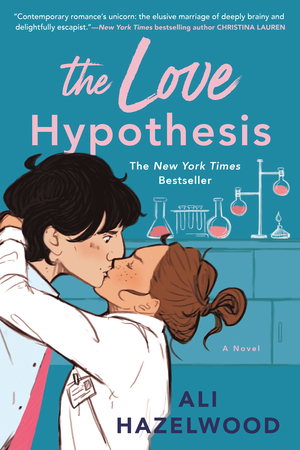
As a third-year Ph.D. candidate, Olive Smith doesn’t believe in lasting romantic relationships–but her best friend does, and that’s what got her into this situation. Convincing Anh that Olive is dating and well on her way to a happily ever after was always going to take more than hand-wavy Jedi mind tricks: Scientists require proof. So, like any self-respecting biologist, Olive panics and kisses the first man she sees.
That man is none other than Adam Carlsen, a young hotshot professor–and well-known ass. Which is why Olive is positively floored when Stanford’s reigning lab tyrant agrees to keep her charade a secret and be her fake boyfriend. But when a big science conference goes haywire, putting Olive’s career on the Bunsen burner, Adam surprises her again with his unyielding support and even more unyielding…six-pack abs.
Suddenly their little experiment feels dangerously close to combustion. And Olive discovers that the only thing more complicated than a hypothesis on love is putting her own heart under the microscope.
I enjoyed the prologue; it was a creative way to bring in the characters and while you know where it will lead, it’s not total impossible scenario and plays well into this romantic plotline.
The beginning is a rough outline of easily ridiculous moments as well as various terminology. I don’t see how someone can be your ex after two dates, you certainly didn’t have a boyfriend after two dates. You just say you didn’t connect and move on. It hardly counts as an ex.
The scientific stuff is blended in creatively and isn’t hidden or dismissed. I enjoyed learning about Olive’s work and how her research is structured. Hazelwood doesn’t explain anything to the reader but things are implied through context so you don’t lose out not knowing exactly what is going on. It also saves readers being pulled from the story for unnatural discussion about science terminology. This works for conversations between Olive and Adam too, it is believable that two scientists would chat in this way about their work and not explain things they would already know. It’s a trap that happens far too often and I love when readers are given credit to gain context or use the internet to look something up if they really want to know. Having said that it isn’t all Latin terminology and scientific names, even the most clueless reader can understand what is going on enough to not be taken out of the story for not understand anything either.
Adam and Olive are an interesting match, they bump heads but at the same time are in similar fields so they have enough in common to be amicable and understand each other. Adam’s reasons to go along with the fake dating is plausible, and even if Olive’s is tenuous at best, if we put a lot of faith on her friend’s fragility in her emotions then it also works.
The romance element is well done. It’s slow and gradual, each party in it for their own reasons. There is one chapter that’s an incredibly detailed sex scene, but once you get through that the story gets back on track.
I liked their slow comfortableness, though Olive is a tad stupid at times. It’s unreasonable to think they’d know everything about each other after only two weeks, it wasn’t a big deal they hadn’t covered every aspect of their lives in that time, even if they were talking more than ten minutes a week. I did enjoy though that there was no blow up or misunderstanding as a conflict. It was also well done that they separated despite them both not wanting to, the rules of the contract were clear and neither of them wanting to admit any change was nice and spoke a lot to their character.
The in jokes were fun and the structure of the fake dating was realistic (as it can be). I do take issue with the notion going on two dates with someone counts as having an ex. They are not your boyfriend and it’s perfectly reasonable to say you didn’t connect and move on and let your friend take a shot. But when you need a reason for your fake dating Hazelwood makes it work. The subtle nature of it and their agreement balanced out the reason behind it and it is an amicable thing to do if we play into the true love/doing it to help a friend aspect.
Not a lot of attention was given to side characters, but for the most part it was easy to forget they were even part of the story so their lack of depth wasn’t an issue (ironic since a side character starts this whole situation). They weren’t needed for the story though as the scientific aspect and Olive’s career trajectory was intrigue enough, her battles of being a woman in STEM and the hurdles she faces gave great conflict and internal struggles, and was a great connection between Adam and herself, solidifying their relationship further.
In my audiobook there was a bonus chapter from Adam’s perspective. When I started I wasn’t interested in it, but as I grew to like Adam through the book I was curious. Unfortunately it turned out to be a crude perspective of their hook up chapter which I didn’t enjoy and skipped through a lot. I thought, well wanted, the chapter to be his perspective of all the times he had spotted Olive through the years. The man essentially yearns for her so I was hoping his chapter would be the times over the years he’d seen her around the university and his thoughts about her and his longing to talk to her. But alas, it’s just gross ways he thinks about her when they are having sex. It was the full chapter again just from his perspective and it took so much away from his character development in the story I stopped listening.
Overall it was a good book. The plot is solid, the romance works if you don’t mind a few explicit and incredibly detailed descriptions, and I liked the scientific side and the few surprises even if they were expected. Olive and Adam are great characters, and their dynamic works well without either of them changing who they are. It is very much a case of a story that does what it says on the tin. It’s a feel good romance that’s light and fun which if that’s what you’re after it’s the perfect solution.
You can purchase The Love Hypothesis via the following
Blackwell’s | Angus & Robertson
Fishpond | Amazon | Amazon Aust | Audible

 Do you see that duck over there?
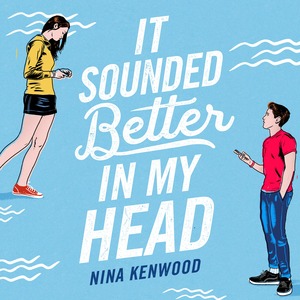 When her parents announce their impending divorce, Natalie can’t understand why no one is fighting, or at least mildly upset. Then Zach and Lucy, her two best friends, hook up, leaving her feeling slightly miffed and decidedly awkward. She’d always imagined she would end up with Zach one day―in the version of her life that played out like a TV show, with just the right amount of banter, pining, and meaningful looks. Now everything has changed, and nothing is quite making sense. Until an unexpected romance comes along and shakes things up even further.
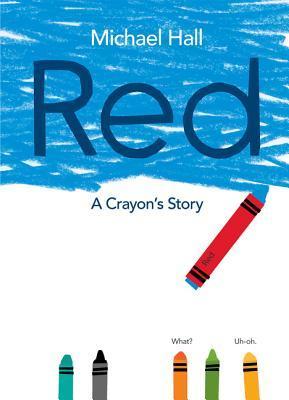 Red has a bright red label, but he is, in fact, blue. His teacher tries to help him be red (let’s draw strawberries ), his mother tries to help him be red by sending him out on a playdate with a yellow classmate (go draw a nice orange ), and the scissors try to help him be red by snipping his label so that he has room to breathe. But Red is miserable. He just can’t be red, no matter how hard he tries Finally, a brand-new friend offers a brand-new perspective, and Red discovers what readers have known all along. He’s blue This funny, heartwarming, colorful picture book about finding the courage to be true to your inner self can be read on multiple levels, and it offers something for everyone.
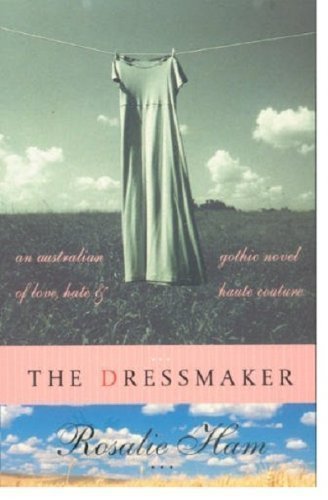 Tilly Dunnage has come home to care for her mad old mother. She left the small Victorian town of Dungatar years before, and became an accomplished couturier in Paris. Now she earns her living making exquisite frocks for the people who drove her away when she was ten. Through the long Dungatar nights, she sits at her sewing machine, planning revenge.