Fun With Shakespeare

It’s not all plays and analysis here, there’s a whole heap of fun stuff about Shakespeare to enjoy. From stories to skits and songs there’s a range of things to enjoy and discover. I’ve compiled a list of things to get you started on the fun side of Shakespeare.

Fun Stuff

Shakespeare through infographs
How the Shakespeare Characters Are Connected
Shakespeare in Pop Culture
Shakespeare references in Disney movies
TV Shows and Movies based on Shakespeare
Further fun at No Sweat Shakespeare
Shakespeare Quiz
Insult by Shakeapeare
Shakespearean Insulter
Shakespeare Insults
17 Shakespearean Insults To Unleash In Everyday Life
Shakespeare for Kids
Shakespeare Fun Stuff
That’s not Shakespeare
The Ultimate Movie Adaptation List

Articles

Shakespeare’s Skull is Missing
Rare Shakespeare Edition Found
Shakespeare’s Handwriting to be Digitised

Stories

A Tiny Feast by Chris Adrian

Titania and Oberon, the Queen and King of the Fairies, live under a hill in a modern city park. To save their marriage, they take a mortal toddler and raise him, only to discover he has developed terminal leukaemia. The story is set in a fairy den and an oncology ward, and is a heartbreaking and very real story about love, death, and parenthood.

Thursday Next series by Jasper Fforde

Granted this series isn’t solely about Shakespeare, but there are running themes, ongoing jokes and references, and the fourth book, Something Rotten, is so Shakespeare it’s incredibly clever and amusing. If you’ve read the books you may want to check out the many allusions to Shakespeare in the series, there are references to plays but also mentions about the author debate and Shakespeare clones.

Goodreads

This glorious website has multiple lists that explore Shakespeare retellings of every kind.

Rewriting Shakespeare (YA edition)
Popular Shakespeare Retellings
Retelling Shakespeare

Poetry

Epitaph on Shakespeare by John Milton
Poems about Shakespeare

 Media

Horrible Histories Shakespeare Song
Horrible Histories Shakespeare Mastermind
Horrible Histories Shakespeare Doesn’t Like Fighting Song
Horrible Histories Quote Alert
QI The Immortal Bard
Changing interpretations of Hamlet

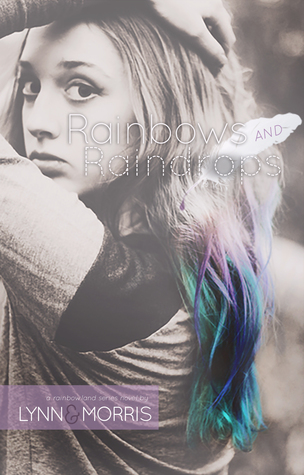
Rainbows and Raindrops by Kelley Lynn and Jenny S Morris

 Rainbows and Raindrops by Lynn and Morris
 RELEASE DAY BLITZ

Published: 18th April 2016Goodreads badge
Publisher:
 CookieLynn Publishing
Pages: 214
Format: ebook
Genre: Young Adult
★   ★   ★   ★   ★  – 5 Stars

Before… They are the Musketeers–one for all and all for Rain, or however that saying goes. 

Now that Rain’s sixteen, freedom is at her fingertips. Cliff jumping at the lake. Rain’s first tattoo. Spence finally asking her out. With her friends by her side, there’s no reason Rain can’t be happy in a world that constantly tries to extinguish her addictive, carefree spirit.
After… It’s just Rain. No misfits and no Musketeers.

Until Rain pulls up to her new summer job and discovers the two people she’s been hiding from–Spence and Landon– are her new cabin mates. Landon’s determined to help Rain overcome her guilt and remember what once was. As they become closer, he awakens a part of her soul she never thought she’d feel again.

Making Rain wonder if, despite all the mistakes she’s made, it’s worth trying to get back to the girl she used to be.

Note: I was provided with a copy of this book for review.

I can promise you that after reading the first few pages of this I was sure I wasn’t going to love this book. I judged early and based on those first pages I thought that this girl Rain was going to become tiresome if she was that over the top through the whole story. She was a loud, over bearing extrovert that seemed to take up all the space, but my mind quickly changed. I really thought after her big introduction that I wouldn’t like Rain, but once you understand, even before “the event”, once you see her life and her situation and know there is a different side to her. Wild is definitely a good word for Rain, free spirit is close, but not quite. She is trying to escape her reality, doing things in the moment and looking for little joys in life which can make her reckless.

This is a before and after type story, jumping between moments, scenes, and time to tell a complete story with some intrigue and mystery. Lynn and Morris bring Rain’s before world to life with all the colour she brings to it, and contrasts it beautifully with the after. What I loved was the mystery of what happened wasn’t dangled in front of your face, the focus surrounded Rain and her emotions, her feelings and her thoughts. Despite not knowing what had happened Rain still got inside your heart and made you feel all her emotions alongside her.

Even once it’s revealed the aftermath is captivating enough, Lynn and Morris’ writing engrosses you and you become invested in these characters, their lives, emotions, and loss. The story makes you anxious and nervous, not so much for the romance aspect but because of the conflict and pain and guilt that is coursing through it.  I became so involved with this story I was compelled to keep going. It really does grab a hold of your heart and the more you read that grip tightens and makes your heart beat faster and the butterflies swarm. I became nervous for these characters, worried, sad, fearful, and proud of every one of them. Nothing felt rushed or outlandish, there were no quick fix solutions and seeing Rain work through her pain and see the others do it as well felt honest.

Emotion definitely drives this story, emotion and the characters. I didn’t feel a romantic suspense, or even a love triangle, not that there isn’t romance, but it isn’t the focus of the story. Grief and dealing with loss is the driving force but it’s also about friendship and being young, afraid, and fearless.

I really fell in love with each of these characters for different reasons and I really didn’t mean to. Everyone from Rain to Spencer, to Annie and Stacey, they’re so much like real people you want to comfort them and help them as best you can. I loved Spencer and Landon early on, they’re such sweeties and Landon is such a wonderful friend to Rain, they have been there for one another for most of their lives and their intense friendship is beautiful. The entire friendship of the group is wonderful; because they all have different home lives and struggles, the four of them find solidarity and comfort in each other. They make their own family and support one another. This bond is so beautiful, one that crushes you even more once it’s broken.

Lynn and Morris don’t make the journey easy, and nor should it be. But the emotions Rain feels are honest and you really get a sense of her fear and shame, and the guilt she feels. Fixing a past you’ve run away from is never going to happen overnight and that’s what makes this so excellent, everything from the characters to the pacing, the gradual improvements and the setbacks. It takes the time it needs to tell the story right, and when you come out the other side you feel satisfied.

There is so much I want to say about this story but can’t for fear of giving away too much. Trust me though when I say that it’s heartbreaking, and beautiful, and honest, and captivating, and all those wonderful words that people use to make you read a book. It is a wonderful story, one I couldn’t stop reading, and I am so glad it is the first in a series because I can’t wait to keep reading about these guys.

You can purchase Rainbows and Raindrops via the follow

Amazon

Amazon Aust

Book Trailer

ABOUT THE AUTHORS


Kelley Lynn

YA author with genre commitment issues. Eventually the day came when the voices in Kelley Lynn’s head were more insistent then her engineering professor’s. So instead of turning to her Thermodynamics book, Kelley brought up a blank page on her computer and wrote. Somewhere along the way she became a Young Adult author. Kelley’s enjoyed working with traditional publishers as well as publishing work on her own. Feel free to hang out with Kelley at her Facebook Page or see what she’s tweeting about. (@KelleyLynn1) She loves to get feedback on her work through authorkelleylynn@gmail.com

Jenny S Morris

I’m a working wife and mother. Lover of music, avid reader by day and writer/ninja by night.

I love almost anything geek related, and I may have a Kdrama addiction

17 Additional Fun Facts About Shakespeare

welcome-shakespeare-quiz-and-activitiesIt’s time for my second installment of Shakespeare Fun Facts! These facts are sourced and adapted from No Sweat Shakespeare and The Telegraph.

1. There are more than 80 variations recorded for the spelling of Shakespeare’s name. In the few original surviving signatures, Shakespeare spelt his name Willm Shaksp, William Shakespe, Wm Shakspe, William Shakspere, Willm Shakspere, and William Shakspeare. There are no records of him ever having spelt it “William Shakespeare” but, additional fun fact, I’m sure I learnt that the Shakespeare spelling came about as a printing error. I have been trying to find the source but basically, it was something like when printing the letters ran together and make it look different, or it was something about how the printer laid out the letters.

2. Shakespeare has been credited with introducing almost 3,000 words to the English language and popularising many more. Examples include: fashionable (Troilus and Cressida), sanctimonious (Measure for Measure), eyeball (A Midsummer Night’s Dream), and lacklustre (As You Like It); not to mention expressions like foregone conclusion (Othello), in a pickle (The Tempest), wild goose chase (Romeo and Juliet), and one fell swoop (Macbeth).

3. He is also credited with inventing the now common names Olivia, Miranda, Jessica and Cordelia (as well as the less popular such as Nerissa and Titania).

4. In Elizabethan theatre circles it was common for writers to collaborate on writing plays. Towards the end of his career Shakespeare worked with other writers on plays that have been credited to those writers. Other writers also worked on plays that are credited to Shakespeare. We know for certain that Timon of Athens was a collaboration with Thomas MiddletonPericles with George Wilkins; and The Two Noble Kinsmen with John Fletcher.

5.  Shakespeare’s last play – The Two Noble Kinsmen – is reckoned to have been written in 1613 when he was 49 years old.

6. The Comedy of Errors is Shakespeare’s shortest play at just 1,770 lines long.

7. There are only two Shakespeare plays written entirely in verse: they are Richard II and King John. Many of the plays have half of the text in prose.

8. It’s certain that Shakespeare wrote at least two plays that have been lost – titled Cardenio, and Love’s Labour’s Won. It’s likely that Shakespeare wrote many more plays that have been lost.

9. It was illegal for women to perform in the theatre in Shakespeare’s lifetime so all the female parts were written for boys. The text of some plays like Hamlet and Antony and Cleopatra refer to that. It was only much later, during the Restoration, that the first woman appeared on the English stage.

10. According to the Oxford Dictionary of Quotations, Shakespeare wrote close to a tenth of the most quoted lines ever written or spoken in English. He is the second most quoted writer in the English language – after the various writers of the Bible.

11. Shakespeare’s Globe Theatre came to a premature end on 29th June 1613 after a cannon shot set fire to the thatched roof during a performance of Henry VIII. Within two hours the theatre was burnt to the ground, to be rebuilt the following year.

12. An outbreak of the plague in Europe resulted in all London theatres being closed between 1592 and 1594. As there was no demand for plays during this time, Shakespeare began to write poetry, completing his first batch of sonnets in 1593, aged 29.

13. Copyright didn’t exist in Shakespeare’s time, as a result of which there was a thriving trade in copied plays. To help counter this, actors got their lines only once the play was in progress – often in the form of cue acting where someone backstage whispered them to the person shortly before he was supposed to deliver them.

14. In one of Hitler’s 1926 sketchbooks, there is a design for the staging of Julius Caesar. It portrays the Forum with the same sort of “severe deco” neoclassical architecture which would later create the setting for the Nazi rallies at Nuremberg.

715. The Lady Macbeth supporting figure on the Gower Statue of Shakespeare in front of the Royal Shakespeare Theatre in Stratford-upon-Avon is modelled after actress Sarah Bernhardt. The bronze characters represent four elements of Shakespeare’s genius: Falstaff chortles for Comedy; Henry V holds the crown aloft for History, Hamlet with Yorick’s skull broods for Philosophy, and Lady Macbeth wrings her hands for Tragedy.

16. Many composers contemplated or tried writing operas about Shakespeare’s plays including Tchaikovsky, Verdi, Delius, and even Mozart who apparently almost wrote one about The Tempest.

17. In 1786, Queen Catherine the Great, Empress of all the Russias, did her own adaptation of Shakespeare’s play The Merry Wives of Windsor, titled “What it is to have Linen and Buck-baskets”. She also translated Timon of Athens. Other world leaders have attempted to translate Shakespeare’s plays too. Julius Nyerere, the first president of Tanzania, translated both Julius Caesar and The Merchant of Venice into Swahili.

Quoting Shakespeare

If Shakespeare required a word and had not met it in civilised discourse, he unhesitatingly made it up.”
– Anthony Burgess

Shakespeare.words_The fact that Shakespeare added over 1700 words to the English language is a well-known fact that has been used to show off his creativity and ingenuity but how true is it? Shakespeare created new words by changing nouns into verbs, changing verbs into adjectives, connecting words together, adding prefixes and suffixes, and creating entirely original words. Arguments have been made over whether adding prefixes to existing words counts as a new word or not. Does adding ‘arch’ to villain to create arch-villain mean a new word is created? ‘Assassination’ existed in a form in both English and Arabic before Macbeth, does this mean Shakespeare created that intention of the word? If we leave the deep discussion to the linguists and take the number as is, there are so many we use today. I will restrain myself from posting a massive list but there is a collection on a few sites which I’ve linked below. A small selection of created words include:

accused | addiction | advertising | amazement | arouse | bandit | bedroom | besmirch | blanket | blushing | bet | bump | buzzer | champion | compromise | courtship | critic | dauntless | dawn | deafening | drugged| dwindle | elbow | excitement | eyeball | fashionable | flawed | gloomy | gnarled | grovel | hint | hobnob | impartial | lonely | luggage | lustrous | majestic | marketable | metamorphise | mimic | negotiate | obsequiously | ode | olympian | outbreak | puking | rant | scuffle | skim milk | submerge | summit | swagger | torture | tranquil | worthless | zany

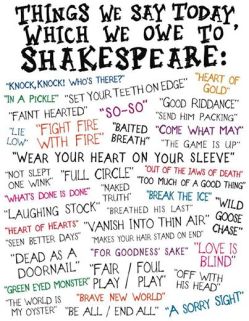
Of course, since Shakespeare added completely new words to the language he deserves credit for that, and many words he used existed already he merely popularised them. One thing he can be credited with, away from individual words, he was also the creator of phrases and terms we still use today. These are a few phrases that have survived the centuries and cemented themselves so deep in English language that it’s hard to believe we were once without them.

Come what may (Macbeth) | Heart of gold (Hamlet)
Good riddance (Troilus and Cressida) | Knock-knock (Macbeth)
All of a sudden (The Taming of the Shrew) | Faint-hearted (Henry IV part I)
Heart of gold (Henry V) | Wild-goose chase (Romeo and Juliet)
Brave new world (The Tempest) | Break the ice (The Taming of the Shrew)
For goodness’ sake (Henry VIII) | Foregone conclusion (Othello)
Love is blind (The Merchant of Venice) | The beast with two backs (Othello)
Assassination (Macbeth) | Bated breath (A Midsummer Night’s Dream)
Be-all and end-all (The Merchant of Venice) | One fell swoop (Macbeth)
Kill with kindness Macbeth | Twinkling of an eye (The Merchant of Venice)
Fair play (The Tempest) | Wild-goose chase (Romeo and Juliet)
As good luck would have it (The Merry Wives of Windsor)

shakespeare_words_used_todayThere are also a range of words Shakespeare invented and used that have faded into history. On the Shakespeare-themed QI episode Stephen Fry discusses them and their meanings. Some of these include kickie-wickie, tanling, slugabed, boggler, wappened, and carlot. More can be found here. Another incredibly fun way to remember the words and phrases Shakespeare gave us is through song. Horrible Histories created a wonderful and catchy song about Shakespeare’s words which you can find here, they also did a skit about Shakespeare on Mastermind with his phrases. But, if you get carried away thinking Shakespeare quoted everything, there is are a few blogs dedicated to proving that not everything is from Shakespeare which you can find here and here.

Virginia Woolf asked in To the Lighthouse, “If Shakespeare had never existed…would the world have differed much from what it is today? Does the progress of civilisation depend upon great men? Is the lot of the average human being better now that in the time of the Pharaohs?” Looking at the range of words and phrases that we use every day without even thinking about their origins it would certainly be a different world if Shakespeare had never existed. So much of our language would be different, the deeper you fall into his dictionary of terms it’s really quite hard to imagine.

Links and Bits

Words Shakespeare invented
Unsuccessful Shakespearean words
Quips Created by Shakespeare
Shakespeare’s Neologisms
Words Shakespeare used that had different meanings

In the Spotlight: The Tempest

In the Spotlight

Now, Ariel, I am that I am, your late and lonely master,
Who knows what magic is;—the power to enchant
– The Sea and the Mirror, W. H. Auden

The Tempest is one of Shakespeare’s classic comedies; it appears first in the 1623 First Folio selection and is considered by many scholars to be the final play Shakespeare wrote on his own. It also has one of my favourite quotes in it, ‘Thought is free”.

Date Written: 1610 or 1611

First performed: There are records indicating that The Tempest was performed before James I on November 1 1611 but it’s likely there were performances before this.

Setting: an unnamed, uninhabited island

Summary

The magician, Prospero, rightful Duke of Milan, and his daughter, Miranda, have been stranded for twelve years on an island after Prospero’s jealous brother Antonio deposed him. Prospero is reluctantly served by a spirit, Ariel, whom Prospero had rescued from a tree in which he had been trapped by the cruel witch, Sycorax. Her son, Caliban, a deformed monster and the only non-spiritual inhabitant before the arrival of Prospero, was initially adopted and raised by him. He taught Prospero how to survive on the island, while Prospero and Miranda taught Caliban religion and their own language.

Three plots alternate through the play. In one, Caliban falls in with Stephano and Trinculo, two drunkards. They attempt to raise a coup against Prospero, which ultimately fails. In another, Prospero works to encourage a romantic relationship between Ferdinand and Miranda. In the third subplot, Antonio and Sebastian conspire to kill Alonso and Gonzalo so that Sebastian can become King.

Themes: Theatre, the soul, and magic

Characters

Prospero: the main character. The overthrown Duke of Milan. He now lives on an island and is a great sorcerer.

Miranda: Prospero’s daughter

Ariel: a spirit who does Prospero’s bidding and is, at times, visible only to him.

Caliban: a villainous island native, who ruled the island before Prospero arrived. Sycorax (unseen), a deceased Algerian sorceress who was banished to the island before Prospero arrived and enslaved the spirits on the island.

Iris, Ceres, and Juno: spirits who perform the roles of goddesses in a masque presented to the young lovers.

Alonso: King of Naples

Sebastian: Alonso’s treacherous brother.

Antonio: Prospero’s brother, who usurped his position as Duke of Milan.

Ferdinand: Alonso’s son.

Gonzalo: a kindly Neapolitan courtier

Trinculo: the King’s jester

Stephano: the King’s drunken butler

Boatswain

Master of the ship

 Famous quotes

Hell is empty, and all the devils are here!” (Act I, Scene II)
Misery acquaints a man with strange bedfellows.” (Act II, Scene II)

Thought is free.” (Act III, Scene II)

He that dies pays all debts.” (Act III, Scene II)

We are such stuff as dreams are made on, and our little life, is rounded with a sleep.” (Act IV, Scene I)

O, brave new world that has such people in’t!” (Act V, Scene I)

Fun Facts

1. Adaptations of the play, different from Shakespeare’s original, dominated theatre performances from the English Restoration in 1660 until the mid-19th century.

2. The Tempest has more music than any other Shakespeare play, and has proved more popular with composers than most of his other plays with 46 operatic performances throughout history, the first in 1695 by Henry Purcell. Two arrangements that might have been used in Shakespeare’s time still exist – one for “Full Fathom Five” and another for “Where The Bee Sucks There Suck I”, both printed in the 1659 publication Cheerful Ayres or Ballads’.

3. There is no single origin for the plot in The Tempest and many scholars believe it is an amalgamation of many. A strong contender being a document from William Strachey, titled A True Reportory of the Wracke and Redemption of Sir Thomas Gates, Knight.

4. Many well known phrases came from The Tempest including “Brave new world”, “In a pickle”, “Melted into thin air”, “sea change” and “Such stuff as dreams are made on”.

5. The play also demonstrates Shakespeare’s knack for creating new words with word such as abstemious (from the Latin absetmius meaning to indulge slightly in an alcoholic drink), baseless, eyeball, leaky, and watchdog.

6. With only one female speaking role The Tempest has the fewest female characters compared with the other plays.

7. The 1948 western Yellow Sky is a subtle yet clear adaptation of the play, as is the 1956 film Forbidden Planet.

8. One of the shortest Shakespeare play with 17 233 words; outdone only by A Midsummer Night’s Dream (16 511) and A Comedy of Errors (14 701).

9. It is the most performed Shakespeare play on BBC Radio with 21 productions.

10. Thanks to a precedent set by John Herschel, son of astronomer William Herschel who discovered Uranus, two regular moons and seven of the outermost moons of Uranus are named after characters from The Tempest. These are Ariel, Miranda, Caliban, Sycorax, Prospero, Setebos, Stephano, Trinculo, Francisco, and Ferdinand.

11. Unlike most of his plays, The Tempest conforms to Aristotle’s unities – the neoclassical notion that drama should follow three rules: unity of action (a play should have one main plot line with few distractions), unity of place (it should take place in one physical space) and the unity of time (the action fit within 24 hours).

12. Characters from The Tempest have gone further into space than even Uranus with numerous satellites being launched with their namesakes. Ariel 1 was the first British satellite in space, launched in 1962, in addition to six other Ariel satellites developed between 1962 and 1979. In 1971, the Black Arrow R3 rocket launched “Prospero X-3.

Links and Bits

Fun Facts source

Wikipedia

Previous Older Entries Next Newer Entries