Book Bingo 2019 Update #1

BingoThe first four months of the year have passed, way too quickly for my liking but here we are. Now that May has arrived it’s time for the first update in my Book Bingo Challenge. This is inadvertently and definitely the year for reading the things I’ve been meaning to read for a super embarrassingly long time.

I am still not trying to make a line at the moment even though I am very close, I am more curious to find later that I’ve read something that will fit into a box. A small part of me though is keeping an eye out for suitable books that I can read that fall into my categories. It’s a complicated mash up of all the things which is working totally fine for me right now. In all honestly I’m just a little happy I am remembering to actively participate in my own bingo challenge this year.


Debut Author

An Absolutely Remarkable Thing by Hank Green

I was so excited to read this story and Green did not disappoint. I love his complex ideas and the insight of the media and the internet community is something he is more than qualified to explore. With gripping writing and a wonderful science fiction aspect it is a wonderful story and I am so excited (and impatient) for the sequel.

Non-Fiction

Good Girl Stripped Bare by Tracey Spicer

A few years behind the fuss I’m glad I finally got to read this story. I listened to Tracey tell the story herself and from her voice it was interesting hearing her go through her life and career with all the challenges she’s faced. It is an eye opening story and one that it great to hear from someone inside the industry. It isn’t the most powerful book, but it does its best.

Set in Australia

The Lost Man by Jane Harper

This may be Harper’s best work yet. I loved her subtle connection to her other characters and this family oriented, complicated, isolated story was one I could not put down. I read from cover to cover in one sitting and loved every minute of it. There’s suspense, drama, emotions, and moral dilemmas. What more could you want?

#ownvoices

Catching Teller Crow by Ambelin Kwaymullina

I loved how Kwaymullina tells this story. It is profound, mystical, enlightening and a captivating story. The Aboriginal culture is celebrated and I loved how spirituality and practice of two different cultures come together. It’s a beautiful, harrowing story and draws you in.


On TBR For More Than Two Years

Return to the Hundred Acre Wood by David Benedictus

Benedictus has captured Milne’s voice beautifully. There is a difference I will admit, but the heart is there, and it is clearly the best voice to carry on the story of Winnie the Pooh and Christopher Robin. The stories ring true to those from decades ago and you can picture Pooh vividly as well as all the friends we’ve come to know and love.


Movie Adaptation

The Hundred-Year-Old Man Who Climbed Out the Window and Disappeared by Jonas Jonasson

This is a strange book that definitely appeals to some more than others. The movie is a decent adaptation and I would suggest if you didn’t like the book or haven’t gotten around to reading it, go for the film instead. It’s much more enjoyable with the good quirkiness kept in and the better parts of the story being included.

Non Human MC

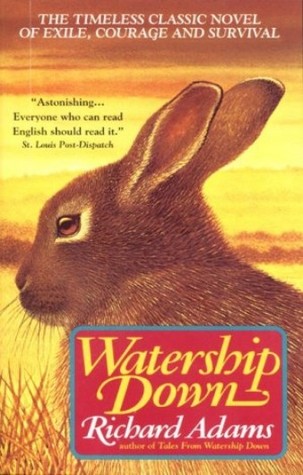
Watership Down by Richard Adams

I have finally gotten around to reading this classic despite catching a few references over the years. A decent read and one that wasn’t as grand as I first thought, but dramatic all the same. There is a realism in the animals but there is also a logic and worldly knowledge.


Fantasy

The Wicked King

Holly Black has shown her master skills once more as we continue in this series. It is the perfect fantasy with magic, foreign lands, war, humans and a mess of all them combined. The magical world Black constructs is fascinating and filled with complicated drama to keep you always guessing and certainly eager for the story to never end.

A Classic

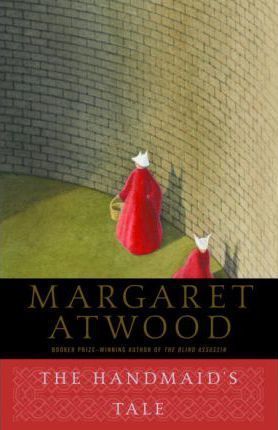
The Handmaid's TaleThe Handmaid’s Tale by Margaret Atwood

Having known the general idea of the novel before starting I was surprised at the actual exploration of this dystopian world. I enjoyed the strangeness of the story and the fact we are never quite given any answers. I’m glad I can tick this book of my list at last.


Lightning Tracks (#1) by A. A. Kinsela

Published: 1st November 2018Goodreads badge
Publisher:
Plainspeak Publishing
Pages: 260
Format: ebook
Genre: YA Fantasy
★   ★   ★   ★ – 4 Stars

Nick isn’t a warrior. He knows some basic karate, but that’s it.

So when an assassin turns up to settle a blood debt, Nick narrowly escapes with his life. In his haste, he unwittingly flees to Korelios, a place he thought existed only in his eccentric aunt’s ancient legends.

All too soon, he finds himself caught in the middle of a war, and he must make an impossible choice: do his duty or follow his heart.

His choice will decide the fate of an entire civilisation.

Note: I was asked for a review by the author. 

I was curious about this story because while there were some elements that I was wary about, I was also intrigued. Fantasy and I have a love/hate relationship so while I was open minded, I was preparing myself. Thankfully my worry was all for nought because this is a wonderful Australian fantasy. It is refined and simple yet has a detailed and engaging story that has all the elements that makes a fantasy a fantasy.

Kinsela keeps the fantasy world elements close to our own, Korelios is another realm overlapping our own world with differences but a familiarity as well. Kinsela herself calls it an alternative history/fantasy novel and I think that is an apt description. The world is vast, made up of different cultures, languages, and has its own important history. The Australian landscape plays backdrop to both realms which was something that I really enjoyed. The characters may speak different languages and not actually be in Australia, but they still have emus, goannas and kangaroos. The world reflects Australia and as an Australian it is wonderful to see the Australian environment be able to be used in this type of storytelling, it is suited for this genre quite well.

Our introduction to the world is told through dialogue, character observation and thoughts, as well as natural story progression. Kinsela cleverly avoids the long paragraphs of description and world building and instead weaves it naturally through the story where the reader can piece together new and old information and construct the world in their mind. The world is rich and complicated but it is easy to understand.

Nick is a character I fell in love with right away. His voice is perfect and his personality is one of a defender more often than a fighter which I loved. Nick is a good kid but has had troubles and his loyalty is a blessing and curse. It’s not just Nick, all of Kinsela’s characters are well developed and from their first introduction she captures their voice and you know who they are. I was already so engrossed in Nick’s story that when it changed points of view I was surprised, certainly intrigued, but it adds a whole extra level of storytelling and suspense.

One thing I was not expecting was to still be so engaged continuously and especially at the end. Kinsela maintains an ideal pace that keeps the story flowing naturally but not fast enough that the reader feels like things are being brushed over. Conflicts are raised and resolved and new ones form in suspenseful and captivating ways while the longer story stretches out. I will admit I had reservations with some elements but Kinsela uses her characters well and in ways that feel true to who they are.

This story was full of delightful surprises and I cannot wait until the second book comes out because I would love to see where Kinsela takes these characters and this wonderful story.

You can purchase Lightning Tracks via the following

Booktopia | Book Depository

WorderyAngus and Robinson

 Fishpond | Amazon Aust | Amazon

The ANZAC Day Parade by Glenda Kane

Published: March 29th 2010Goodreads badge
Publisher:
 Puffin Books NZ
Illustrator: Lisa Allen
Pages: 32
Format: Picture Book
★   ★   ★   ★  – 4 Stars

On Anzac Day an old man, a former member of the 18th Battalion, and a young boy meet – the young boy wide-eyed and wanting to hear the glories of war and death – the old man quietly sad to remember the reality of what was faced.

“Age won’t weary him, he said, but boy, it’s wearied me”

This is a solemn story that has heart but also packs a punch with importance. The ANZAC Day parade brings out the young and old, to honour those who fought in the war, those who came home, and those who did not.

The perspective is of a young boy who has attended the parade, whose eye catches an elderly man, a straggler after the ceremony. He asks for him to tell of the glory of the war, what it was like to fight. The answer the man gives is not one filled with glory, but it is one filled with truth and heartache.

The innocence of a child is a naïve but ignorant voice against the veteran. This was a story I was not expecting; it shoots down the idolisation of war and what those who have never been expect. I was surprised that there is not much of a narrative, but each page has beautiful words about the pain and suffering, but eloquently expressed.

The education of the boy is the perfect framework for this story, but it isn’t the focus either. As the veteran gets lost in his memories so do we as a reader looking at illustrations of the age, the youth, and the memories.

There is no violence shown, there are beautiful drawings by Allen as she captures the gravity of Kane’s words. I liked the solemnity that the boy depicts, a contrast from the spark before, not to diminish him, but to show that the conversation with the veteran has had an impact. Understanding of the day.

There is as much emotion in the illustrations as there is in Kane’s simple words. I found myself impacted by Kane’s words, as well as Allen’s illustrations. Knowing what ANZAC Day means to Australians and New Zealand and the marches that grow yet diminish each year. The beautiful drawings accompany the powerful words and you can see the tone Allen is conveying. The realistic depictions of the man and boy, as well as the surrounding areas puts you there with them. At the memorial, in front of the list of names. It is a reminder of being at these parades and the meaning they hold.

There is information about a WWII battle in Crete at the back which reminds readers it isn’t just WWI that ANZAC honours. It is every war, every war and battle Australians and New Zealanders fought in. As depressing as it can be to read these stories, I enjoy that there are still so many beautiful ways we can tell the stories of these brave men and women of history. How they are not just names on a wall, not just people who march. They have had a huge impact on our world and to honour them, even in a picture book, is simply wonderful.

You can purchase ANZAC Day Parade via the following

QBD | Booktopia

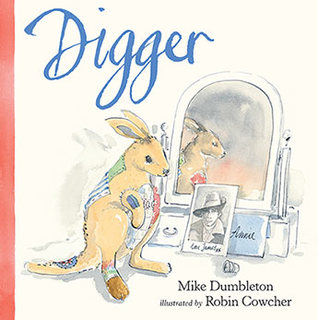
Digger by Mike Dumbleton

Published: March 2018Goodreads badge
Publisher:
 Allen & Unwin
Illustrator: Robin Cowcher
Pages: 32
Format: Picture Book
★   ★   ★   ★   ★  – 5 Stars

The poignant story of a toy kangaroo that goes to war with a young man who doesn’t come back.

When her brother, James, went to war, Annie stitched the name Digger onto her toy kangaroo and gave him to James as a farewell present.
‘A Digger for a digger,’ she said, hugging her brother.
‘I’ll keep him safe,’ James promised.

Digger is the story of one toy kangaroo, one Australian soldier and two girls, in two countries on opposite sides of a world at war. It’s a quiet reminder of the casualties of war, and a tribute to the French schoolchildren who once tended the graves of Australian soldiers who died on the Western Front in the heroic battle for Villers-Bretonneux in April 1918.

I think these kinds of picture books are absolutely fantastic. Based off true stories, photographs, or personal family histories are beautifully pure and honest, even if they are a bit heartbreaking. From reading the dedication alone I teared up.

Crowcher’s illustrations are roughly sketched but beautiful watercolours that match the tone of this story incredibly well. The subdued colours and the outlines capture the story without needing to be finely detailed. They express beauty and peace, and show the chaos of the battlefront without ever needing to show anything traumatic.

Digger’s point of view conveys a lot of the actual conflict, his experience of the noises and the sensations. But Dumpleton doesn’t stick with this perspective as it shifts from Annie, the James, to Collette on the other side of the world. This was incredibly clever because it flows seamlessly and fits in not only with history, but with engaging storytelling.

Even though you may know the outcome, it remains a touching story because it is based on truth. It is based on these boys who went to fight in a war, who were far from home, found care in unexpected places, and the importance memories of home were.

There is nothing explicitly mentioned about injury or death, but the implications are there through other characters. I really liked this approach because it actually felt more impactful to have a different soldier bring Digger to be sent home, to have a simple sentence saying James had given instructions that had to be passed on. It felt real, it felt suitable, and it was heartbreaking.

This is a timeless book because while it focuses on WWI, it still is about soldiers who fought for this country and who are still fighting, as well as those who never got to come home.

You can purchase Digger via the following

QBD | Booktopia | Book Depository

Dymocks | WorderyAngus and Robinson

 Fishpond | Amazon | Amazon Aust

Newcastle Writers Festival Recap: Part Two

The Newcastle Writer’s Festival is always packed with amazing sessions and my Saturday was no different. I attended five sessions on Saturday and while I covered my first three in Part One, I’m covering my other two and my Sunday session in this second part.

Chris Hammer and Holly Throsby with Suzanne Leal

My fourth session on Saturday was Creating Memorable Characters with Chris Hammer, Holly Throsby. They spoke with Suzanne Leal about how they create characters who feel real and the development of their books and writing.

Suzi asked Holly if her towns Goodwood and Cedar Valley were real places but Holly explained they were made up but were similar to many other towns of that kind. She also explained that the reason she set her stories in the 90’s is because that was when she was a teenager and it felt natural to write about when she was a teenager herself.

Chris told us all about his book Scrublands and where the inspiration for Martin came from. There was no journalistic skill needed but he told us that his inspiration was that he had done journalistic stories like that before. Chris explained many people assume he is a war correspondent when they find out he was a foreign correspondent but he wasn’t.

Getting into character creation Suzi asked if Chris had an image of his character in mind or was he based one someone real. Chris explained he chose to keep Martin’s description broad, he isn’t vividly described in the book at all despite being written in third person. Holly worked on instinct, she initially had a couple main characters but nothing definitive, mainly an outline.

Chris said that while there is truth in writing what you know, there is also truth in imagination. He also spoke about how writing a novel is liberating compared to being a journalist. As a journalist you need to fact-check and protect sources, as a writer you can write the big stories first and fact-check it later. His story isn’t based on real events but are similar to stories he’s covered in the past.  Holly is also a songwriter and she spoke about how writing music and novels are different. She can’t write novels the same way she writes songs but there is a melody in her writing.

The audience asked insightful questions and one question was how both authors write distinctive voices, especially with so many different characters. Chris said since his story is through Martin’s perspective he must drag out different characters through their dialogue. Holly said it was a matter of imbuing the sense of the person to the page. Having heard of but not having read any of their books before I came away from the session with some fascinating insight and intrigue, and certainly with renewed interest in checking out their books for myself.

Clementine Ford with Amy Sambrooke

My next session was an evening session with Clementine Ford to discuss her latest book Boys Will Be Boys with Amy Sambrooke. Amy started off the session by asking why Clementine wrote her book to which Clementine explained that there were words and then there was actions. She felt there was a need to have these conversations about the things that came up in the book. It is the perfect companion to Fight Like A Girl and Clementine felt that you couldn’t tell the whole story without telling both sides. The second reason was the Clementine had a baby boy and become even more invested in creating a world where he won’t perpetuate harm nor be subjected to harm by others.

Amy asked Clementine to explain toxic masculinity, something Clementine said was a great term but one that is often misunderstood. Toxic masculinity isn’t all masculinity. She explained that men want to maintain the standard power, men also won’t get told off for being feminists unlike women. She said that men continue to be surprised by the #metoo stories which shows how they don’t understand the women in their lives. She said men don’t ask women about their experiences, a comment which resulted in an enthusiastic round of applause from the audience. She summed it up that toxic masculinity is that men can behave how they like until they have to say sorry and we’re meant to accept it and forget the pain it’s caused.

Amy brought up the concept of consent and why it is so contested. Clementine told a story of a friend of a friend who had GHB put in her drink at a club and how lucky she was to have nothing come from it. She questioned what could possibly be so broken about someone for them to do that, and just because this one woman was saved, who else wasn’t that night. She made the point that is isn’t just the perpetrators but those around them enabling them. People don’t want to acknowledge it’s people they know doing these kinds of things.

The conversation moved onto sex and morality and Clementine said it was never too early to teach consent. Not sexual consent but consent for kissing, touching, hugging; teaching children they don’t have to be hugged by people if they don’t want to. If they don’t want cuddles then they should be respected.

Male bonding was also brought up and this too has suffered, Clementine saying that the patriarchy breaks men in different ways. Not being able to have strong emotional male friendships was something that was causing suffering to men.

It was not all hopeless because Clementine left us with hope that things can change. She told us we need to raise kids in a way that doesn’t make this normal. Make it unacceptable to tell sexists jokes, racist slurs. She reminded us smoking was once so commonplace and people thought it would never change but if someone tried to smoke in a hospital now people would not only look on horrified but would berate whoever had lit up. She said humans are malleable and it will take time but we are capable of changing the behaviour of those in society. One thing that was a great conclusion to the session as the reminder that “power is not gained by taking it from someone else”.

This was a great session to end my Saturday with and one that was enlightening, intense, and fascinating all at once. I came back Sunday with vigour to see Clementine speak again on the panel Why Women’s Stories Matter with Kate Lilley, and Alison Whittaker. Trisha Pender spoke with these amazing women about their stories and why it was important that they were told.

Trisha Pender with Kate Lilley, Alison Whittaker, and Clementine Ford

Kate’s work Reckoning emerged after the #metoo movement but it was a work long in the making. Alison entered into a conversation she hadn’t entered into before. She had hoped to address a specific audience with Blakwork but it turned out to be a small percentage of the audience she received. The book she wrote was an entirely different book in the hands of a white woman than it was in the hands of a queer aboriginal woman. Clementine’s book is a companion piece to her first book telling the other half, Fight Like A Girl isn’t a universal story but the things explored in Boys Will Be Boys harms everyone.

Each woman read from their books and I was fascinated by Alison’s poem “A Love Like Dorothea”, a reworking of the poem My Country by Dorothea Mackellar which is a love letter to 19th century Australia but which ignores the Aboriginal presence entirely.

Amy asked the panel how the political climate influence their books, especially the 2018 NAIDOC theme “Because of her, we can!”. Kate said there is now a cultural shift to take these stories seriously which has moved her to write things with very personal motives. Alison said it was rematriation as a resolution to colonialism, while Clementine said nothing political changed her view, she was always going to write this story. She did say though that the public conscious shifted to have an eagerness to learn about things outside of themselves and while there is still resistance, people are having the conversations.

Clementine read a passage from her chapter Girls on Film and why women’s stories matter. She brought up the Captain Marvel and Ghostbusters backlash and said there is an (incorrect) insistence from people that no one wants to see these stories because they don’t want to see these stories. If we’re only told one story then we think only one story counts.

Trisha said that they always have sessions like this at festivals but they’re still needed. Women’s stories aren’t reviewed as often as men’s. Kate said that literary reviewing in Australia is terrible and not taken seriously. On the subject of diversity Alison worried what it means to be put in the diverse box. The weight of expectation is there even for not important works as people are asked to bear that and think that presence is enough when it isn’t.

The whole panel spoke about the use of humour in their writing and how it is a necessity because the writing can be dark. Clementine said that men are easy to joke about but they are not very good at laughing at themselves. She said that women are extremely funny, our use of sarcasm and in the matters of our lives. The humour is not understood by the people who the joke is about because they don’t understand our stories.

It is always such a thrill listening to these kinds of sessions because not only do you get to hear from people you may never have discovered, but the conversation is so captivating and broad and enlightening. No matter what the session was about I often come out of these festivals with inspiration whether for my own work or simple to change the world. It is a wonderful feeling and one of the reasons I love coming to these festivals. I cannot wait until the next Newcastle Writers Festival next year and I have no doubt Rosemarie Milsom and her team will excel once more.

 

Previous Older Entries Next Newer Entries