Exhibition Launch: Desert Lake – The story of Kati Thanda-Lake Eyre

Tonight I attended a lovely launch of the exhibition Kati Thanda-Lake Eyre, artwork based on the beautiful picture book Desert Lake by Pamela Freeman and Liz Anelli. Hosted by the Newcastle Region Library the launch was a popular event, with people crowding into the Lovett Gallery to help celebrate.

With drinks and nibblies provided there was plenty to keep you entertained before the launch began, including a kid’s craft table where kids could cut out paper and glue new creations together to form their own artistic pieces. Maclean’s Booksellers were in attendance selling copies of Desert Lake as well as Liz’s other work Howzat, and Liz was willing to sign your copy if asked. With enthusiastic chatter and live music playing in the corner the mood was one of celebration and it was a great start the evening.

P1200616

The gallery walls displayed Liz’s beautiful original artwork, gorgeous images filled with colour and wonderful scenes. P1200594What amazed me most were the vivid colours and the incredible detail in each and every picture. I found myself staring at one of them for awhile just taking in the intricate nature of the image and all the tiny details you could see. Looking closely the images looked rough but they were evocative, just like the real scene.
There was a mixture of greens and blues alongside the coloured sky and red/brown ground and it really highlighted how diverse the environment can be. Alongside Liz’s work were interesting information boards about the real Kati Thanda-Lake Eyre and the surrounding areas, including information about the wildlife, the people, and the environment.

P1200622

P1200608

P1200587

Philip Ashley-Brown with Liz Anelli

When the official side of the night began Newcastle’s Lord Mayor welcomed everyone before ABC’s Manager of Broadcast Content Quality, Philip Ashley-Brown, came out to explain how Liz’s exhibition came about as well as talk about some of her previous work. Philip, like me, made a comment about the amount of detail in Liz’s work, saying there is so much going on, something Liz laughed about later saying she always feels she isn’t putting enough detail in.

One thing Liz said which I found interesting was her comment in response to Philip asking about whether she gets caught up in the tiny details. Liz said that when you’re drawing you’re the only person in the world caring about that something. Which is quite an interesting observation I thought, and very true of so many things whether it’s art or writing. Liz explained that you don’t need to go to the outback to appreciate it, and she hoped that if one child can see that in her book, then her job is done. Judging by the beautiful pieces she’s created it’s hard not to appreicate it. She has capture the beauty and reflects reality remarkable well. One thing she said she had learnt whilst researching the book and on her travels around the centre of Australia was that not only is it big, but sometimes very quiet.

There was a large information board that was fairly remarkable that showed Liz’s journey around Central Australia, from Alice Springs to Coober Pedy, Bedourie, Marree, and all around Lake Eyre. Surrounding the impressive map were photos of her trip and all the things she had seen there. It was an extensive journey and one well portrayed judging by the final artwork.

P1200605

P1200620

Overall it was an enjoyable night. It was wonderful to get a chance to see Liz’s original work up close and hear about her research and see the results of her travels. Newcastle Region Library is running the exhibition from 29 March to 14 May if you would like to check it out.

You can purchase Desert Lakes via the following

Booktopia

Maclean’s Booksellers


All Your Bits and Pieces Needs

Liz Anelli Website

Liz Anelli Twitter

Newcastle Region Library

About the Exhibition

Original artwork, sketches and studies by Liz Anelli of the Nature Story series book written by Pamela Freeman for Walker Books. Follow the artist’s research journey around the Central Australian Outback.

About Liz Anelli

Liz Anelli began her children’s book career in 1986 with the Scrapyard Monster (MacDonalds), a tale set in the scrapyard that her United Kingdom art school overlooked. Since then she has illustrated 15 books and numerous articles for newspapers, websites and magazines. She moved with husband Mario to Australia in 2012 and quickly fell in love with the colourful city of Newcastle. Her first major project was a huge illustrated map for The Maritime Centre telling the story of The Port in pictures. An ASA Children’s Picture Book Award allowed her to research Desert Lake (Walker Books) and she spent her May Gibbs Trust Fellowship 2015 in Adelaide developing new manuscripts. One Photo (Penguin Books) will be published in September 2106.


In the Spotlight: A Midsummer Night’s Dream

In the Spotlight

“This is magnificent…and it’s true! It never happened, yet it is still true! What magic art is this?”
Robin Goodfellow, Sandman #19

A Midsummer Night’s Dream is one of Shakespeare’s most popular plays and one of my favourites. It is classed as a comedy and is part of the First Folio collection printed after Shakespeare’s death.

Date Written: 1595 or 1596

First performed: 1595 or early 1596

Setting: Athens, Greece

Summary

The play consists of four interconnecting plots, all connected to the marriage of Theseus, the Duke of Athens, to Hippolyta, Queen of the Amazons and takes place in both the forest and in Fairyland. From the start it’s a complex plot, two sets of couples (Hermia & Lysander and Helena & Demetrius), whose romantic affections are complicated enough already, enter the forest and find themselves in the realm of King Oberon and his Fairy Queen Titania. Also entering the forest are a band of amateur actors (known as the Mechanicals) who wish to rehearse their play. Throughout all of this a mischievous fairy known as Puck wreaks havoc and the other fairies play tricks on those who’ve entered as well.

Characters

The Athenians

Theseus: Duke of Athens
Hippolyta: Queen of the Amazons, betrothed to Theseus
Philostrate: Master of the Revels
Egeus: father of Hermia, wants her to marry Demetrius
Hermia: daughter of Egeus, in love with Lysander
Helena: in love with Demetrius, Hermia’s friend
Lysander: in love with Hermia at first but later loves Helena and then returns to loving Hermia
Demetrius: initially loves Hermia but later loves Helena
Spirits 1 & 2 (speak only to Puck and Oberon)

The fairies

Oberon: Titania’s husband and King of the Fairies
Titania: Oberon’s wife and Queen of the Fairies
Robin Goodfellow/Puck: servant to Oberon
Peaseblossom: fairy servant to Titania
Cobweb: fairy servant to Titania
Moth: fairy servant to Titania
Mustardseed: fairy servant to Titania

The Mechanicals

Peter Quince: carpenter, leads the troupe and plays Prologue
Nick Bottom: weaver, plays Pyramus
Francis Flute: bellows-mender, plays Thisbe
Robin Starveling: tailor, plays Moonshine
Tom Snout: tinker, plays Wall
Snug: joiner, plays Lion

 Famous quotes

The course of true love never did run smooth.” (Act I, Scene I)

Love looks not with the eyes, but with the mind, and therefore is winged Cupid painted blind.” (Act I, Scene I)

Lord, what fools these mortals be!” (Act III, Scene II)

Though she be but little, she is fierce!” (Act III, Scene II)

If we shadows have offended, 
Think but this, and all is mended,
That you have but slumbered here
While these visions did appear.
And this weak and idle theme,
No more yielding but a dream,
Gentles, do not reprehend:
If you pardon, we will mend:
And, as I am an honest Puck,
If we have unearned luck
Now to ‘scape the serpent’s tongue,
We will make amends ere long;
Else the Puck a liar call;
So, good night unto you all.
Give me your hands, if we be friends,
And Robin shall restore amends.” (Act V, Scene I)

Fun Facts

1. The mechanicals’ play-within-a-play was performed by the Beatles as part of Around the Beatles, a TV special, broadcast by ITV on 28 April 1964. Paul McCartney played Pyramus, John Lennon was Thisbe, while George Harrison and Ringo Starr played Moonshine and Lion respectfully.

2. Judi Dench enjoys the rare privilege of having played Titania in early youth and relatively old age. She played the role at school in York in the 1940s, on stage and screen for Peter Hall in the 1960s and then again for Hall in 2010 at the Rose Theatre, Kingston.

3. Samuel Pepys, the diarist, saw it on 29 September 1662 and is recorded as hating it, saying “Then to the King’s Theatre, where we saw “Midsummer’s Night’s Dream,” which I had never seen before, nor shall ever again, for it is the most insipid ridiculous play that ever I saw in my life. I saw, I confess, some good dancing and some handsome women, which was all my pleasure.”

4. After the Restoration era, the play was not performed in its entirety until the 1840s.

5. The scholar Harold F Brooks pointed out that the title could be read as “The Dream of a Midsummer Night”, noting that Theseus’s palace is to be sprinkled with the fairies’ field-dew benediction – “It was to dew gathered on May-day morning that magic properties were attributed.” It could therefore be set in May and people are dreaming of midsummer.

6. According to the Rough Guide to Shakespeare, one staging that took place around 1631 at Buckdale, Huntingdonshire broke the Sabbath, causing the actor playing Bottom to be placed in the stocks for 12 hours, still wearing his ass’ head.

7. The 19th century saw a rash of extravagantly designed productions. The most over the top in the UK was probably Charles Kean’s 1856 production at the Princess’s Theatre, which employed the services of 90 tutu-wearing sprites for the finale. The show was also notable for casting an eight-year-old Ellen Terry as Puck.

8. A Midsummer Night’s Dream inspired the musician Felix Mendelssohn. He wrote Wedding March in 1842 and is from his Midsummer Night’s Dream incidental music. This wedding march is very popular to hear in weddings and is often played by using a church pipe organ. Interestingly Mendelssohn was just 17 when he wrote it.

9. The wedding march was very popular after the Princess Royal Victoria chose the music on her wedding on 25 January 1858 with Prince Frederick William of Prussia.

10. If you look at the traditional folklore, there is no name for a fairy queen. Shakespeare took the name Titania from Ovid’s Metamorphoses.

11. The two largest moons of Uranus are named after Titania and Oberon. In 1787, British astronomer William Herschel discovered the moons and named them after the King and Queen.

12. A Midsummer Night’s Dream has been the inspiration for classical ballets such as George Balanchine’s two-act ballet of the same name in 1962 and Frederick Ashton’s one-act ballet entitled The Dream in 1964.

13. Aside from in the title, the word ‘midsummer’ does not appear at all in the play.

Links and Bits

Fun Facts sources

Wikipedia

Book Event: The ‘Gay’ Book with Will Kostakis and Benjamin Law

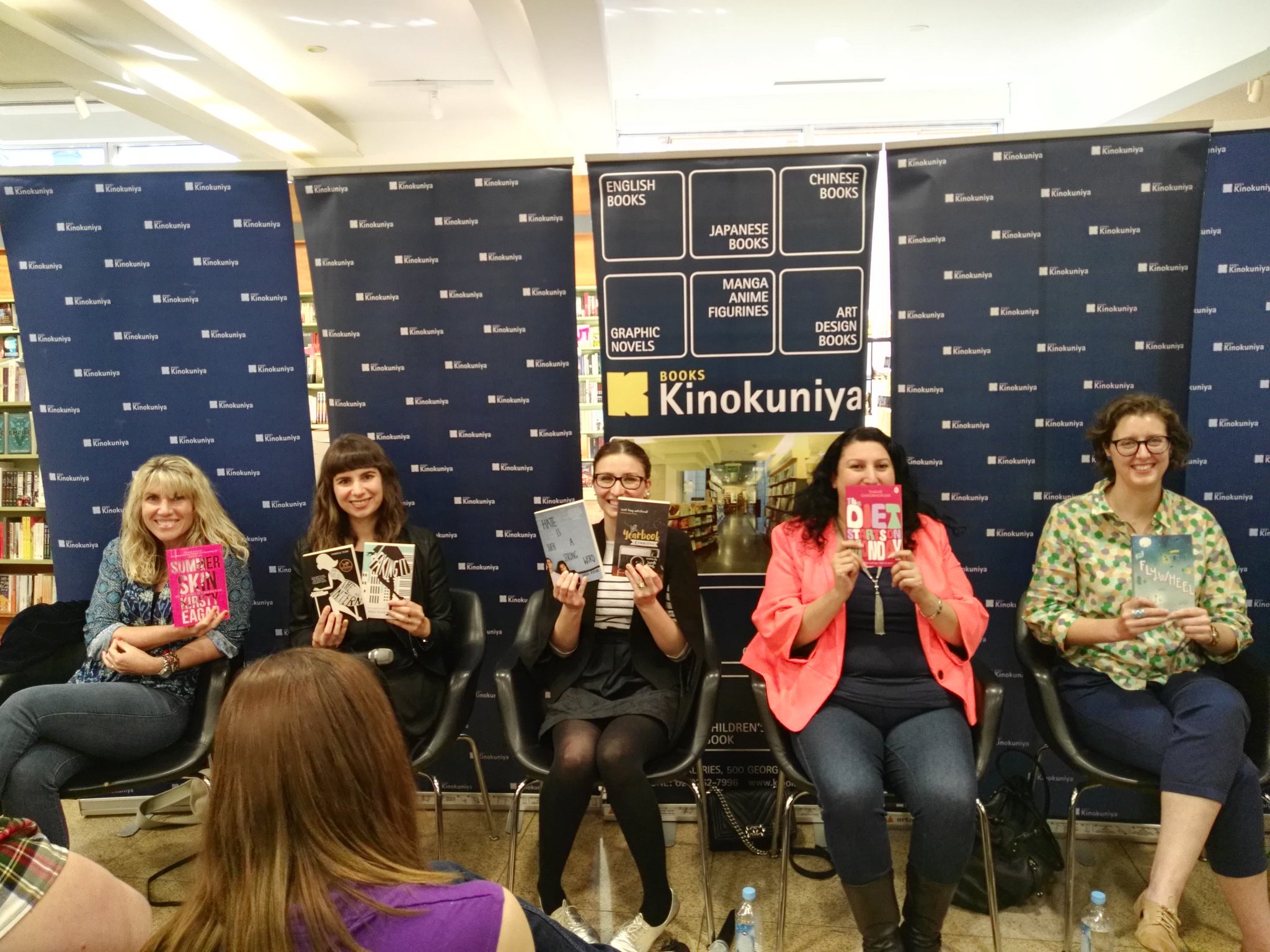
P1200565Last night I attended a book event at Kinokuniya bookstore with Will Kostakis and Benjamin Law discussing The ‘Gay’ Book. Benjamin Law, according to his Twitter bio, is a writer, raconteur, and local homosexual. In 2012 he published Gaysia: Adventures in the Queer East as well as The Family Law, the latter of which was made into a TV series for SBS. He is currently writing its second season. Will wrote his first novel aged 19, called Loathing Lola which, I discovered, is very hard to track down and basically out of print. He was the 2005 Young Writer of the Year, he published his second novel The First Third three years ago, and has recently published The Sidekicks.

It was quite a turn out to hear the two speak; chairs were packed in with a few people opting to stand at the back. From the start it was humorous with jokes abound, Benjamin telling us it was the gay wedding of the year and we were divided into the groom side and the groom/bride side. The pair interviewed each other, asking questions back and forth, ribbing off one another, and hilarious discussions and confessions were told such as Ben seeing Will in a Speedo (which we were never provided context or explanation for), and Will wanting to be like Benjamin when he grew up.

P1200570Will spoke about how the controversy around The Sidekicks and his experience coming out was unexpected but something he couldn’t ignore. He was thrust into being ‘the gay writer’ overnight which was a shock. He made the decision to respond himself to the school and publically (names omitted) because if he responded in the dark, it would keep happening. He never expected it to spread as it had, saying the international response was disbelief that it had happened, while the Australian reaction recognised it as an ongoing problem. I love though that none of this has stopped people not only loving the book, but finding out ways to discuss it in places where it cannot be discussed, and Will told us some great stories of his experiences in schools.

Even though I’ve heard Will speak before about his work and his experiences, it’s always different and new. He told us he got into writing because he was reading books that felt like the author was holding back. His books try to be honest, something that comes across well according to his agent so that’s a good thing.

P1200571Having never heard Benjamin speak it was interesting to hear his story. Doing his PhD in Creative Writing he had to write everything, from stories, to memoirs, the journalistic pieces. In doing so he discovered he enjoyed writing memoir, it felt natural doing so. Like Will, Benjamin didn’t position himself as the gay writer, but he said you tend to identify with what separates you, in his case being gay and Asian; he joked he was basically a turducken of minorities. It was an interesting discussion because it was something I hadn’t thought much about. Benjamin told us that you really can’t disentangle yourself from those parts of you, and while he hoped his generation would be the last to be persecuted for being different, he was sad to see it hasn’t changed.

Benjamin spoke about growing up in a family of five and dealing with family issues such as his mother suddenly becoming a single parent. He said everything is about perspective, quoting one of my favourite sayings by Mel Brooks, ‘Tragedy is when I cut my finger. Comedy is when you fall into an open sewer and die’. Will asked him whether there was any hesitation in writing memoir, because while fiction can be filled with the writer, there is a barrier there. Benjamin said when you write a story you become the custodian of the story and you tell your story. He said readers should be smart enough to know that it wouldn’t be an expose or revenge letter, and know that it’d be a different story if his mum wrote it or his sister. As Will pointed out Benjamin’s books are great ‘what ifs’, what would have happened if his family had stayed in Asia, what his life would be like and what anyone’s would have been if they grew up somewhere else.

Will asked Benjamin about his show, The Family Law, and asked whether he was different now and whether it influenced the characters he writes. Benjamin made a great point about how characters and people are complex and flawed, no one is a villain. His character isn’t put on a pedestal nor is he perfect, Benjamin didn’t set out to make an Asian role model, he needed grit to them.

Amidst the humour and personal stories there were some brilliant points made about representation and how things like homosexuality is presented in books and the media. Will brought the ‘gayness’ forward in The Sidekicks because even in The First Third the gay character was trivialised in his opinion. Benjamin pointed out that we don’t talk about white heterosexual stuff like we do gay stuff. One of the important things that Will mentioned was that when people write a ‘gay’ book, they are not trying to convert people, they are just trying to show how other people live. And not only that, just because there is a gay character does not mean it is a ‘gay’ book. This was something that was also brought up by a brilliant audience question who asked why people can read about M/F kissing, but somehow if there is a M/M kiss somehow it becomes hypersexual and an issue.

P1200569

Another question from the audience was asking the first place the boys came across a queer character and both gave quite different answers. Will’s was in year 9, reading Shakespeare’s Sonnet 20, a sonnet where the author’s beloved is compared to both a man’s and a woman’s, raising question over the author’s sexuality. Will was afraid of being out and a successful author but he realised if Shakespeare could do it, then so could he. Such is the power of representation. Benjamin’s on the other hand was Melrose Place, no less profound than Shakespeare’s of course, but slightly different. The character in the show was barely a character, a sidekick of a sidekick, but it was something.

It was a fantastic evening and getting to listen to Benjamin and Will discussing their experiences, their work, and laughing at the ongoing witty and hilarious banter made it so enjoyable. Benjamin had filled us with his greeting card wisdom and both Will and Benjamin told us about the support they’d gotten from their families as well as cheeky anecdotes about them. It was wonderful because between the two of them they talked about some important and serious issues but they didn’t stand on a soap box, they used their experience and their own stories to open the conversation about what matters, what’s relevant right now, and why representation is important.

I got my copy of Loathing Lola signed by Will which was exciting. I had been chatting with him on Twitter that afternoon about the book and then via direct message and it was a fascinating discussion about where Loathing Lola came from, where is began, and a few surprises about his new book The Sidekicks and how it connected with his first book. If you can track down a copy it’s a pretty great read. Overall it was a brilliant bookish night out and I can’t wait for the next one!

I’ve included some links below if you want to find out more about Will and Benjamin and their work.


All Your Bits and Pieces Needs

Benjamin’s Twitter

Benjamin’s Instagram

Benjamin’s Website

Will Twitter

Will’s Facebook

Will’s Website

Fun Facts About Shakespeare

Children are made to learn bits of Shakespeare by heart, with the result that ever after they associate him with pedantic boredom. If they could meet him in the flesh, full of jollity and ale, they would be astonished…Shakespeare did not write with a view to boring school-children; he wrote with a view to delighting his audiences. If he does not give you delight, you had better ignore him.
– Bertrand Russell

Shakespeare is such a fascinating and complicated character there is always something to discover and discuss. Especially since records are so few and a lot of what is known is based on what others have said about him. Having over 400 years of exposure and being famed in his lifetime as well as after his death, there are a multitude of facts about his life, his work, and the world around him. I’ve selected a few that I’ve found to share, some I’ve mentioned in previous posts and others I have also just learnt. If you’re a trivia nut like I am then these may be very useful to you.

These facts are sourced and adapted from No Sweat Shakespeare.

1. There is documentary proof that Shakespeare was baptised on 26th April 1564, and scholars believe that, in keeping with the traditions of the time, he would have been baptised when he was three days old, meaning Shakespeare was probably born on April 23rd. However, as Shakespeare was born under the old Julian calendar, what was April 23rd during Shakespeare’s life would actually be May 3rd according to today’s Gregorian calendar.

2. Shakespeare had seven siblings: Joan (b 1558, only lived 2 months); Margaret (b 1562); Gilbert (b 1566); another Joan (b 1569); Anne (b 1571); Richard (b 1574) and Edmund (b 1580).

3. One of Shakespeare’s relatives on his mother’s side, William Arden, was arrested for plotting against Queen Elizabeth I, imprisoned in the Tower of London and executed.

4. Shakespeare and Anne Hathaway had three children together – a daughter, Susanna, and twins, Judith and Hamnet (who died in 1596 aged 11). His only granddaughter Elizabeth – daughter of Susanna – died childless in 1670. Shakespeare therefore has no descendants.

5. Shakespeare lived a double life. By the seventeenth century he had become a famous playwright in London but in his hometown of Stratford, where his wife and children were, and which he visited frequently, he was a well-known and highly respected businessman and property owner.

6. It’s likely that Shakespeare wore a gold hoop earring in his left ear – a creative, bohemian look in the Elizabethan and Jacobean eras. This style is evidenced in the Chandos portrait, one of the most famous depictions of Shakespeare.

7. During his lifetime Shakespeare became a very wealthy man with a large property portfolio. He was a brilliant businessman – forming a joint-stock company with his actors meaning he took a share in the company’s profits, as well as earning a fee for each play he wrote.

8. Shakespeare’s family home in Stratford was called New Place. The house stood on the corner of Chapel Street and Chapel Lane, and was apparently the second largest house in the town.

coat-of-arms-Shakespeare

Shakespeare coat of arms

9. Sometime after his unsuccessful application to become a gentleman, Shakespeare took his father to the College of Arms to secure their own Shakespeare family crest. The crest was a yellow spear on a yellow shield, with the Latin inscription “Non Sans Droict”, or “Not without Right”.


10. On his death Shakespeare made several gifts to various people but left his property to his daughter, Susanna. The only mention of his wife in Shakespeare’s own will is: “I gyve unto my wief my second best bed with the furniture”.The “furniture” was the bedclothes for the bed.

Note: People are often confused by the second best bed thing, thinking it meant Shakespeare didn’t love his wife. I actually learnt last week that the second best bed was actually the marital bed, the best bed in the house was reserved for guests.

11. Shakespeare’s original grave marker showed him holding a bag of grain. Citizens of Stratford replaced the bag with a quill in 1747.

12. Although Catholicism was effectively illegal in Shakespeare’s lifetime, the Anglican Archdeacon, Richard Davies of Lichfield, who had known him wrote some time after Shakespeare’s death that he had been a Catholic.

13. Shakespeare’s shortest play, The Comedy of Errors is only a third of the length of his longest, Hamlet, which takes four hours to perform.

14. Two of Shakespeare’s plays, Hamlet and Much Ado About Nothing, have been translated into Klingon. The Klingon Language Institute plans to translate more!

15. In the King James Bible the 46th word of Psalm 46 is ‘shake’ and the 46th word from the end of the same Psalm is ‘spear’. Some think this was a hidden birthday message to the Bard, as the King James Bible was published in 1611 – the year of Shakespeare’s 46th birthday.

16. The moons of Uranus were originally named in 1852 after magical spirits from English literature. The International Astronomy Union subsequently developed the convention to name all further moons of Uranus (of which there are 27) after characters in Shakespeare’s plays or Alexander Pope’s The Rape of the Lock.

17. Shakespeare never actually published any of his plays. They are known today only because two of his fellow actors – John Hemminges and Henry Condell – recorded and published 36 of them posthumously under the name ‘The First Folio’, which is the source of all Shakespeare books published.

18. The United States has Shakespeare to thank for its estimated 200 million starlings. In 1890 an American bardolator, Eugene Schiffelin, embarked on a project to import each species of bird mentioned in Shakespeare’s works that was absent from the US. Part of this project involved releasing two flocks of 60 starlings in New York’s Central Park. These have since gone on to become a significant pest and threat the native wildlife, even once causing a fatal plane crash. Interestingly the starling is only mentioned once in all the plays, in Henry IV Part One.

19. Rumour has it that poet John Keats was so influenced by Shakespeare that he kept a bust of the Bard beside him while he wrote, hoping that Shakespeare would spark his creativity. So

So there’s 19 fun facts you may not have known about William Shakespeare. I’ve got plenty more so look for another batch in the coming weeks.

Shakespeare 400th Owl

Shakespeare’s Sonnets

“What majesty flows from his pen
His poetry soars like a sweet violin”
                    – Nigel Bottom, Something Rotten

Shakespeare’s sonnets are not really my area of expertise, though having said that Shakespeare isn’t my area of expertise either, but I love it therefore I am flooding my blog with it for the month of April. However! I do love looking up all this stuff about the Bard and his work and discovering new things I didn’t know, especially regarding the sonnets. My only real knowledge of the sonnets before now was Sonnet 18, Shall I compare thee to a summer’s day, and the fact he mentions a ‘dark lady’ a lot in them which I learnt from Doctor Who.

Writing, Quill, Books, Transparent Background, Vector

Some say Shakespeare’s sonnets are his most popular work, I thought his plays were but considering I knew about Sonnet 18 as a kid without knowing the title or that it was by Shakespeare maybe that’s the evidence there, I don’t know. But with 154 sonnets a fair few were going to enter the general population and become incredibly well known.

Along with his 37 plays, Shakespeare also wrote 2 long poem narratives, as well as the 154 sonnets. His first piece was the narrative poem Venus and Adonis which was written and published in 1593 when Shakespeare was 29 years old. The sonnets themselves were likely composed over an extended period from 1592 to 1598. Shakespeare’s sonnets are much more numerous than his plays so I will not be including a full list here. I’ve included a few links below that let you read them; many include commentary and annotations as well.

Edit: I discovered that the reason Shakespeare started his sonnets was because an outbreak of the plague in Europe resulted in all theatres being closed between 1592 and 1594. During this time no one wanted to see plays so Shakespeare started working on his sonnets instead.

Shakespeare Online has a wonderful break down of the content and reoccurring subjects of each sonnet; many seem to be grouped together with running stories or subjects, similar themes and tones such as the passage of time, love, beauty, and mortality. Many of them are considered the most romantic poems ever written and judging how popular and well known they are to this day it is hard to dispute.

The sonnets are written predominately in iambic pentameter, a rhyming scheme in which each line consists of ten syllables. These syllables are divided into five pairs called iambs or iambic feet. An iamb is made up of one unstressed syllable followed by one stressed syllable. Shakespeare Online provides an excellent example:

A line of iambic pentameter flows like this:
baBOOM / baBOOM / baBOOM / baBOOM / baBOOM.

Shall I / com PARE/ thee TO / a SUM / mer’s DAY?
Thou ART / more LOVE / ly AND / more TEM / per ATE (Sonnet 18)

Each sonnet is made up of 14 lines and only three of the 154 don’t follow this rule: Sonnet 99 (with 15 lines), Sonnet 126 (12 lines), and Sonnet 145 (written in iambic tetrameter). Many of Shakespeare’s plays are also written in iambic pentameter but the lines do not rhyme nor are they grouped into stanzas. Iambic pentameter that doesn’t rhyme is known as blank verse.

Sonnets1609titlepageIn 1609 there was a possible breach of copyright as Shakespeare’s sonnets were published by Thomas Thorpe without his permission under the title: SHAKE-SPEARES SONNETS. Never before Imprinted. (despite sonnets 138 and 144 being previously published in 1599). There is debate about whether Thorpe actually published without Shakespeare’s permission; he may have used an authorised manuscript from Shakespeare or an unauthorised copy.

It’s argued that Shakespeare’s Sonnets is a prototype of new ‘modern’ love poetry. While not that popular in 18th century England, Shakespeare’s sonnets grew in popularity in the 19th century alongside the renewed interest in his original works as part of the Romantic era.

Sonnet 1

From fairest creatures we desire increase,
That thereby beauty’s rose might never die,
But as the riper should by time decease,
His tender heir might bear his memory:
But thou, contracted to thine own bright eyes,
Feed’st thy light’s flame with self-substantial fuel,
Making a famine where abundance lies,
Thyself thy foe, to thy sweet self too cruel.
Thou that art now the world’s fresh ornament
And only herald to the gaudy spring,
Within thine own bud buriest thy content
And, tender churl, makest waste in niggarding.
Pity the world, or else this glutton be,
To eat the world’s due, by the grave and thee.

Sonnet 18

Shall I compare thee to a summer’s day?
Thou art more lovely and more temperate:
Rough winds do shake the darling buds of May,
And summer’s lease hath all too short a date:
Sometime too hot the eye of heaven shines,
And often is his gold complexion dimmed,
And every fair from fair sometime declines,
By chance, or nature’s changing course untrimmed:
But thy eternal summer shall not fade,
Nor lose possession of that fair thou ow’st,
Nor shall death brag thou wander’st in his shade,
When in eternal lines to time thou grow’st,
So long as men can breathe, or eyes can see,
So long lives this, and this gives life to thee.

Sonnet 33

Full many a glorious morning have I seen
Flatter the mountain tops with sovereign eye,
Kissing with golden face the meadows green,
Gilding pale streams with heavenly alchemy;
Anon permit the basest clouds to ride
With ugly rack on his celestial face,
And from the forlorn world his visage hide,
Stealing unseen to west with this disgrace:
Even so my sun one early morn did shine,
With all triumphant splendour on my brow;
But out, alack, he was but one hour mine,
The region cloud hath mask’d him from me now.
Yet him for this my love no whit disdaineth;
Suns of the world may stain when heaven’s sun staineth.

Edit: Musician Paul Kelly had turned some of Shakespeare’s Sonnets in songs. You can watch the video of him discussing it here or find out more on his website.

Links and Bits

Shakespeare’s sonnets

Shakespeare’s Sonnets

Famous sonnets

Theories about the sonnets

Outline of sonnet content

Sonnet structure and style

Listen to famous sonnets being read

Previous Older Entries Next Newer Entries