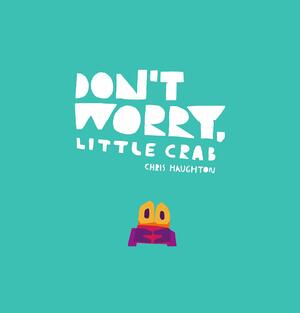
Don’t Worry, Little Crab by Chris Haughton

Published: 1st June 2019Goodreads badge
Publisher:
Walker Books
Illustrator: Chris Haughton
Pages: 43
Format: Picture Book
★   ★   ★  – 3 Stars

Little Crab and Very Big Crab live in a tiny rock pool near the sea. Today they’re going for a dip in the big ocean. “This is going to be so great,” says Little Crab, splish-splashing and squelch-squelching along, all the way to the very edge. Then comes a first glance down at the waves. WHOOSH! Maybe it’s better if they don’t go in?
Haughton has written a wonderful story about taking chances and trusting new experiences. Big Crab tells Little Crab they are going to the sea and it’s clear this will be Little Crab’s first time and they are keen to go on this adventure.

The story is a great exploration about being excited for a new adventure or experience but when faced with the reality being a little apprehensive. Putting their trust in Big Crab we see Little Crab gain confidence as they slowly embrace a new experience.

It’s also a great book for sounding out onomatopoeic words and puts you in the scene vividly, especially when the illustrations are minimal. The focus is on the squishing of seaweed and the tapping of claws which shows the journey they take with few words.

The illustrations are adorable, though basic. They are bold and simple and set the scene, changing a little to suit the story but remaining striking solid colours that fill the page. The contrast between on land and sea was great and it’s another way to highlight what Little Crab would have missed if they weren’t brave and trusting.

Drawn in by a cute cover and the prospect of a tiny version of an animal I was rewarded with an adorable story. It has a wonderful message that new experiences can be great but you’ll never know if you don’t take the plunge.

You can purchase Don’t Worry, Little Crab via the following

QBD | Blackwell’s

Dymocks | Wordery | Angus & Robertson

 Fishpond | Amazon | Amazon Aust

The Littlest Turtle by Lysa Mullady

Published: 15th August 2023Goodreads badge
Publisher:
Magination Press
Illustrator: Erica Salcedo
Pages: 32
Format: Picture Book
★   ★   ★   ★  – 4 Stars

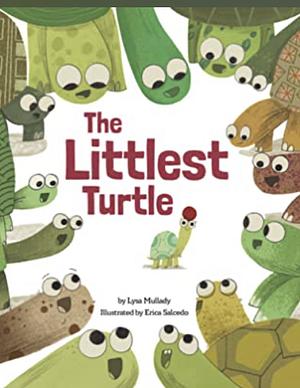
For years, the little turtles climbed on top of the big turtles to eat the freshest fruit from the top of the bushes. The big turtles ate the fallen berries–sour and rotten. Littlest Turtle follows along with this tradition until she hears the feelings of the big turtles. Littlest Turtle sees how unfair this all is and thinks about the important question: would it be so hard to share?
Follow along as Littlest Turtle joins together with the big turtles, speaks up for change, and comes up with a new tradition that works for all turtles, no matter the size!

When I find picture books I love I immediately go around and shove it in the faces of co-workers and make them read it. My little socialist turtles is one I made people read one, because they are adorable, and two, because it’s a great message about one little voice making a difference.

From the outside it seems like a good system, working together to get the same goal: food. But the quality of the food is different for different turtles. Mullady shows how this system of inequality with the turtles is unfair. By listening to the bigger turtle, the little turtle learns the system is unfair, something they never realised before, never had to think about before. But now their little eyes are open they can’t keep quiet and start to make change.

The most dangerous phrase is “This is the way things have always been done” and Mullady mimics this twice with “That’s just the way it’s always been” and “There’s no reason to change what works.” But works for whom? Those benefiting can see no reason to change, and those without live with less.

It is a lot to put a whole message about balance and inequity on a book about a tiny turtle, but it is a great way to show readers that unfair comes in a lot of different ways. And listening to those who are at the worse end can benefit everyone in the end.

There’s a lot of great symbolism if you want to get into it. The small turtles literally standing on the backs of the suffering turtles to gain their sweeter reward. But Mullady brings none of that heavy handed messaging over. It’s simple, it’s about berries. It’s about cooperation and listening. But as an adult you can use it as so many teaching tools and ways to explain larger concepts.

There is a wonderful teaching tool in the back about all the lessons kids (and adults) can learn from this. About empathy, about embracing difference and accepting change. There’s a great story wrapped up in a wonderful lesson coupled by absolutely adorable illustrations.

I am a sucker for a cute illustration and Salcedo gets you from the cover. One small thing surrounded by the bigger versions of the thing is peak book cover and one I have never been disappointed by before. The different sized turtles are shown well with perspective and you see how the tiny turtles need the larger turtles whether they understand that or not. Their little faces are cute and joyful, and having them be so cartoony helps make this a fun light-hearted story about cooperation and not a nasty us vs. them type story which it so easily could become.

It really is a great book about showing how one individual, who listens, and works with a community, can make change better for everyone. What isn’t to love about a little socialist turtle?

You can purchase The Littlest Turtle via the following

QBD | Blackwell’s

Dymocks | Fishpond | Amazon | Amazon Aust

The Pronoun Book by Chris Ayala-Kronos

Published: 27th October 2015Goodreads badge
Publisher:
Clarion Books
Illustrator: Melita Tirado
Pages: 26
Format: Picture Book
★   ★  – 2 Stars

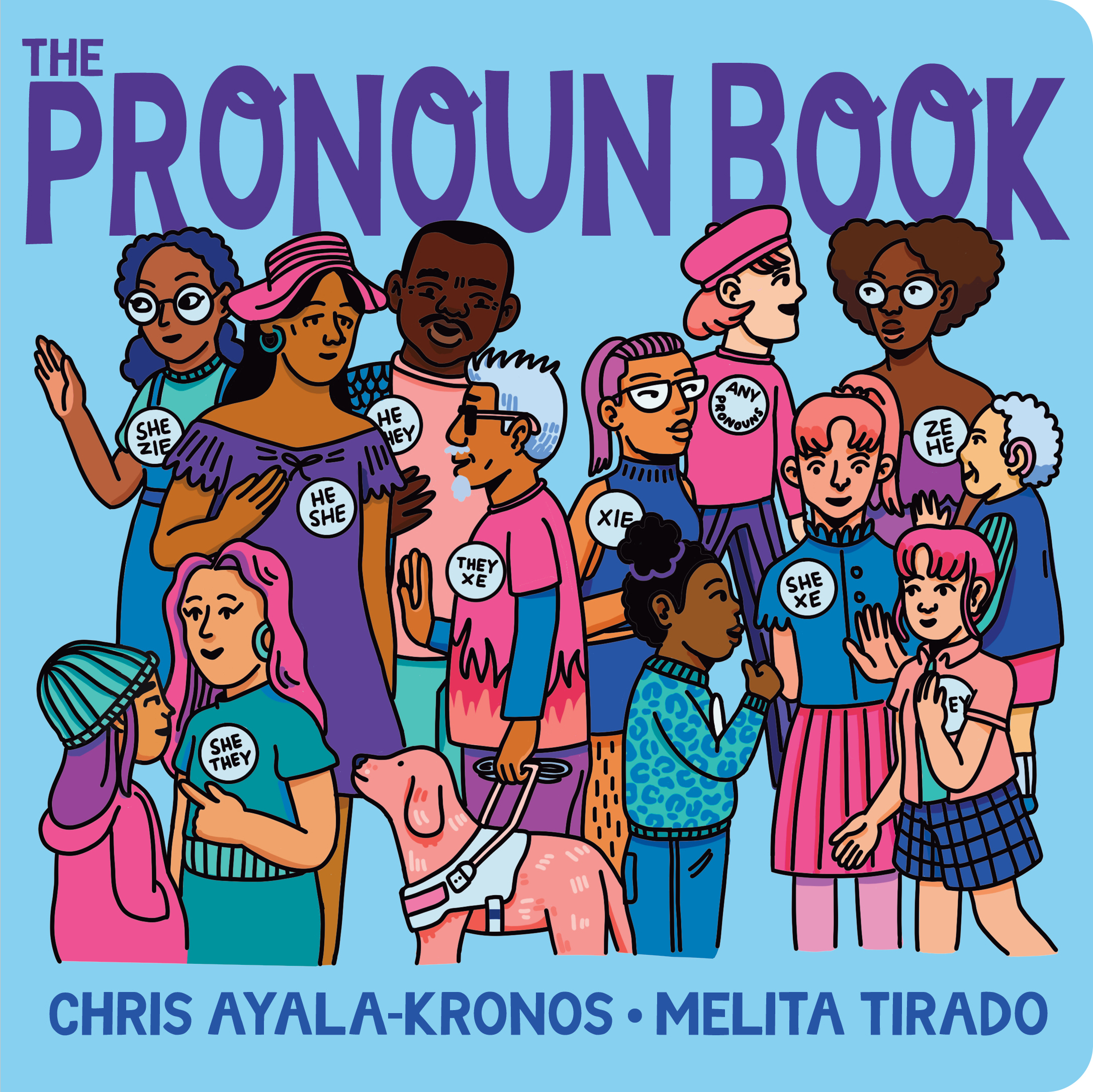
They, she, he . . . all together, us! Join along in this vibrant board book’s joyful celebration of people and their pronouns.
How do you know what someone wants to be called? Ask!
This lively board book features eye-catching illustrations of a diverse cast of people and simple text that introduces their pronouns, perfect for readers both young and old.

This is no nonsense picture book. Technically it isn’t a story, it’s basically a PSA in book form. That isn’t to say it’s bad or ineffectual. It’s basically a book that says if you want to know what to call someone: ask. End book. But then there are a few pages of examples through illustrations of the different types of people that you may meet and the pronouns they may use.

I think it’s a bit simplified to call it a celebration of people and their pronouns when there are basically no words in this book besides she, he, and they. No extra text explaining anything until you get to the resources and notes at the very end. Nothing reminding people that you can’t assume based on appearance, don’t ignore requests, or listen when people correct you and don’t feel bad we’re all learning. Something might have been more helpful than a few pages that are picture book sized posters of nothing.

I’m sure it’s still a good basic intro book, but there would have to be so many conversations as a result. Which again, is great, I love books that start conversations, but it is a lot easier if that is aided by the book. Having a page of notes and resources at the end is something that could happen with any book that had a real story attached to it. Even this one with a few more words would do.

Overall, it was fine, but it’s weird to call it a book. It could be a poster on the wall and illicit the same conversation. If you want a better book about pronouns for kids a better option would be What Are Your Words by Katherine Locke which you can watch a video of it being read here.

You can purchase The Pronoun Book via the following

QBD | Booktopia | Blackwell’s

WorderyAngus and Robinson

 Fishpond | Amazon Aust

The Sour Grape (#6) by Jory John

Published: 1 November 2022Goodreads badge
Publisher:
HarperCollins
Illustrator: Pete Oswald
Pages: 40
Format: Picture Book
★   ★   ★   ★  – 4 Stars

The Sour Grape holds grudges for every reason under the sun. Lime never returned a scarf they borrowed? Grudge! Orange never called back? Grudge! But when a friend holds a grudge against the Sour Grape without listening to an explanation, the Sour Grape realizes how unfair grudges can be. Could a bunch of forgiveness and compassion be enough to turn a sour grape sweet?

Another course in the Food Group picture books introduces us to Sour Grape. It is a great story, not overly sweet or cute, but it was an interesting and reflective story. One that followed Grape as they told their tale of woe and sorry.

What I enjoy about John’s books is there is often a reason why a character becomes the way they are. This book is no exception as it demonstrate people often have reasons for their behaviour; things happen outside their control, something has happened in their past that can affect their present selves, or sometimes mistakes just happen. What is also wonderful is John makes sure there is a chance to develop as a character and grow by the end of the story. In this case realise so many issues are not a big deal if you communicate and have understanding.

I enjoyed the physical effect of being sour had on Grape, how it affected their outward appearance as well as their interactions with other people. John is great at storytelling and putting messages forward without wedging them in unnaturally, or worse, by having a large neon sign that says “here is the lesson”. The tone of the book is reflective, the message clear, but never unnatural.

I liked the message of this one and it’s is certainly one we could all learn. It’s not telling the reader they can’t be grumpy, or can’t let things annoy them, but it does ask to take things into perspective and have a little understanding. Focus on the positives in the world not the negatives. Let things pass, understand accidents happen, and people will make mistakes. Try not to let it consume your life to your own detriment and others.

John’s food puns on point again as always. I love how they suit the food in question, they aren’t generic and instead have purpose to their story. Oswald also comes through with adorable illustrations of various fruits. A banana walking a dog raises all sorts of questions but in the world of the Food Group gang it’s best not to think about it too much.

You can purchase The Sour Grape via the following

QBD | Booktopia | Blackwell’s

Dymocks | WorderyAngus and Robinson

 Fishpond | Amazon | Amazon Aust

A Fox Called Herbert by Margaret Sturton

Published: 3rd April 2020Goodreads badge
Publisher:
Anderson
Illustrator: Margaret Sturton
Pages: 32
Format: Picture Book
★   ★   ★   ★  – 4 Stars

Meet Herbert, the rabbit who knows he was born to be a fox. When his mommy isn’t looking, he puts on pointy fox ears, makes himself a bushy tail, and asks his sister to paint him orange, just like a fox. But Mommy doesn’t understand; why can’t he just be a good rabbit?

This delightful picture book is a true celebration of being ourselves and supporting our loved ones. Let this joyful tale inspire you to be who you are and follow your dreams.

The story is a simple one about identity, there is no bigger meaning or explanation. Herbert feels like a fox and wants to look like one.

I liked that it isn’t an explicit animal allegory for trans or gender diverse kids, it is an entry level to identity and being able to be the identity you feel inside with support and understanding. The fact you have to find meaning yourself is fantastic because it can mean so many different things to different people on a range of different levels. The simplicity of it means you can read whatever you want into it without the text telling us what it’s meant to mean.

The illustrations are cute. Sturton’s designs are playful and she captures the playfulness and childlike innocence of Herbert. The colours are great and the full page spreads juxtaposed against the white space and the text works well in telling the story.

There are certainly other stories out there more complicated, more literal, and more detailed about identity but I liked that this doesn’t put Herbert in any particular category. He isn’t labelled, he isn’t trying to change anything right now. He only wants his mum to understand he doesn’t feel like the rabbit she thinks he is. Feeling like you are in the wrong body can mean a lot of different things, and the fact Sturton doesn’t choose one path for Herbert means this book can be interpreted by a lot more people, and maybe help them understand that there is nothing wrong in finding a body you are more comfortable in.

You can purchase A Fox Called Herbert via the following

QBD | Booktopia | Blackwell’s

Dymocks | Wordery

Fishpond | Amazon | Amazon Aust

Previous Older Entries Next Newer Entries