Published: 25 March 2025 (print)/1 April 2025 (audio) 
Publisher: Pan Macmillan Australia/Bolinda Publishing
Pages: 400/11 hrs and 9 mins
Narrator: Lucy Moir
Format: Audiobook
Genre: Fiction
★ ★ ★ ★ – 4 Stars
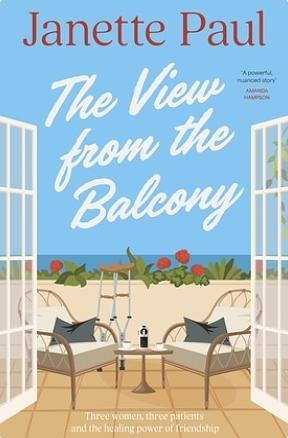 Three women and the healing power of friendship.
Andie has no memory of the man who pushed her out of the way of a speeding car. A week before Coral’s biggest career highlight, her mum has a fall. And the last thing Mara wants is to be assigned to work at the hospital bedside of the much-despised senior partner of her law firm.
Andie, Coral and Mara become the daily visitors to the three patients at the end of East Wing of Hepburn House Rehabilitation Hospital. The balcony that connects the three rooms provides an oasis, a healing place, but more than that, too: a place where their lives will interconnect and never be quite the same again…
A heartwarming and evocative novel of love, friendship and family, where hope overcomes all – even terrible hospital coffee.
This is a wonderful story about women and their lives, it’s also about friendship and support and all the different types of experiences people can have. It’s about the multifaceted aspects of family, friendship, work, and romance, and how responsibility is often a burden when carried alone.
I enjoyed the emotional journey the women went on and even though there were disasters and chaos at times, in all of their lives, I enjoyed that they were allowed a real experience, full of heart. No dramas. It isn’t bland, simple, or emotionally uninteresting either, it was a beautifully real story about three people in different stages of their lives and the struggles and joys they experience.
All three women have stress in their lives and things that are causing chaos for them. Mara deals with the stress of family obligations and lack or support, Coral is dealing with the pressures of family and her obligations, while Andi is dealing with the trauma of her accident and healing.
I don’t know whether I need to worry that someone my age and in my situation resonated with Coral so much. I felt sympathy and had a connection with her and her circumstances as she was pulled in every direction and made to feel bad for wanting a break or time to herself. It might be Paul’s great writing though, you really get into the mindsets of these characters. You understand their stresses, their fears, and with remarkable ease you understand who they are and where they’re coming from.
Paul’s approach of writing about the unseen and oft forgotten people was a great decision. When someone is recovering the temptation is to focus on their story, who they are meeting in the hospital, what their recovery journey is like. To have this flipped and we’re focused now on those in a supportive role it reminds you how even popping in for a visit each day can be draining and a demanding practice.
The setting of a care hospital is a great place to interact because with a mix of patients, staff, plus the fly in fly out nature of family and visitors it makes for a great place to overlap, interact, and gauge these characters and their lives.
I loved all the characters, even the difficult and harsh ones, because you know there’s reasons why, there’s life history, there’s emotional issues or illness that makes them hard to deal with. But their complexity makes them real, turns them into people you know, you’ve met, and the ability Paul has to layer so much depth into the characters without being heavy handed is amazing.
I actually enjoyed the three narrators didn’t find one another until the end of the book. It wasn’t like they were the only three characters either, each one has a little group around them so they are never alone, but they still never cross paths. It works too because it is completely believable and understandable. In a place like the rehab centre people pop in and out all the time, and often you’re so wrapped up in who you’re there to visit you only notice people in passing as you bustle onto your next duty of the day. This is contrasted by the evidence that those in recovery did find one another and formed relationships, which we only catches glimpses of through our main characters. In another book these characters would be the main focus and Coral and co would be the side characters we never get a chance to see deeply.
There’s complications of course. There’s decisions that need making, there’s circumstances that work in a ward but not in the outside world. There’s risks to take and opportunities to weigh up which was as impactful and consequential as any major disaster. I’m glad there wasn’t a huge Event the characters had to deal with. The three main characters had their own events to deal with and overcome and I loved how that was perfect for this type of story.
Paul brings great closure with the ending, Val and Coral finally get to have their moment, the realisation of clarity or whether the clarity was new or just a fluke is irrelevant as it helped heal them both. I was hoping Mara and the physio Riley were going to hook up, they are a good match and the few interactions they had felt like they really clicked. There’s career prospects and personal growth, and new opportunities to leave readers feeling hopeful.
I will admit I am a little annoyed at the ending, but only because I was rooting for Coral so much. She deserved great things and regardless of her acceptance I was annoyed her obligations – despite her decision that they weren’t – stopped her doing something she had earned, worked for, and should be able to celebrate. But my disappointment was made up in the comradery these women showed, the ride or die for someone they barely know and are spurred into by the people around them.
You can purchase The View from the Balcony via the following
QBD | Dymocks | Booktopia
Angus & Robertson
Fishpond | Amazon | Amazon Aust | Audible


 Tilly Dunnage has come home to care for her mad old mother. She left the small Victorian town of Dungatar years before, and became an accomplished couturier in Paris. Now she earns her living making exquisite frocks for the people who drove her away when she was ten. Through the long Dungatar nights, she sits at her sewing machine, planning revenge.




 Based on my success last year I am starting my goal at Reading 30, Reviewing 20. From there I will either meet it or exceed it. If I hit it early I can always bump it up. I admire those who have their starting points at 50 or beyond. I think that would stress me out too much, I’d rather be pleasantly surprised when I exceed my original goal. Give myself a confidence booster.