A little over a week ago I went to a talk in North Sydney to hear David Dyer talk about his new book, The Midnight Watch. The story is of the Californian, the ship who saw the Titanic sink and did nothing to help. The story itself is incredible, I am working on a review for that at the moment, but I journeyed the many hours and had an adventurous train trip to hear David speak because I was in love with this book before I even read it.
It was a quaint little cafe and wine and canapés were offered which was very swish. There was a small but enthusiastic crowd; the 30 chairs provided being mostly filled. I discovered during the talk many people had no read the book yet which was interesting, but many did purchase it on their way in or out so I guess David’s talk was successful.
David only spoke for 30 minutes which I was very surprised about. The event had been listed as 6-7pm, and it wasn’t until about 6:15 I realised the first half hour was for the food to go around. Not to be ungrateful because David did a wonderful job, but I’m slightly indignant that it only went for 30 minutes. The argument can be made that the $35 I paid was for the food/wine/venue, but if you chose not to eat or drink, you really are paying a lot (and personally coming from a fair distance) for 30 minutes. To his credit, David fit a lot into those 30 minutes.
He told us that he’d always been passionate about the Titanic, having seen A Night to Remember when he was around four years old. Reading this book I was amazed to learn there had even been another ship in the area, I always hear about Carpathian and Titanic, never a third. The way David tells the story is beautiful and filled with history that comes straight from the records.
 Helen Baxter from Blues Point Bookshop introduced him and asked whether there was anything more to write about the Titanic, was it not overdone? But she complimented David for not only taking on the task but for doing it astonishingly well. David himself was surprised by the interest, the story is of course well known by the 1997 film, which catapulted the story like no film ever has. Because of this everyone knows the story of Titanic, but what surprised David was that not many people know that everyone on board could see another ship. The entire story would have been different, the Titanic may not have even been remembered, if the Californian had gone to her rescue and saved the 1500 who were lost.
David spoke about how his obsession grew over the years until he finally wrote a book about it. Even though the book is fiction it sets out to tell the truest story. As well as the Titanic/Californian story, an additional backdrop of the novel, and history really, is the suffragette movement; something David said was at its peak just before the disaster and which was set back years as a result.
Before becoming a writer David told us about training to become a doctor (but he faints at the sight of blood) before deciding to go to sea and work on merchant ships and tankers. He learnt a lot about himself at sea and this experience feeds into the novel. He was also a lawyer working in Australia and in London. In an incredible coincidence he was a litigation lawyer in the firm that represented White Star Line, the company that owned the Titanic.
When he decided to write the novel he began researching, and somehow ended up back in Sydney as a teacher. He took time off in 2009 to do hard research into the Californian and why it didn’t go to help. This took him all over the world, London, New York, Boston, and the Liverpool Maritime Museum, where all of Captain Lord’s papers are held.
Lord left all of his things to a friend who kept them all his life, and when he passed he donated them to the museum. David thought he would find an answer in these documents but only found commendations and a lot of people praising Lord, saying he was very brave. One of the greatest finds was two original letters that had been given to Lord by the two men who’d watched the distress rockets being launched and seen the Titanic in the distance.
These letters were written within a day of the sinking and listening to David read out his photocopies was incredible. These were the actual words of those who’d seen Titanic and are amazing contemporaneous evidence. As David read the words of the two men it’s no wonder Lord had the letters kept secret for 50 years because they clearly show him at fault.
David said that even more important than documents was actually visiting places and locations where events happened – New York, Venezuela, London, Liverpool etc. David called it narrative telepathy; he needed to go to the places the people went, needed to get under their skin. He went to the captain’s address and the second mate’s address to get a sense of how terrible they’d feel and what it was like for them to live among the community where so many were lost. David sensed Lord’s shame and anger, but not from malice. It was a small mistake that had consequences of 1500 lives.
In order to achieve the most narrative telepathy David was in the middle of the north Atlantic 100 years to the second over the sink site on 14 April 2012. He spent hours there looking over the water. The weather was the same, dead calm, no wind and a black night. He couldn’t imagine being in the water. Apparently one of the worst sounds heard by the 700 who escaped in lifeboats was people crying out in pain as they entered the water. The worst sound came ten minutes later when there was no sound at all because that was how long they had. This, David said, is what’s at stake in the novel – the captain should have come to help.
The audience were quite good considering most hadn’t read the novel yet. They asked why lord had kept the letters if they incriminated him. David admitted he didn’t know but thought perhaps Lord couldn’t bring himself to destroy them. There were bits of evidence to support it wasn’t the Titanic, but he may have known in his heart that it was.
David answered a question about the transcripts of the American and UK trials that took place, telling us they are available online for public viewing. The American trial was four days after the disaster and useful for being so immediate, while the UK one was more measured and thorough a few months later. Captain Lord and the two officers gave evidence and much of the dialogue in the book is verbatim from these transcripts.
Ending on a light hearted note David answered a comment about Clive Palmer stating that he would never have gotten his second Titanic to work because not only would he need to adhere to safety measures that did not exist 100 years ago, but no one would agree to share one bath between 600 people in third class as they had to do on the original.
As I said, despite only speaking for 30 minutes David managed to speak about a lot, including time for questions. There was a lot he couldn’t elaborate on which was a shame because it was clear he loved the topic and could have spoken for longer but what he did mention was fascinating. At the end I was able to get my book signed and I was even brave enough for a question (at the signing table mind you, not during the talk) so I was pretty pleased.
David is appearing at the Sydney Writers’ Festival to talk more about his novel and the suffragette movement if you’re interested. Full details are on his website and the SWF website.

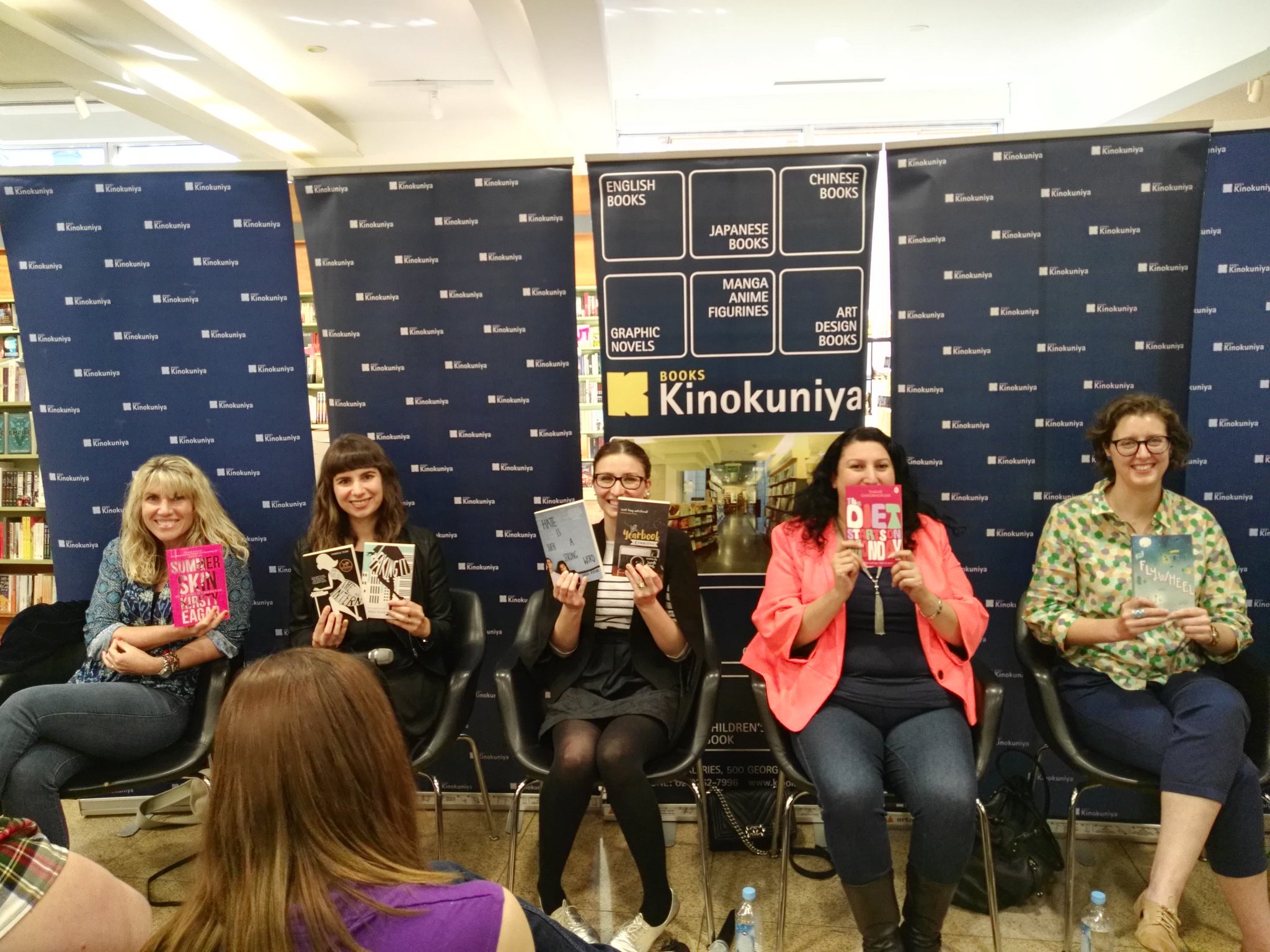
 It was lovely to hear the panel talk about why they love the Aussie YA community, praising our passion and how engaging we are. Kirsty loving our open mindedness and how open-hearted we are, while Sarah loved how vocal we are about the books we love. Tamar mentioning along the same lines how she loved seeing readers react with books and characters. The common opinion from all five was how accepting the YA community is, which is a wonderful thing to have recognised by other people.
 Last week I attended a book event in Sydney for Fiona McFarlane, author of
  Last night I attended a book event at Kinokuniya bookstore with Will Kostakis and Benjamin Law discussing The ‘Gay’ Book. Benjamin Law, according to his Twitter bio, is a writer, raconteur, and local homosexual. In 2012 he published Gaysia: Adventures in the Queer East as well as The Family Law, the latter of which was made into a TV series for SBS. He is currently writing its second season. Will wrote his first novel aged 19, called Loathing Lola which, I discovered, is very hard to track down and basically out of print. He was the 2005 Young Writer of the Year, he published his second novel The First Third three years ago, and has recently published The Sidekicks.
 Will spoke about how the controversy around The Sidekicks and his experience coming out was unexpected but something he couldn’t ignore. He was thrust into being ‘the gay writer’ overnight which was a shock. He made the decision to respond himself to the school and publically (names omitted) because if he responded in the dark, it would keep happening. He never expected it to spread as it had, saying the international response was disbelief that it had happened, while the Australian reaction recognised it as an ongoing problem. I love though that none of this has stopped people not only loving the book, but finding out ways to discuss it in places where it cannot be discussed, and Will told us some great stories of his experiences in schools.
 Having never heard Benjamin speak it was interesting to hear his story. Doing his PhD in Creative Writing he had to write everything, from stories, to memoirs, the journalistic pieces. In doing so he discovered he enjoyed writing memoir, it felt natural doing so. Like Will, Benjamin didn’t position himself as the gay writer, but he said you tend to identify with what separates you, in his case being gay and Asian; he joked he was basically a turducken of minorities. It was an interesting discussion because it was something I hadn’t thought much about. Benjamin told us that you really can’t disentangle yourself from those parts of you, and while he hoped his generation would be the last to be persecuted for being different, he was sad to see it hasn’t changed.