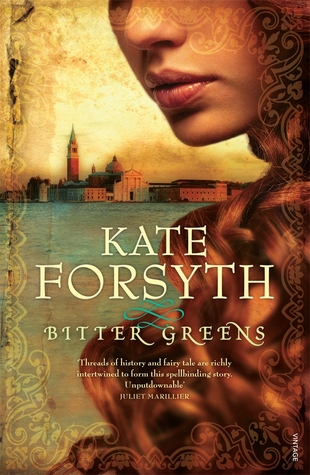
Bitter Greens by Kate Forsyth

Birthday

Today is the birthday of Australian author Kate Forsyth!

Kate Forsyth is an Australian author known for her children’s books, her heroic fantasy series, as well as her historical novels. With more than twenty books under her belt for both adults and children, there are stories to suit all ages. She has also won or been nominated for numerous awards, including winning the Aurealis Award five times. Before becoming a writer, Forsyth worked as a journalist before then moving on to freelance work to have more time to focus on her writing. Having written her first novel at the age of seven Forsyth has gone on to become an internationally bestselling author, and shows no sign of stopping anytime soon.

Forsyth’s love of fairytales is one of the reasons I really like her, her adult historical fictions Bitter Greens and The Wild Girl allow a backstage pass behind the fairytales we know and love today, including new insights into what the truth is behind these gripping stories. Bitter Greens about the origins of the tale of Rapunzel, and The Wild Girl about the woman and the love story behind many of the Grimm Brothers fairytales. Understanding how these timeless tales came about gives them so much more meaning and puts important and forgotten faces in front of stories where they belong.

One of the other things I love about Kate Forsyth is her ongoing and enduring passion for fairytales. It is a joy to hear her speak about fairytales and her passion, as well as the impact and influence they have had on her life, as is listening to her discuss her passion for books and reading in general. I implore you all to pick up one of her books, any of her books, and start reading them straight away, and I wish Kate a very happy birthday!

To learn more about Kate and her work just pick a link and start clicking!

 All Your Bits and Pieces Needs

Website
Blog
Goodreads
Twitter
Pintrest
Facebook
 

Published: 20th March 20123349b-goodreads-button

Publisher: 
Vintage Australia
Pages:
 576
Format: 
Book
Genre:
 Historical Fiction
★   ★   ★   ★   ★   – 5 Stars

Charlotte-Rose de la Force has been banished from the court of Versailles by the Sun King, Louis XIV, after a series of scandalous love affairs. She is comforted by an old nun, Sœur Seraphina, who tells her the tale of a young girl who, a hundred years earlier, is sold by her parents for a handful of bitter greens…

Selena is the famous red-haired muse of the artist Tiziano, first painted by him in 1512 and still inspiring him at the time of his death, sixty-four years later. Called La Strega Bella, Selena is at the centre of Renaissance life in Venice, a world of beauty and danger, seduction and betrayal, love and superstition, retaining her youth and beauty by the blood of young red-haired girls.

After Margherita’s father steals a handful of parsley, wintercress and rapunzel from the walled garden of the courtesan Selena Leonelli, he is threatened with having both hands cut off unless he and his wife give away their little red-haired girl. And so, when she turns seven, Margherita is locked away in a tower, her hair woven together with the locks of all the girls before her, growing to womanhood under the shadow of La Strega Bella, and dreaming of being rescued…

Three women, three lives, three stories, braided together to create a compelling story of desire, obsession, black magic and the redemptive power of love.

Bitter Greens is the story of the fairytale Rapunzel, told against the backdrop of seventeenth century Europe and through the lives of many extraordinary women. The story focuses on three women in particular, Charlotte-Rose de Caumont de la Force – a member of King Louis XIV’s court, Margherita – a girl stolen from her family and shut away, and a courtesan surrounded by magic – Selena Leonelli. Each of their stories is told through an intricately threaded narrative and through the eyes and lives of these women, a wonderful story is told about passion, history, and fairytale.

The way Forsyth connects each of these stories together is brilliant. Her storytelling ability is engaging, mystical, and pulls at all the right emotions. What she has done is create a compelling novel that is based on history, based on the life of Charlotte-Rose de Caumont de la Force, based on a period of time with royalty and court, convents, and just to keep things interesting, the Black Death.

The story starts with Charlotte- Rose and we learn of her banishment from court and it is through her new life in the convent that the stories of the other women are brought to life through the tale told by Sister Seraphina. The altering nature of each woman’s story was particularly enjoyable because it allowed you to feel like you too were being told the story in multiple sessions by someone. An entire story cannot be told in one afternoon in the garden, and Forsyth does not try to pretend like it is possible.

As I read about the convent life Charlotte-Rose endures I remember liking it to a women’s prison, though I’m sure that is a slight exaggeration but the way Forsyth describes it, especially coming from the life Charlotte-Rose had in court, it seems like a horrible place to end up and made me wonder why anyone willingly chose it. But as we see it through Charlotte-Rose’s eyes we are only exposed to her view of things, and it is writing like this that is truly excellent. The story Forsyth writes is enthralling and is one that is packed with detail making you feel like you are there beside each character the entire time. This is not just for Charlotte-Rose’s story though, the details throughout this book are extraordinary and there are minute details and grand details that not only add to the story but make you admire the writing and writer even more so.

By telling us the three women’s stories – Charlotte-Rose, Margherita, and Selina Leonelli, you learn that everyone has a story. The women in this story do not necessarily start out as the people they become, nor do they remain the same people there were, there are, like for everyone, many influences in their lives and each of these unique women are certainly victims of their circumstance, but it is what they do with it that can change everything and makes this a gripping story.

As I say there are many points of view as well as jumps in time through this book, meaning every perspective and every story can be told. This does not result in any confusion however as each story is woven together beautifully, heartbreakingly, and magically all at once. They are all connected, flowing one after the other, twisting together with such ease that you never lose your place, nor forget what has come before. You do however get so engrossed with each story that Forsyth is telling you are suddenly brought back to reality when the scene chances again and you realise you are in a memory, or the past, or someone else’s mind.

Bitter Greens isn’t so much a story within a story, but at the same time it is. Sister Seraphina tells the tale of Margherita to Charlotte-Rose, but through these two stories we see many other stories emerge, histories and pasts, all connecting together in the epic tale filled with history, passion, and longing. It is truly spectacular and a joy to become lost in and the historical aspects only add to the wonder. The detail and the complexities certainly show the years of research behind it, even passing comments can be something wonderful as you recognise a small seemingly obscure part of history being referenced.

Along with everything else this book has to offer from, the way Forsyth brings the story to an end is superb. The details possibly forgotten by the reader are brought back and reconnected to the story and a full circle is made where you didn’t know one needed completing. After initially being a tad saddened by the ending I soon recovered and understood. It is also hard to argue with history about where a story ends up. What was also wonderful was that the Afterword provides you with a brief ongoing story about Charlotte-Rose’s life, and what became of her and how her story got to be told, there is also additional information in the Forward.

There is a lot of power in Bitter Greens, not just in the life and realities people had to deal with during this time, but also the power of the people, the women, and the stories of the past. Historical fiction, good historical fiction, can make you see the past in a new light, bring out the everyday and make it shine. That is what Forsyth has done with this book, made it not just Rapunzel’s story retold, but looked at where she came from and how she came to be with integrity and adventure.

This book not only makes you realise there are more fairytale writers away from Grimm, Perrault, and Anderson, but discovering how these stories were created is astonishing. The fact that there is so much truth threaded into this work of fiction is marvellous and it makes you wish that some of the magical elements were a little bit real. Though having said that there is actually more reality than magic, and what magic there is is more on the unconventional side than fairytale magic typically is, enough to steep it more in reality than pure fantasy.

I explained this book to my sister as one she must read. She argued she did not like historical novels but I told her this was too good a story to pass up. I believe my words were “But it has fairytales! And prostitutes! And the plague!”. Possibly not the best argument but it is certainly not an untrue one. Bitter Greens does have all of these things, but what Forsyth does with the fairytales, prostitutes, and the plague is something to be admired, she takes these components and captures them into this story and turns them into a novel that is must read for lovers of history and fairytales alike. This is so much more than a simple Rapunzel story, it is a story that will leave you amazed, educated, and delighted.

The Ruby in the Smoke (#1) by Philip Pullman

Published: November 12th 1988
Goodreads badgePublisher: Scholastic
Pages: 373
Format: Book
Genre: Young Adult/Historical Fiction/Mystery
★   ★   ★   ★  – 4 Stars

Sally is sixteen and uncommonly pretty. Her knowledge of English literature, French, history, art and music is non-existent, but she has a thorough grounding in military tactics, can run a business, ride like a Cossack and shoot straight with a pistol.

When her dear father is drowned in suspicious circumstances in the South China Sea, Sally is left to fend for herself, an orphan and alone in the smoky fog of Victorian London. Though she doesn’t know it, Sally is already in terrible danger. Soon the mystery and the danger will deepen – and at the rotten heart of it all lies the deadly secret of the ruby in the smoke.

This book certainly starts off unexpectedly, I will give you that. In what is a crime/detective type story, we are immediately introduced to a Miss Sally Lockhart and the mysteries around herself and her father. The novel opens with 16 year old Sally visiting her father’s place of business after his death to inquire about a letter she received and Pullman instantly sucks you in by the second paragraph by saying “in fifteen minutes she was going to kill a man”. If that doesn’t make you keep reading then what will?

As a character, Sally is has had little conventional education, but she does know her fair share about running a business, military tactics, and how to shoot a pistol. The world she knew is changed when her father is drowned in suspicious circumstances and now must live as an orphan in 1872 Victorian London, living with her aunt who does not approve of her and how she lives her ‘unladylike’ life.
The letter mentions something called the Seven Blessings, and when her initial inquiries go awry Sally tries to find an alternative way. However while she continues to investigate Sally learns her life is in danger, and with the help of friends of her father and helpful strangers turned friends, Sally tries to solve the growing mystery and keep herself from harm. As readers we are not given much to go on ourselves about what these are and we must learn with Sally as she investigates these Seven Blessings that no one wants to talk about despite the chaos they create, though we are given an advantage as we are shown where this possible danger lies, as well as hopes for Sally finding some answers.

With the help of people like 13 year old office boy Jim, as well as brother and sister Frederick and Rosa Garland, Sally continues her journey for answers. After leaving her aunts house she lives with Frederick and Rosa, helping them to improve their business as payment for their help. As a photographerand actress, Frederick and Rosa are very enjoyable characters, they have quirks, as does their employee Theophilus ‘Trembler’ Molloy, ex-pick pocket with a nervous disposition. There are dangers and fear through this story, which makes it seem real and demonstrates the danger that really is present. People are selfish and ruthless when they want something, and there are suffers because of this, but Pullman offers enough hope and goodness to counteract this.

This is only the first book in the series so not a lot is given away, yet a lot is revealed, and that is not to say there is no curiosity sparked about characters and their circumstances. Pullman ends on a wonderful cliffhanger, as cliffhangers go, with new mysteries on top of the half solved old ones to bring readers into the second book. I had been wanting to read this series for about ten years and I am really glad I have finally gotten around to it. The way Pullman writes is for the Young Adult reader, but there is just as must grit, violence, death and intrigue as any other book. Perhaps not as well described, but there is drug use and violence throughout which I found rather charming in a book for this age group. The way Pullman uses it is certainly for the pot movement and isn’t exactly shown in the best light, though it does suit the era, and by doing so, amidst this crime and mystery, there is a nice little moral address about the dangers of drugs for the younger readers; but with full credit to Mr Pullman he weaves it in almost seamlessly with the narrative and it is certainly well placed.

The fact this is set in the Victorian era just adds to this charm. Reading about old England and the inventions emerging and the technologies is great. Seeing how people react to new things could pretty much be suited to anything at any time, but the fact this is the past makes you realise just how some things just don’t change, and how people don’t like it when it does. Another joy of being in this era is how proper and adult these 16 and 21 year olds can be. Not to mention the society, which I think Pullman captures well, especially around Sally. Somehow I think through capturing the society and the era, it adds a little more to the characters and who they are. It makes them more believable, rather than some one who could be living anywhere or any time. You certainly get the feeling of walking through London and its surrounding areas in the later 19th century, it’s rather enjoyable.

There are twists in this book, and enough intrigue and unanswered questions to get you into the second book. And while we may not call  it an actual cliffhanger per se, but the characters introduced, what happens to them and their lives and personalities are so engaging that you do want to keep reading and see what happens. It certainly ends very differently from where it begins, and all for the better I feel.

The Boy in the Striped Pyjamas by John Boyne

Published: September 12th 2006
Goodreads badgePublisher: David Fickling Books
Pages: 224
Format: Book
Genre: Historical Fiction/Junior Fiction
★   ★   ★   ★   ★  – 5 Stars

Berlin 1942

When Bruno returns home from school one day, he discovers that his belongings are being packed in crates. His father has received a promotion and the family must move from their home to a new house far far away, where there is no one to play with and nothing to do. A tall fence running alongside stretches as far as the eye can see and cuts him off from the strange people he can see in the distance.

But Bruno longs to be an explorer and decides that there must be more to this desolate new place than meets the eye. While exploring his new environment, he meets another boy whose life and circumstances are very different to his own, and their meeting results in a friendship that has devastating consequences.

First of all I understand why this book is either loved or disliked. I didn’t know this was classed as a children’s book until I picked it up and I was a little surprised but I have read kids books on just as tragic topics so it isn’t unheard of. As for the book where do I even begin?

From the moment I started reading this book I was greeted with a child’s voice that had such innocence within it and observation with no deep thought it was wonderful. Bruno is a nine year old boy in his own world with his own priorities. His world changes around him and he doesn’t understand and tries to make the best he can out of what he is made to do. What I think people find hardest is how naive Bruno seems to be, he is only nine after all, and what is wonderful about children is they don’t understand adult prejudice until it is drummed into them and they become adults. Bruno doesn’t understand why things are happening, he just does as he is told, tries to fill in his own answers and pieces together the rest.

I liked that this story made you understand that there were more people involved than just Hitler. It is so interesting to see what happened from the point of view from an officer or someone within the system but also apart from the consequence. There was so much more going on during this era and it does not just boil down to the actions of one man, this book shows just what goes on behind the scenes of the man in charge. And there is no better angle than through a child, even if his family is involved, he is unaware of what it means.

It is sad and unsettling this book because you know it is perfectly true to some point. Within the first few dozen pages you realise that this very well could be, and as you read these phrases that are drilled into these children and hear the lessons they are taught, you know that this was what was happening. Now I say again, yes this is fiction, not exact historical fiction, and it is YA fiction so give it some liberties before slandering it. It tells these events in as good a way as say Two Weeks With The Queen tells you about homosexuality and AIDS. It is a story told through the eyes of a child, that has to be the biggest advantage this story has.

Writing style was rather like A. A. Milne at times with the repetition and matter of fact and selfish way children can sometimes think and behave and this I felt added something by reinforcing this was a little boy who was being left in the dark and didn’t even know it. Bruno has such an innocent look on the world and he is constantly trying to figure it all out. His conversations with Shmuel at the fence show just how naive he is, and how very wrapped up in his sheltered world he seems. But also Boyne writes through Bruno in such a way that it perfectly matches the mind of a nine year old boy worried about his own problems and ignorant to the greater picture.

Boyne maintains his style of describing without actually telling and a lot of things are described but not written down, and I trusted this to get me to the end. This approach was good because it keeps a lot of the explicit violence and unpleasantness about the events in this book out but it allowed Boyne to keep the story realistic allowing you to easily figure out what was going on. As I read and I saw the pages start to thin on one end I really didn’t want to go on, and with so few pages left I knew it was going to be wrapped up quickly. I got through it and I’m glad I did. The ending was a bit unfulfilling but expected. It gives you a lot to think about and you certainly don’t stop thinking about it quickly.

Tuck Everlasting by Natalie Babbit

Published: November 1st 1985
Goodreads badgePublisher: Farrar, Straus and Giroux
Pages: 144
Format: Book
Genre: Historical/Junior Fiction
★   ★   ★   ★  – 4 Stars

Doomed to – or blessed with – eternal life after drinking from a magic spring, the Tuck family wanders about trying to live as inconspicuously and comfortably as they can. When ten-year-old Winnie Foster stumbles on their secret, the Tucks take her home and explain why living forever at one age is less a blessing that it might seem. Complications arise when Winnie is followed by a stranger who wants to market the spring water for a fortune.

Tuck Everlasting is a novel by Natalie Babbit and is set in the summer of 1880. This is a great story about a young girl Winnie who lives opposite the woods, dreams of adventure and stumbles upon a great secret. Being only ten years old she greets things and thinks things through as a child and is quick to access and accept those around her. I love it when authors write children protagonists, and all characters really, to match their ages. There is something great about reading a book and while it may seem illogical and a bit strange as we read, you know it is because it is through the eyes of a child and that is how they think and react. What makes Winnie great also is the era in which she lives. She has the child’s mind but she had the 19th century society influence as well.

While Winnie is trying to have an adventure she meets the Tuck family. This is where the curiosity begins because we are given two conflicting sides. This is soon replaced with a new curiosity as we get to know the Tucks better. Once Winnie is introduced to Mae, Angus, Miles and Jesse, it is from that moment she has her own little adventure all to herself.

The Tuck’s are a very decent family, you can tell the era which they come from in their speech and lifestyle, nothing special in particular about them on the outside. Jess and Miles are young men who like to travel and be adventurous while Mae and Angus are happy just being together. When Winnie stumbles upon the Tucks they are so bewildered and yet glad to have found her and they treat her as one of their own almost instantly, Jesse especially. I did find it a little odd that this seventeen year old boy was so attached and fond of a ten year old. I understand how she was smitten, him being bronzed, curly haired and being “even more beautiful up close” but he practically proposes to her. But aside from that it was a good story, it didn’t go where you thought it would which was a good thing I think. There was surprises and twists and in such a short book that was quite well done.

This was made into a ok movie starring Alexis Bledel of Gilmore Girls fame, but having read the book I think there is slightly more to enjoy in the book. In my mind, and a lot of the time I think I am right, the book trumps the movie. Sometimes they are both as bad as each other, but a lot of the time books come out on top. One of my favourite moments is when you discover a movie you liked was originally a book. Either I will track down the book to see the changes, or hope that it was better, or sometimes, like Hugo, you want to find out if it just as spectacular. I have to say Babbit’s book definitely trumps the movie in this case, but only just. With credit to the film a lot was similar.

Babbit’s idea is not new by any means but they people she placed around this idea were, and they were real and honest people who did not choose this life and were doing their best to protect people from it. It is an honourable and heartfelt book that makes you think, but even without reading anything into it, this story is simply about a little girl who has this wonder in her life and where that wonder takes her. It is as simple as that.

Next Newer Entries