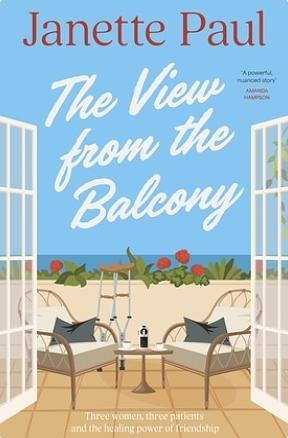
The View from the Balcony by Janette Paul

Published: 25 March 2025 (print)/1 April 2025 (audio) Goodreads badge
Publisher:
Pan Macmillan Australia/Bolinda Publishing
Pages: 400/11 hrs and 9 mins
Narrator: Lucy Moir
Format: Audiobook
Genre: Fiction
★   ★   ★   ★ – 4 Stars

Three women and the healing power of friendship.
Andie has no memory of the man who pushed her out of the way of a speeding car. A week before Coral’s biggest career highlight, her mum has a fall. And the last thing Mara wants is to be assigned to work at the hospital bedside of the much-despised senior partner of her law firm.

Andie, Coral and Mara become the daily visitors to the three patients at the end of East Wing of Hepburn House Rehabilitation Hospital. The balcony that connects the three rooms provides an oasis, a healing place, but more than that, too: a place where their lives will interconnect and never be quite the same again…

A heartwarming and evocative novel of love, friendship and family, where hope overcomes all – even terrible hospital coffee.

This is a wonderful story about women and their lives, it’s also about friendship and support and all the different types of experiences people can have. It’s about the multifaceted aspects of family, friendship, work, and romance, and how responsibility is often a burden when carried alone.

I enjoyed the emotional journey the women went on and even though there were disasters and chaos at times, in all of their lives, I enjoyed that they were allowed a real experience, full of heart. No dramas. It isn’t bland, simple, or emotionally uninteresting either, it was a beautifully real story about three people in different stages of their lives and the struggles and joys they experience.

All three women have stress in their lives and things that are causing chaos for them. Mara deals with the stress of family obligations and lack or support, Coral is dealing with the pressures of family and her obligations, while Andi is dealing with the trauma of her accident and healing.

I don’t know whether I need to worry that someone my age and in my situation resonated with Coral so much. I felt sympathy and had a connection with her and her circumstances as she was pulled in every direction and made to feel bad for wanting a break or time to herself. It might be Paul’s great writing though, you really get into the mindsets of these characters. You understand their stresses, their fears, and with remarkable ease you understand who they are and where they’re coming from.

Paul’s approach of writing about the unseen and oft forgotten people was a great decision. When someone is recovering the temptation is to focus on their story, who they are meeting in the hospital, what their recovery journey is like. To have this flipped and we’re focused now on those in a supportive role it reminds you how even popping in for a visit each day can be draining and a demanding practice.

The setting of a care hospital is a great place to interact because with a mix of patients, staff, plus the fly in fly out nature of family and visitors it makes for a great place to overlap, interact, and gauge these characters and their lives.

I loved all the characters, even the difficult and harsh ones, because you know there’s reasons why, there’s life history, there’s emotional issues or illness that makes them hard to deal with. But their complexity makes them real, turns them into people you know, you’ve met, and the ability Paul has to layer so much depth into the characters without being heavy handed is amazing.

I actually enjoyed the three narrators didn’t find one another until the end of the book. It wasn’t like they were the only three characters either, each one has a little group around them so they are never alone, but they still never cross paths. It works too because it is completely believable and understandable. In a place like the rehab centre people pop in and out all the time, and often you’re so wrapped up in who you’re there to visit you only notice people in passing as you bustle onto your next duty of the day. This is contrasted by the evidence that those in recovery did find one another and formed relationships, which we only catches glimpses of through our main characters. In another book these characters would be the main focus and Coral and co would be the side characters we never get a chance to see deeply.

There’s complications of course. There’s decisions that need making, there’s circumstances that work in a ward but not in the outside world. There’s risks to take and opportunities to weigh up which was as impactful and consequential as any major disaster. I’m glad there wasn’t a huge Event the characters had to deal with. The three main characters had their own events to deal with and overcome and I loved how that was perfect for this type of story.

Paul brings great closure with the ending, Val and Coral finally get to have their moment, the realisation of clarity or whether the clarity was new or just a fluke is irrelevant as it helped heal them both. I was hoping Mara and the physio Riley were going to hook up, they are a good match and the few interactions they had felt like they really clicked. There’s career prospects and personal growth, and new opportunities to leave readers feeling hopeful.

I will admit I am a little annoyed at the ending, but only because I was rooting for Coral so much. She deserved great things and regardless of her acceptance I was annoyed her obligations – despite her decision that they weren’t – stopped her doing something she had earned, worked for, and should be able to celebrate. But my disappointment was made up in the comradery these women showed, the ride or die for someone they barely know and are spurred into by the people around them.

You can purchase The View from the Balcony via the following

QBDDymocks | Booktopia

 Angus & Robertson

Fishpond | Amazon | Amazon Aust | Audible

Coffee, Cake and Contemporary Women’s Stories

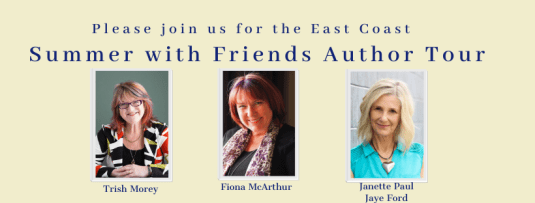
Saturday was my big bookish day and after I had spent my morning up at the Wallsend book sale, I headed down to Lake Macquarie for a coffee, cake and books event in the afternoon. The event was held in a cute little café opposite the lake in Warners Bay and there was a wonderful view of the water from the tables. The authors in conversation were Trish Morey, Fiona McArthur, and special guest for the day Cathryn Hein with Jaye Ford as interviewer. Julie from Lake Macquarie libraries welcomed everyone and said that the event was the first of hopefully many like it. For a first time event it was well attended, the tables were full and there were delectable nibbles provided before and during the event from the café. The authors themselves were lovely as well. I’d met most of them at various other things before and being able to enjoy their conversations, their friendship and their stories was special and not only allowed you to get to know these talented women a bit better, but gain an insight into their craft.

Jaye, Cathryn, Trish, and Fiona

Jaye started the afternoon off introducing everyone and explained that this was part of their Summer With Friends Tour that herself, Trish and Fiona were doing, this time with an extra friend in Cathryn. Jaye spoke to each of the authors about their latest books, their inspirations and how the story developed. Trish explained how her latest book, One Summer Between Friends, got to be set on Lord Howe Island after a holiday there reminded her of its beauty. With a desire for a small town type setting, a place where everyone knows everything and you can’t easily escape, Lord Howe was the perfect location. She explained how she wanted to test the boundaries of friendship, wanted it to be fractured and see if it could be put together again. Trish also explained how life imitating art in her own world helped to make her book stronger because she was able to put personal experience into it. The hands on research she used didn’t change her story a great deal, she explained, but the detail and emotion she was able to now include was based on her real reactions, something which I thought was brave and amazing.

Fiona’s book, The Desert Midwife, came from a previous version which had been rejected from the publisher but had now been reworked into something similar but new. Jaye spoke with Fiona about the concept of love at first sight and Fiona admitted she knew three people who’d experienced the phenomenon, herself included with her own husband. This notion is explored in her novel and how a woman is able to cope when her loving husband suddenly no longer remembers her. Jaye asked about Fiona’s research and we heard stories of travelling around communities near Uluru and how interactions with the communities influenced Fiona’s story. She spoke about midwifery and how she always likes to promote that birth is natural, how if left to nature it usually sorts itself out and she joked that often midwives instruct doctors on better ways to do things. Their conversation turned to Fiona’s new endeavour into indie publishing with her book Midwife on the Orient Express and she expressed how nice it was to be able to select her own cover, keep the title she wanted and how she had been inspired by others, like Cathryn, who had gone out on their own.

Cathryn’s own story, Eddie and the Show Queen – the fifth in her series set in the Levenham’s area, goes to some emotional places but it is one filled with humour too. Jaye spoke to Cathryn about how she came up with her ideas for the various, amusing fundraising solutions in the story and Cathryn admitted it was the most fun she’d had coming up with all of those options. Bringing it back to the dual tones, Jaye asked how it felt to write both emotions and Cathryn said she enjoyed the contrast between the two. She said it wasn’t real if people were happy all the time and if she can make herself cry when she’s writing it, that’s good. Being the fifth book in a series, Cathryn spoke about how after writing the first – Rocking Horse Hill – she wanted to explore the stories of more characters. She explained how she comes up with the titles and then writes the book to that title. Cathryn explained with this new one, Show Queen was originally Show Girl but in an international market Show Girl means something different entirely and so she changed it.

Jaye spoke with the women about creative blocks, Cathryn explaining how some medical issues recently had halted her creativity, but she was slowly gaining it back as she got better. She explained the fear she had when she couldn’t write, she told us writing was her dream and not being able to write was horrible. One thing that really resonated with me was Cathryn saying that “100 words a day gives you a book in the end” which I think I might need to paint in large letters on my wall. It is a wonderful piece of advice and one I know I need. Trish spoke about how writing intense books was hard when her own life had become intense with family issues and so she needed to write a different kind of book, this also included not writing about sex all the time. Fiona told us that in the beginning she had trouble finding the time to write with children and a husband to care for and so she found some hours in the early morning that were all hers. Between 4:30am and 6am there was time no one wanted her for anything and it allowed her to write. Now she had retired she has all day which is even better. Fiona also offered some more fabulous advice telling us “if you keep going, eventually you get there”. Another for my wall.

Jaye spoke with the women about their routines and how they started their days, where their writing process took them. From long walks to doing Sudoku and taking afternoon naps there were numerous routines to get the brain kicked into gear and allowing time for plot points to be nutted out. Cathryn reminded everyone that you have to be disciplined because it is a business, and Jaye invited each author to talk about their writing process and how they gain their ideas and start planning (a plotter), or whether they make it up on the fly (a pantser). Trish acknowledged everyone has a different process, she likes to start with a ‘what if?’ situation and a character then venture into a story. Fiona is a pantser, and while Cathryn admitted she too is a pantser, she also mentioned that she needs to know how her story starts and she needs a crisis moment before she can start.

By now we’d all been served our afternoon tea and cakes and the audience was able to ask questions. There were some great questions like further clarification on the plotters vs pantsers and how do you start a story in the first place. Fiona sees her scenes like one would a movie and she builds on that first scene, Cathryn told us that the story takes as many pages as it takes to tell the story, whatever that length may be, as long as it doesn’t bore the reader.

Another question from the audience was how to identify and keep track of continuity. Fiona told us that when you start you don’t know your characters well, but you get to know them as you write the book. You get the story out then you can go back and fix it later. Trish said you need to keep your characters grounded, you give them a description at the start and use it as a reference and do the same for personality, find words and titles that go with the characters. I loved Cathryn’s approach, she mentioned she finds three things for her characters: something physical that sets them apart, some verbal tick/saying that is theirs alone, and a gesture that identifies them.

The two hours flew by and I easily could have sat there listening for two hours more. A whole lot more was spoken about, laughed about, and explored but I wrote eight pages of notes and to recap the afternoon in its entirety would be never ending. I will say though, if you ever get a chance to go to an event similar to this I insist you do; it is so wonderful to be allowed access into this world where authors discuss their work, their inspirations and to see the friendships and support that have formed over decades. I was entertained, I was moved, I was inspired not only in my writing but in many other ways too. It was a wholly delightful afternoon.