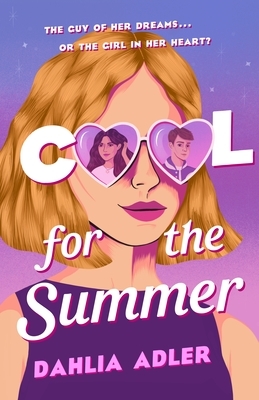
Cool for the Summer by Dahlia Adler

Published: 11 May 2021 (print)/11 May 2021 (audio) Goodreads badge
Publisher:
Wednesday Books/Macmillan Audio
Pages: 259/6 hrs and 20 mins
Narrator: Natalie Naudus
Format: Audiobook
Genre: Young Adult Contemporary Romance
★   ★ – 2.5 Stars

Lara’s had eyes for exactly one person throughout her three years of high school: Chase Harding. He’s tall, strong, sweet, a football star, and frankly, stupid hot. Oh, and he’s talking to her now. On purpose and everything. Maybe…flirting, even? No, wait, he’s definitely flirting, which is pretty much the sum of everything Lara’s wanted out of life.

Except she’s haunted by a memory. A memory of a confusing, romantic, strangely perfect summer spent with a girl named Jasmine. A memory that becomes a confusing, disorienting present when Jasmine herself walks through the front doors of the school to see Lara and Chase chatting it up in front of the lockers.

Lara has everything she ever wanted: a tight-knit group of friends, a job that borders on cool, and Chase, the boy of her literal dreams. But if she’s finally got the guy, why can’t she stop thinking about the girl?

I am so glad this is my second Adler book because I have wanted to read her stuff for years and I’m glad I loved the first one because I’d be disappointed if this was my first introduction, though the sliding doors element of Going Bicoastal might have tempted me past this mediocre read. There is no real plot except Larissa having a crisis over her feelings. The benefit is it’s a fast read because I kept waiting for the plot to start and I realised it was already two thirds of the way through and nothing had actually happened yet.

Instead of having a character look on at the popular kids Adler has written this from the inner circle and perspective from those in that group. The characters are exhausting. The effort they go to to be in their friend group is so much more work than friends need to be with a lot more rules. The US American trope of popular kids is on clear display and they are vacuous and shallow. There are some examples where they show some depth, but they are all still shallow and showing compassion within your shallow and entitled group doesn’t hold much sway. Plus they aren’t given a lot of depth so most of them are easily forgettable. It doesn’t do much to break the stereotypes. I feel bad for Larissa even having these people as friends sometimes. It’s always a fascinating study reading these kinds of books. We didn’t have this in my school, we had groups sure, but not the hierarchy these US high school books always contain. It makes it a strange novelty and a tired trope to see it in these books.

There were some good moments. I enjoyed the stuff with Jasmine, it felt like the only time Larissa was her real self, less performative, which was possibly the point even though it’s never addressed. I did enjoy the casualness of Larissa’s bisexuality. It wasn’t an issue, dealing with it wasn’t the plot (technically), and it was an established thing. I do like it when diverse books can have a character have an identity but not make the entire plot about that identity.

It felt like a novella despite being a full length book, and could easily have been cut down to a short story. No plot would be lost since there isn’t any and with a tighter story it could have been a lot more enjoyable.

You can purchase Cool for the Summer via the following

Booktopia

 Blackwell’s | Angus & Robertson

Fishpond | Amazon | Amazon Aust

Dear Sweet Pea by Julie Murphy

Published: 1 October 2019 (print)/1 October 2019 (audio) Goodreads badge
Publisher:
Balzer + Bray/Harper Collins
Pages: 273/6 hours, 20 minutes
Narrator: Phoebe Strole
Format: Audiobook
Genre: Contemporary Junior Fiction
★   ★   ★ – 3 Stars

Patricia “Sweet Pea” DiMarco wasn’t sure what to expect when her parents announced they were getting a divorce. She never could have imagined that they would have the “brilliant” idea of living in nearly identical houses on the same street. In the one house between them lives their eccentric neighbour Miss Flora Mae, the famed local advice columnist behind “Miss Flora Mae I?”

Dividing her time between two homes is not easy. And it doesn’t help that at school, Sweet Pea is now sitting right next to her ex-best friend, Kiera, a daily reminder of the friendship that once was. Things might be unbearable if Sweet Pea didn’t have Oscar–her new best friend–and her fifteen-pound cat, Cheese.

Then one day Flora leaves for a trip and asks Sweet Pea to forward her the letters for the column. And Sweet Pea happens to recognize the handwriting on one of the envelopes.

What she decides to do with that letter sets off a chain of events that will forever change the lives of Sweet Pea DiMarco, her family, and many of the readers of “Miss Flora Mae I?”

This book was enjoyable, had a few issues, but for a book kids will read it was a nice story. There was a lot of diversity and insights into being a kid, body issues and friend dramas, as well as big family changes.

Being in year seven I think Sweet Pea is around 13, which explains the lack of critical thinking and the impulsive actions. But while she is sensible in some areas, and has a well-rounded view on others, she is still quite selfish and judgemental of those around her. Having a character like this is good because why should a kid be perfect when they are still growing, and hopefully this story is the start of her growth. She has a lot of important things happening in her life and her good intentions don’t always work out.

One things I thought was curious was there are no consequences for Sweet Pea hiding her father’s important mail or deleting phone messages. I felt that was the wrong message to send that even if Sweet Pea felt bad, no adult found out what she did and even when it was clear there would have been major consequences nothing seemed to come of it.

Opening all the mail was magically forgotten about too, as was reading everyone’s private letters to Flora Mae and then resealing them (perfectly somehow) and sending them on. Even though there are consequences for the ones she does deal with, it was a weird thing to leave unmentioned.

The way characters are described aren’t blended well, there is a lot of “there is a guy behind the counter, he looks like this and is wearing this” but imagine this for every person Sweet Pea sees. It’s takes you from the story a little, especially in audio form when you stop to describe someone then the story continues. It shows off good representation and shows diversity, even if it’s a one off background character, but the writing needed to make it more streamlined.

Another unrealistic thing is I cannot imagine her school calling her Sweet Pea, even if it has Patricia on her forms. What kind of awkward thirteen year old wants everyone calling her Sweet Pea, I feel that is prime humiliation, even in a small town and a small school. She can’t be awkward and anxious while also being on having everyone call her a personal nickname.

Strole does a good job as narrator, I liked her voice for Sweet Pea and aside from the clunky descriptions I fell into the story easily.

Overall I liked the story, even with the flaws. Murphy writes these characters who are imperfect and finding their way in the world. It’s a bold adventure and a lot of change for Sweet Pea but one I think would resonate with a lot of kids around the same age.

You can purchase Dear Sweet Pea via the following

QBD | Booktopia

WorderyBlackwell’s | Angus & Robertson

Fishpond | Amazon | Amazon Aust | Audible


Enough Love? by Maggie Hutchings

Published: 29th June 2021Goodreads badge
Publisher:
Affirm Press
Illustrator: Evie Barrow
Pages: 32
Format: Picture Book
★   ★   ★   ★  – 4 Stars

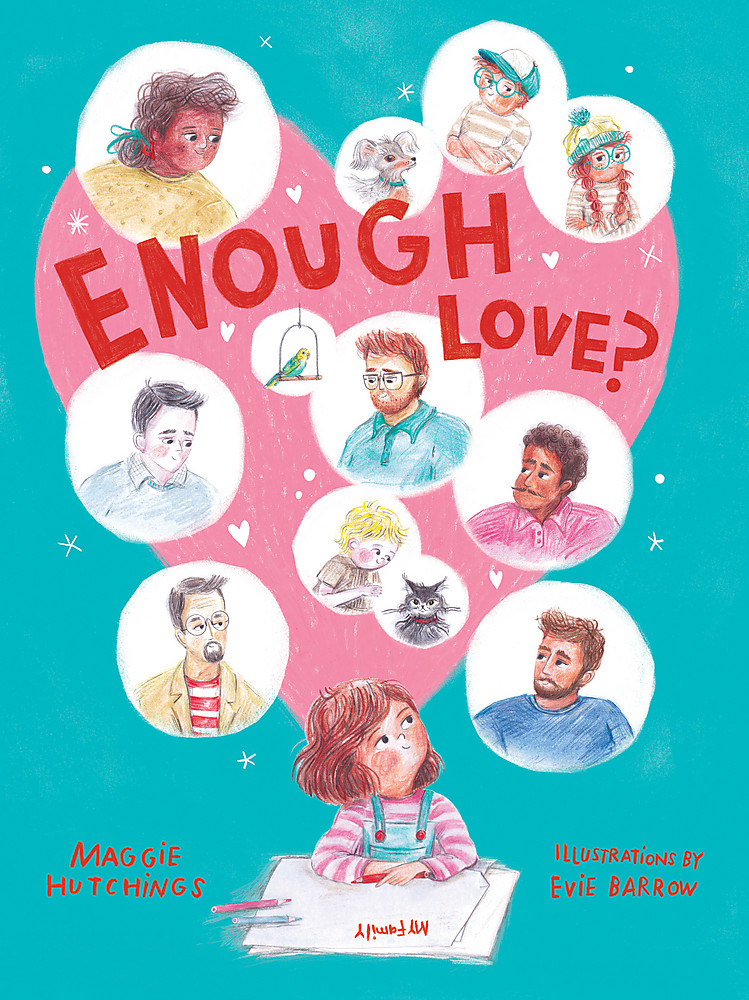
Willa had one dad one mum one home and a bird. And that was enough. So when Willa’s parents split up, she’s pretty sad. But at least they are still all hers. Until Dad meets Kevin and Willa’s family starts to grow … and keeps on growing. When will enough be enough? Or is there always room for more love?
This is a great book and I loved how complicated it became. This is a story beyond your basic divorced family, two houses and maybe a step sibling. Hutchings shows us how families can become complicated, big, messy, and how there is always enough love to go around.

The story flows well and with the repetition of one mum, one dad, one home, one bird, it is a creative way to tell a story of change as a family grows. It is also a good reminder that while family can grow, no own is ever taken out even if it changes.

The illustrations are realistic pencil sketches and Barrow makes each person unique while still keeping the family similarities. The call backs to the same scenes as Willa draws her family is great because even if the numbers change, the scene of her drawing her family is consistent.

I don’t want to spoil the end result, but there is a great representation of diversity, LGBTQIA families, as well as step siblings, half siblings, and the array of pets that also make up our family. It’s a great adventure Willa goes on through the years and I loved how the relationship changes never took away from how Willa felt or how she interacted with her parents and the time she spent with them.

Overall this is a story about family but it is also about love and is there such thing as too much love and is change really a bad thing in the end?

Enough Love? appears to be out of print but there may be a copy at your local library and possibly at Dick Smith

Summer Bird Blue by Akemi Dawn Bowman

Published: 11 September 2018 (print)/11 September 2018 (audio) Goodreads badge
Publisher:
Simon Pulse/Tantor Media Inc.
Pages: 375/9 hrs and 4 mins
Narrator: Em Eldridge
Format: Audiobook
Genre: Young Adult Contemporary
★   ★   ★ – 3.5 Stars

Rumi Seto spends a lot of time worrying she doesn’t have the answers to everything. What to eat, where to go, whom to love. But there is one thing she is absolutely sure of-she wants to spend the rest of her life writing music with her younger sister, Lea. Then Lea dies in a car accident, and her mother sends her away to live with her aunt in Hawaii while she deals with her own grief. Now thousands of miles from home, Rumi struggles to navigate the loss of her sister, being abandoned by her mother, and the absence of music in her life. With the help of the “boys next door”-a teenage surfer named Kai, who smiles too much and doesn’t take anything seriously, and an eighty-year-old named George Watanabe, who succumbed to his own grief years ago-Rumi attempts to find her way back to her music, to write the song she and Lea never had the chance to finish. Aching, powerful, and unflinchingly honest, Summer Bird Blue explores big truths about insurmountable grief, unconditional love, and how to forgive even when it feels impossible.

I’ve wanted to read this book for ages when I was looking to expand my diversity reads, and I’m glad to read it. It’s a good story about grief and sisters as well as a decent mini side plot about identity and working out where you fit in the world.

There is a good exploration of grief – guilt when you catch yourself being happy, the obsession with doing the one thing you think would make it better ie. writing the song, and how less talking is sometimes what you need like her relationship with the neighbour. Kai’s no nonsense friendship is good too. Not tiptoeing around, but she is able to admit that she will be set off if people try to talk about her sister with her, so she isn’t oblivious but can’t help it. And with the rush of being dumped by her mother and trying to adjust away from her friends who could have helped (apparently there’s no phone or internet in this area of Hawai’i?) then of course she is going to be additionally angry.

What I enjoyed was Rumi knows she is being mean and unreasonable sometimes, but she also thinks she has cause, which she translates to the reader without over explaining. She’s sad she hurts her aunt and knows she always does it, but she also things she should be allowed to sit in her grief. Alone.

I liked Rumi being imperfect because she doesn’t change by being sad, she just can’t regulate as well. She has been abandoned, she doesn’t want to distract herself with friends or shopping, she wants to be left in the hole where her sister left behind.

There was a line I loved that was basically she is now alone, without her sister and without her mum, so she needs to be able to work out how to be alone, work out who she is now she’s alone. Her life was so connected to her sister she needs to find things to do without her. I liked this as a justification for her behaviour and her line of thinking. It isn’t her grief pushing her and her anger being unreasonable. She may not translate that to her aunt or anyone around her that well – she is still an emotional wreck and a teenager – but she knows what she is trying to do. And that is be ok being alone. And she can’t work out how to be alone, and work through her grief alone if people keep trying to make her do frivolous things.

So much of this review could be a discussion about how well this story explores grief but it’s already long enough. Bowman has truly done a great job, and the way each character deals with it makes it a wonderfully messy and real response that doesn’t try and hide the reality and pain. This is very much an example of “Put on your own mask before helping others” approach that Rumi isn’t getting.

In terms of the diversity representation, Rumi’s confusion over feeling left behind shown through her memories was integrated well, and connected to Leah being supportive. It was a great approach instead of sole focus being Rumi looking directly at her own feelings/identity. As a reader we see the hints and clues through memories about who she is before she realises.

What I enjoy about books with aromantic characters is it’s the only books you’ll get where there is no romance. There needs to be more YA where people just make friends, even if they are heteronormative, even if they do want love and romance. What I love about this book is a character makes a new friend and the world doesn’t force them together. I love these because finding friends is just as important as romance as a teen. And being friends first is great, but finding a friend and being happy with that should be a goal, not just for the aromatic books – which are rare anyway. It’s another way to have representation without making them specific aromantic books and highlights the importance of good, solid friendships.

Looking at the reviews (which honestly sometimes you really shouldn’t do, even as a reader. Don’t read the comments and all that), I understand how some people think it might be heavy handed, but it’s not. As someone who has read a lot of lesbian and gay books, people need to remember they are so much more well-known now, more accepted, more common. People don’t need a book anymore about ‘do I like girls and is that weird?’. But I think we still need books about ‘why don’t I like any one and is that weird?’. We are still in the early stages in terms of representation, but it isn’t as bad as they make out, it’s well done to be honest. Teenagers have deeper conversations than you’d think. Talking to strangers can be a lot easier and some people are more open than others too. I don’t know how people can revere Loveless when this one also has someone working through their identity, just because it’s more active than passive doesn’t make it worse.

Eldridge does a great job with the audio, though audio certainly highlighted how repeatedly the words “Aunty Ani” is said which does get annoying. But you’re rarely taken from the story and it was easy to stay in this world of grief and family and discovery.

You can purchase Summer Bird Blue via the following

QBDDymocks | Booktopia

WorderyBlackwell’s | Angus & Robertson

Fishpond | Amazon | Amazon Aust

Different Types of LGBTQIA Picture Books

Just like how there’s no one type of story, there is also no one type of LGBTQIA picture book. Picture books are a great way of exploring different kinds of diverse stories and can introduce kids and families to a variety of different experiences. There are books about different families, books about characters falling in love, and books about characters discovering who they are on the inside. The range of books has grown dramatically in the past few years and it’s wonderful to see so many different books represented both rooted in reality, through animal stories, as well as metaphor and fantasy.

Any search of LGBTQIA picture books will give you a myriad of results and a range of books to look for. I’ve compiled a list of a few different types of picture books that explore LGBTQIA history, identity, and families. There are so, so, many more available, this is obviously a small selection, but is it is a great example of the different approaches to diverse stories and how representation can come in a variety of stories.

Books with LGBTQIA characters

I Am Jazz by Jessica Herthel and Jazz Jennings

Introducing Teddy: A Gentle Story About Gender and Friendship by Jessica Walton

Bunnybear by Andrea J. Loney

King and King by Linda de Haan

Prince & Knight by Daniel Haack

Jerome By Heart by Thomas Scotto

Maiden & Princess by Daniel Haack

When Aidan Became a Brother by Kyle Lukoff

My Shadow Is Pink by Scott Stuart

Born Ready: The True Story of a Boy Named Penelope by Jodie Patterson

From Archie to Zack by Vincent Kirsch

Red: A Crayon’s Story By Michael Hall


Red: A Crayon's Story by Michael Hall

Books Containing Gender Non-Conforming Characters

Jacob’s New Dress by Sarah and Ian Hoffman

Jacob’s Room to Choose by Sarah and Ian Hoffman

Want to Play Trucks by Ann Stot

Morris Micklewhite and the Tangerine Dress By Christine Baldacchino

Pink Is for Boys by Robb Pearlman

Julián Is a Mermaid by Jessica Love

Julián at the Wedding by Jessica Love

Not Every Princess by Jeffrey and Lisa Bone

Téo’s Tutu by Maryann Jacob Macias

My Princess Boy by Cheryl Kilodavis

Except When They Don’t by Laura Gehl

Sparkle Boy by Lesléa Newman

Peanut Goes for the Gold by Jonathan van Ness


About LGBTQIA Parents

My Two Super Dads by Bronny Fallens

My Two Dads and Me by Michael Joosten

And Tango Makes Three by PETER PARNELL AND JUSTIN RICHARDSON

Love Makes a Family by Sophie Beer

My Two Moms and Me by Michael Joosten

My Two Dads by Claudia Harrington 

Mommy, Mama, and Me by Lesléa Newman

Daddy, Papa, and Me by Lesléa Newman

Heather Has Two Mommies by Lesléa Newman

It Takes Love (and some other stuff) to Make a Baby by LL Bird

Uncle Bobby’s Wedding by Sarah S. Brannen

Who’s Your Real Mum?  by Bernadette Green

Stella Brings the Family by Miriam B. Schiffer


History of LGBTQIA

Sylvia and Marsha Start a Revolution!: The Story of the Trans Women of Color Who Made LGBTQ+ History by Joy Ellison

Pride: The Story of Harvey Milk and the Rainbow Flag by Rob Sanders

This Day in June by Gayle E. Pitman

Twas the Night Before Pride by Joanna McClintick

The Meaning Of Pride by Rosie Thor

Two Grooms on a Cake by Rob Sanders

Be Amazing by Desmond is Amazing and Dylan Glynn


Information

It Feels Good to Be Yourself: A Book About Gender Identity by Theresa Thorn and Noah Grigni

What are your Words? by Katherine Locke


There are also great books that have a story entirely irrelevant to any LGBTQIA issue but just happen to have two same-sex parents or characters who are in the LGBTQIA community. I love these ones the best because the book is not about being diverse it just happens to be diverse. These are two examples I have come across but I am always looking out for more. As always, representation matters, but there is something delightful about normalising things so that they aren’t a stand out book because they are diverse.

General books but characters are same sex

Things in the Sea are Touching Me by Linda Jane Keegan

Harriet Gets Carried Away by Jessie Sima


Previous Older Entries Next Newer Entries