Agatha Raisin and the Witches’ Tree (#28) by M. C. Beaton

Published: 3 October 2017 (print)/ 23 November 2017 (audio) Goodreads badge

Publisher:
Minotaur Books /Audible
Pages: 192/6 hrs and 33 mins
Narrator: Penelope Keith
Format: Audiobook
Genre: Cosy Mystery
★   ★  – 2 Stars
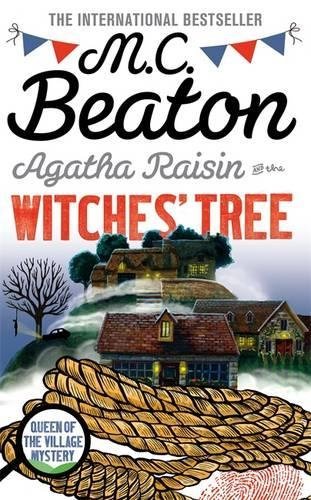
Cotswolds inhabitants are used to inclement weather, but the night sky is especially foggy as Rory and Molly Devere, the new vicar and his wife, drive slowly home from a dinner party in their village of Sumpton Harcourt. They strain to see the road ahead―and then suddenly brake, screeching to a halt. Right in front of them, aglow in the headlights, a body hangs from a gnarled tree at the edge of town. Margaret Darby, an elderly spinster, has been murdered―and the villagers are bewildered as to who would commit such a crime.

Agatha Raisin rises to the occasion (a little glad for the excitement, to tell the truth, after a long run of lost cats and divorces on the books). But Sumpton Harcourt is a small and private village, she finds―a place that poses more questions than answers. And when two more murders follow the first, Agatha begins to fear for her reputation―and even her life. That the village has its own coven of witches certainly doesn’t make her feel any better…

I didn’t care much about the murders or the mystery, I paid more attention to the filler bits about the characters and their day to day which is odd since usually that’s the tedious part. This time around it was certainly the more interesting part of the book.

I have no issue admitting I have no idea what was going on in the wider story, a lot of little things happened that involved a range of people that favoured my attention more. I genuinely got to the end and realised I had no idea who had been the murderer. It could be Beaton brushed over it so quickly that it truly was a non-event but I think that the murders are less of a feature in these books of late. So often they seem to take a back seat to the general interactions around Agatha and other characters, despite this approach rarely paying off successfully.

The different village is always a nice addition. I think you really can’t sustain multiple murders in a single village, even if they are always the newcomer. Beaton’s crude humour and jarring references can shock you from what is meant to be a cosy mystery but so many books in you can only roll your eyes and keep going.

I found there were contradictory moments around Agatha, it’s like Beaton couldn’t decide if she was fearful for her life or doesn’t care what happens, either through bravado or something else. Agatha must always have her life threatened by various people but this time she alternated between fearful and blasé. If it switched between books that would be one thing, but to have it change within the same book felt strange. This fits in with the overall inconsistencies of the story though, so many books lately need a tighter edit, both to stop inconsistencies and flesh out characters and dialogue more. With so many books now in the series it’s crying out for something new and fresh on the page instead of the usual diatribe.

James rears his head long enough to be an absolute horrible person and I don’t know whether the fact he is Agatha’s on and again off again neighbour, ex-husband, and once established character is why we can’t cast him out, make him move villages or outright murder him and dump him in a local pond.

I am still waiting for Agatha and Charles to realise they should be together. It is truly some of the only good writing in these books the interactions between these two. I like their banter and how Charles cares for Agatha despite the fact he is cheap and a philanderer, and Agatha cares about him in her own way. Beaton is definitely hinting at it and comes so close that to take the extra step it would be an amazing move, and one to finally stop her lusting after every man she meets. Redoing her makeup five times a day, changing her outfit all the time, and wallowing about her age, envious of teenagers and general irritability would all be fixed if she settled with Charles and be satisfied with herself.

I’m so close to finishing this series I can see the end in sight. I’m hoping for good and better things but I’ve been hit with whiplash before as all the progress made suddenly is shafted and we’re back to resetting the characters into shadows of their evolved selves. One can only reluctantly pick up the next book and find out.

You can purchase Agatha and the Witches’ Tree via the following

QBD | Booktopia | Book Depository

Dymocks | Wordery | Angus and Robinson

 Fishpond | Amazon | Amazon Aust | Audible

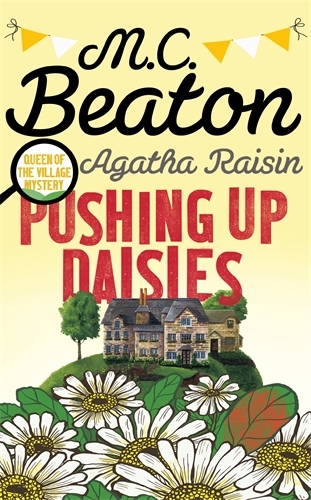
Pushing Up Daisies (#27) by M. C. Beaton

book-bite

Published: 20th September 2016 (print)/20 September 2016 (audio) Goodreads badge
Publisher:
Minotaur Books /Audible
Pages: 280/6 hrs and 22 mins
Narrator: Penelope Keith
Format: Audiobook
Genre: Cosy Mystery
★   ★  – 2 Stars

When Agatha Raisin left behind her PR business in London, she fulfilled her dream of settling in the cozy British Cotswolds where she began a successful private detective agency. Unfortunately, the village she lives in is about to get a little less cozy. Lord Bellington, a wealthy land developer, wants to turn the community garden into a housing estate. When Agatha and her friend Sir Charles Fraith attempt to convince Lord Bellington to abandon his plans he scoffs: “Do you think I give a damn about those pesky villagers?” So when Agatha finds his obituary in the newspaper two weeks later, it’s no surprise that some in town are feeling celebratory.

The villagers are relieved to learn that Bellington’s son and heir, Damian, has no interest in continuing his father’s development plans. But the police are definitely interested in him―as suspect number one. His father’s death, it seems, was no accident. But when Damian hires Agatha to find the real killer, she finds no shortage of suspects. The good news is that a handsome retired detective named Gerald has recently moved to town. Too bad he was seen kissing another newcomer. But when she is also found murdered, Gerald is eager to help Agatha with the case. Agatha, Gerald, and her team of detectives must untangle a web of contempt in order to uncover a killer’s identity.

This is my only Bookish Bites Agatha Raisin review because a short review feels like it needs to be a Bookish Bites and not a regular one. Especially when the book summary is almost longer than the review.

The reason I have barely any notes is because it was a complete non-event. Nothing of any consequence happened that I recall and the events that happen were all over the place. Agatha has weird interactions with strangers and all the new characters have the same rude temperament that Beaton is fond of giving everyone of late.

Agatha’s agelessness rears its head again as she says she is 53. I don’t know why I can’t let this go but it annoys me so much. Time goes on, people reference past events, months and years are mentioned in the story but Agatha is not allowed to age. It’s such a weird line to draw. Maybe a few of these stories take place within the same year and those books where multiple Christmases happen are all part of a time hole that exists in the Cotswolds that everyone knows about and nobody mentions.

The fact I have no recollection of anything that happens in this book is unsurprising given how many of them are basically the same story with new forgettable characters each time. I considered rereading it to see if I could get better notes this time but felt that I didn’t want to subject myself to it again and given my rating I couldn’t quite find the inclination.

You can purchase Pushing Up Daisies via the following

QBD | Booktopia | Book Depository

Dymocks | Wordery | Angus and Robinson

 Fishpond | Amazon | Amazon Aust | Audible
Dishing the Dirt (#26) by M. C. Beaton

Published: 14th September 2015 (print)/11 February 2016 (audio) Goodreads badge
Publisher:
Minotaur Books /Audible
Pages: 304/6 hrs and 29 mins
Narrator: Penelope Keith
Format: Audiobook
Genre: Cosy Mystery
★  – 1 Star

A therapist had moved into the village of Carsely and Agatha Raisin hates her. Not only was this therapist, Jill Davent, romancing Agatha’s ex-husband, but she had dug up details of Agatha’s slum background.

Added to that, Jill was counselling a woman called Gwen Simple from Winter Parva and Agatha firmly believed Gwen to have assisted her son in some grisly murders, although has no proof she had done so.

A resentment is different from a dislike and needs to be shared, so as the friendship between James and Jill grows stronger, the more Agatha does to try to find out all she can about her. When Jill is found strangled to death in her office two days’ later, Agatha finds herself under suspicion – and must fight to clear her name.

I have seen a few reviews mention an Agatha Raisin drinking game but you could also do a Bingo based on the formulaic events that happen in each book. I certainly think it would be a more interesting way of experiencing the series.

The stories are still going the same unengaging way – some character thinks they can solve the murder before Agatha or the police and then they get killed before they tell anyone. Everyone is rude and instantly jumps to abusing people and calling them a variety of colourful names. The immediate answer to any inconvenience is to threaten to kill someone which means of course that someone will end up dead in the next chapter. It’s the same every time and while formula is good, and expected in a cosy, there is no creativity, imagination, or variation on any of these. The plot is all over the place, there are random characters and scenes and none of it was important and if it was it was so late in the story I didn’t care. It’s flat and uninteresting and grating on the nerves.

I can’t decide if Beaton wants only murders now and minimal village life because there’s no village normalcy anymore. No ladies society, no fetes and no village people other than token characters like Mrs Bloxby who only pops in as a plot device half the time.

What doesn’t help is Penelope Keith, who normally is fabulous, has the same voice for many of these characters so they all screech in the same way. I guess when all the characters start being abusive and screeching you only can screech in one way.

Honestly the only saving grace is Charles who flits in and out as he pleases but he speaks his mind and there was a time a few books back I thought he and Agatha were going to get together which would do the series a huge favour. Charles is a delightful character, he has his flaws but the banter and dynamic between himself and Agatha is always enjoyable and I love seeing their interactions.

I’ve definitely decided that Beaton hates these characters and writing these books. It’s the only explanation for why they are so flat and feel like scenes tacked on to one another with no thought or care. I know Agatha’s behaviour and the outlandish behaviour by the entire cast are meant to be humorous but they end up making me angry at the stupidity of it all. Agatha hates everyone, all her friends annoy her and the solutions to everything are either get married and give up her job, or go on holiday and get over the trauma of nearly being murdered. Because when you’re attacked and almost strangled to death in your own kitchen it’s brushed over as a non-event and people expect you to recover immediately from your trauma. The fact Agatha is still shaken by it is the only redeemable part of her character because it shows she’s not completely hollow.

As if it couldn’t get any worse, Beaton, who published this book in 2016, has a scene with a man who initially is described as liking to wear dresses, but by the time Agatha meets him, she insults him, and Beaton can’t decide if he is a man who likes dresses, a cross dresser, or a trans woman because in the space of a few sentences she infers all three.

I had to pause the book in disgust when the word “Tranny” was used because it was so offensive, even if it was in relation to a shop name. This is unacceptable even for Agatha Raisin. The fact the sentence finishes with “for people like you” and then this person thanks her for helping them is pushing even my limits to finish this godawful series. The term transvestite is repeatedly used after this and it’s just wholly unpleasant. The whole series is filled with offensive terms, the earlier books repeatedly had Agatha threatening people by saying they should get AIDS so it isn’t beyond Beaton to use this kind of language but it was a surprise given this wasn’t the early 90s but published in a time I thought people, or even a few editors if she even uses them anymore, would know better.

I’m repeating myself here but the clear downfall of these stories was definitely extending them from four to six hours, or whatever the page length equivalent was. The extra length has completely lessened their quality. When they were shorter they were nice and concise mysteries which wrapped up while still having character depth and exploration. Now they are longer and the stories are drawn out, when the main mystery is solved another pops up and the remainder two hours is spent dragging it out. I also think as Ms Beaton ages her own opinions are bleeding onto the page and it ends up being a long rant about society and the youth and how no one is a lady anymore. It’s amazing she has time to fit a murder in amongst that.

You can purchase Dishing the Dirt via the following

QBD | Booktopia | Book Depository

Dymocks | Wordery | Angus and Robinson

 Fishpond | Amazon | Amazon Aust | Audible

The Blood of an Englishman (#25) by M. C. Beaton

Published: 16th September 2014 (print)/11 February 2016 (audio) Goodreads badge
Publisher:
Minotaur Books /Audible
Pages: 294/6 hrs and 18 mins
Narrator: Penelope Keith
Format: Audiobook
Genre: Cosy Mystery
★   ★  – 2 Stars

Even though Agatha Raisin loathes amateur dramatics, her friend Mrs. Bloxby, the vicar’s wife, has persuaded her to support the local pantomime. Stifling a yawn at the production of “Babes in the Woods,” Agatha watches the baker playing an ogre strut and threaten on the stage, until a trapdoor opens and the Ogre disappears in an impressive puff of smoke. Only he doesn’t re-appear at final curtain.

Surely this isn’t the way the scene was rehearsed? When it turns out the popular baker has been murdered, Agatha puts her team of private detectives on the case. They soon discover more feuds and temperamental behaviour in amateur theatrics than in a professional stage show—and face more and more danger as the team gets too close to the killer.

You can really start to see a lack of care in these stories. New characters that can be introduced and removed in one book, no need for backstory or cementing into the established world, simply in and out and on to the next thing. I had to reread this story because I couldn’t recall much of what happens and having reread it I can attest that is because nothing actually happens. It’s a boring story, nothing is memorable and the investigation is filled with a lot of nothing that can’t keep your attention. The plot seems to be random scenes pieced together that have the thinnest connecting thread if any.

Clearly Beaton has given up the complex community of earlier books and now focuses on these extra characters but none of them have any depth. Most pop in an out in one book and they are as shallow and ludicrous as each other. The only characters that keep being included are the detective staff, though less so in this story, and Charles. Beaton includes familiar characters as a reminder that they still exist but they serve no real purpose to the story. James is barely mentioned, Mrs Bloxby has a few scenes but it feels more like a reminder that other people live in this village than actually contribute to the story.

The descriptions are repetitions of the same ones trotted out book after book. Honestly if I hear one more time about Agatha and her long legs and glossy hair I think I might just scream. I have no other image of this woman except long legs and glossy hair. I think somewhere a few books back there might have been a mention of “frumpy” in her lesser moments but what does that even mean? Beaton seems to have found her descriptors and refused to budge. No matter how much time has passed these are the facts of these characters and nothing else will be said of them. Small, bear-like eyes, long legs, glossy hair. Not to mention twenty five books in and Agatha is still in her early fifties.

Beaton’s opinions are out in force again about the state of society as well as whatever the current issues are at time of writing making casual comments about sexual assault and paedophilia, much like the earlier books she jumps to reducing serious issues to crass comments by characters. The mystery almost didn’t matter as a lot of time was focused on Agatha and her “unfortunate obsessions” as they’re called (of which there are many this time around) where she lusts after the latest attractive man she comes across. You’d also think a book that had such a gruesome death would be more interesting but I’ve expected too much.

Moving away from the set cast of characters is a hindrance because there isn’t a lot to keep your attention. New people who haven’t been well developed don’t hold your interest if you aren’t going to include well known characters that can tie things together. It’s another book following the usual formula with the addition of having random scenes added in that serve little to no purpose. It’s a shame Penelope Keith had to keep reading these if I’m honest.

You can purchase The Blood of an Englishman via the following

 Booktopia | Book Depository

Dymocks | Angus and Robinson

 Fishpond | Amazon | Amazon Aust | Audible

Our Chemical Hearts by Krystal Sutherland

Published: 4 October 2016 (print)/4th Aug 2020 (audio) Goodreads badge
Publisher:
G.P. Putnam’s Sons Books for Young Readers/Penguin Random House Australia
Pages: 320/8 hrs and 1 min
Narrator: Robbie Daymond
Format: Audiobook
Genre: Young Adult
★  – 1 Star

Henry Page has never been in love. He fancies himself a hopeless romantic, but the slo-mo, heart palpitating, can’t-eat-can’t-sleep kind of love that he’s been hoping for just hasn’t been in the cards for him-at least not yet. Instead, he’s been happy to focus on his grades, on getting into a semi-decent college and finally becoming editor of his school newspaper. Then Grace Town walks into his first period class on the third Tuesday of senior year and he knows everything’s about to change.

Grace isn’t who Henry pictured as his dream girl-she walks with a cane, wears oversized boys’ clothes, and rarely seems to shower. But when Grace and Henry are both chosen to edit the school paper, he quickly finds himself falling for her. It’s obvious there’s something broken about Grace, but it seems to make her even more beautiful to Henry, and he wants nothing more than to help her put the pieces back together again. And yet, this isn’t your average story of boy meets girl. Krystal Sutherland’s brilliant debut is equal parts wit and heartbreak, a potent reminder of the bittersweet bliss that is first love.

I’m sad this wasn’t a great Aussie YA because we usually do it so well. The Americanisation was disappointing when I learnt Sutherland was Australian and we missed out on a great Aussie story. I thought it was a bad American book but when I realised it was a bad book Americanised for the overseas market somehow that was somehow worse.

To get in our little slice of Australia there is a horrible stereotypical character which is absolutely painful. Sutherland should know how terrible this is for us to see the over exaggerated Australian in media and she should stop perpetuating it. It isn’t even that the narrator of the audiobook CANNOT do an Australian accent to save their life, but the dialogue Sutherland has written is so awful I kept having to pause it because it hurt to listen and I need it to stop. I couldn’t even stop and pick up my copy of the book because it’s not just the accent, I was not enjoying so much of this book and I could get through it faster listening to it.

I also find it hilarious that Murray who is so Australian it keeps being rammed down our throats, that his own parents would chastise Henry for using the word ‘bastard’. Like, give us some realism here please for the love of god.

I need to write or read a story where a teen’s favourite music is from the last 20 years and not something from before they were born. I get it’s probably easier to not date things or whatever, but if your goal is to create the Unique Girl and the Unique Boy then the fact it happens far too often diminishes that. There is another stereotype about how one kiss with a boy led Grace to come out as a lesbian and Henry’s favourite movie is Fight Club which is an interesting choice and given my opinions of Henry that doesn’t surprise me.

In a story where the word cripple is used, albeit by a character with a limp, to also have other characters wonder if it’s politically correct to mention someone has a limp was a curious contrast. It was a shock to hear the word cripple used and whether Sutherland justifies it by having a character describe themselves it still felt weird.

Grace wears typical guy clothes but it is stressed that she isn’t a tomboy. The role Grace plays is usually reserved for the boy in these types of YAs, the one who thinks the Deep Thoughts, but she is also playing her role as the Mysterious Girl that intrigues the boy who apparently has never seen another girl in his life. The self-reflection and acknowledgement of the Manic Pixie Dream Girl doesn’t stop it from being an eye roll.

Henry is a romantic and a dreamer but he is also a fool. The way Henry talks about Grace is cringe worthy and he has already put her on a pedestal because she’s so intriguing. There isn’t anything remarkable about Grace, she is a normal, sarcastic, cynical teen and the book wasn’t doing anything to work against the tropes that has Henry wanting to “save her”. One redeeming factor is when Grace quizzes Henry on why he’s never had a girlfriend, one of the first reasons he gives is he’s seventeen and I will give Sutherland credit for that being a legitimate reason.

There were other issues as well. Betrayal of trust and stalking were twice used as a joke, and despite being published in 2016 there are two problematic jokes and gays and lesbians, plus one about AIDS being funny with no sense of irony that I can discern if that’s even an excuse.

It was basically for all this combined that I did not finish this book and left at the halfway mark. I’ve read reviews that the ending is good but aside from speed running the entire second half to have some reasonable ending isn’t too appealing. I’ve read other one star reviews that explain what’s wrong with this book a lot better than I can and it’s a comfort to know there’s others out there like me. I am contemplating watching the movie to see if it’s remotely tolerable and let me see the ending without need me to finish this godforsaken book but I don’t think I care enough about this book to watch the movie. If not a summary will suffice because I couldn’t keep going even to see if there was any redemption and I have a bad feeling the movie will take away any depth these characters had.

You can purchase Our Chemical Hearts via the following

QBD | Booktopia | Book Depository

Dymocks | WorderyAngus and Robinson

 Fishpond | Amazon | Amazon Aust | Audible

Previous Older Entries Next Newer Entries